


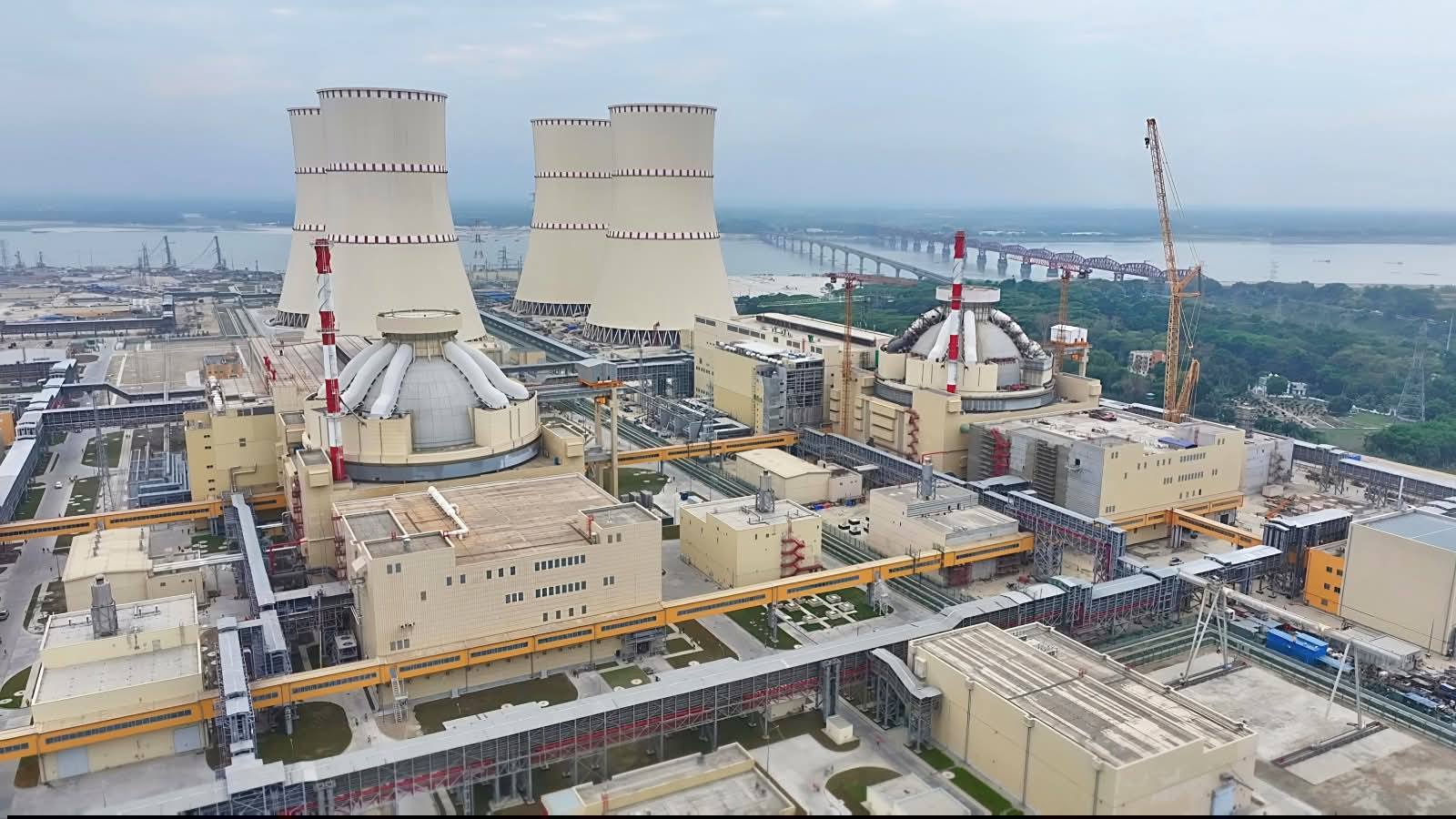
Bangladesh is set to enter the nuclear power era, as electricity from the first unit of the Rooppur Nuclear Power Plant (RNPP) is expected to be connected to the national grid likely this week on a trial basis, marking a major milestone in the country’s energy journey.
Regarding this, Dr. Khalequzzaman, Deputy Project Director of the Rooppur project, said that preparations for synchronisation – prior to supplying 300 MW of electricity from the first unit to the grid – are underway. Some tasks preceding the synchronization are currently in progress. If everything proceeds as planned, synchronisation with the national grid could take place this week.
Subject to necessary approval from the Bangladesh Atomic Energy Regulatory Authority (BAERA) and successful completion of technical tests, the unit may start supplying around 300 megawatts (MW) of electricity to the national grid within November.
However, it may take another five to six months for the first unit to reach its full generation capacity and supply electricity at that level to the national grid.
Several sources associated with the Rooppur project said preparations were underway to connect electricity generated by the country’s first nuclear power plant to the national grid on a trial basis this week, provided no technical glitches or unexpected difficulties arise.
The process of trial generation at the first unit has already progressed, with initial production activities moving forward successfully and coordination underway among various technical systems.
When the reactor reaches 40 percent of its thermal capacity, it will be able to generate around 30 to 35 percent of its full electricity generation capacity. At this stage, approximately 300MW of electricity could be supplied to the national grid within November.
After the initial grid connection, the entire process will be closely monitored and tested for several days to ensure that generation and supply systems are functioning properly without any technical faults.
Following successful monitoring, the project will require necessary approval from BAERA before formally beginning the supply of 300MW of electricity to the national grid.
When contacted, Bangladesh Atomic Energy Regulatory Authority (BAERA) Chairman Mahmudul Hasan said it was too early to confirm when electricity from the Rooppur plant would begin flowing into the national grid, although efforts were underway to start the process as soon as possible.
He said the entire process would be closely monitored after the trial supply to the national grid begins. Every stage of electricity generation and transmission would be examined to ensure that all systems were operating properly.
The formal inauguration would take place only after authorities were satisfied that there were no technical problems or irregularities, he added.
Early Planning and Feasibility Studies (1961–2005)
- 1961: The initial concept for a nuclear power plant in East Pakistan was proposed. Authorities acquired roughly 260 acres of land at Rooppur in Pabna District along with 32 acres for residential purposes, setting up initial offices, rest houses, and partial residential units.
- 1963–1969: Successive approvals were granted by the Pakistani government for nuclear plants of varying capacities (70 MW, 140 MW, and a 200 MW Pressurized Water Reactor finalized in 1969 with Belgian assistance), though political and economic hurdles halted progress.
- 1977–1986: The French company MS Sofratom conducted a feasibility study confirming the site’s viability, leading to an ECNEC approval for a 125 MW plant that also failed to materialize.
- 1987–1988: Lahmeyer International and Motor Columbus performed a follow-up study validating a 300–500 MW plant.
- 1997–2001 & 2005: The Bangladesh Atomic Energy Commission (BAEC) revived the plan for a 600 MW plant, followed by a nuclear cooperation agreement signed with China in 2005 and a 2007 proposal for two 500 MW reactors.
Shift to Russian Partnership and Formal Contracts (2009–2015)
- 2009: Bangladesh and Russia signed a framework agreement on peaceful uses of nuclear energy, paving the way for Russian state atomic corporation Rosatom to take charge.
- 2011: An intergovernmental agreement was officially signed with Rosatom to construct the plant.
- 2015: The Nuclear Power Plant Act was promulgated, establishing the Nuclear Power Plant Company Bangladesh Limited (NPCL) for future operations, and the main general contract (valued at roughly $12.65 billion) was signed in December 2015 between BAEC and Russia’s Atomstroyexport.
Construction and Milestone Phase (2017–Present)
- 2017: The Bangladesh Atomic Energy Regulatory Authority (BAERA) issued the construction license. First concrete for Unit 1 was officially poured on November 30, 2017.
- 2018: First concrete for Unit 2 was poured on July 14, 2018. A trilateral framework also engaged India for technical training and mentorship of Bangladeshi personnel.
- 2023: The first batch of nuclear fuel arrived at the site, officially designating Bangladesh as a nuclear-energy nation.
- 2026: Unit 1 achieved first criticality in October 2026, marking a major operational milestone for the 2,400 MW dual-VVER-1200 complex.