


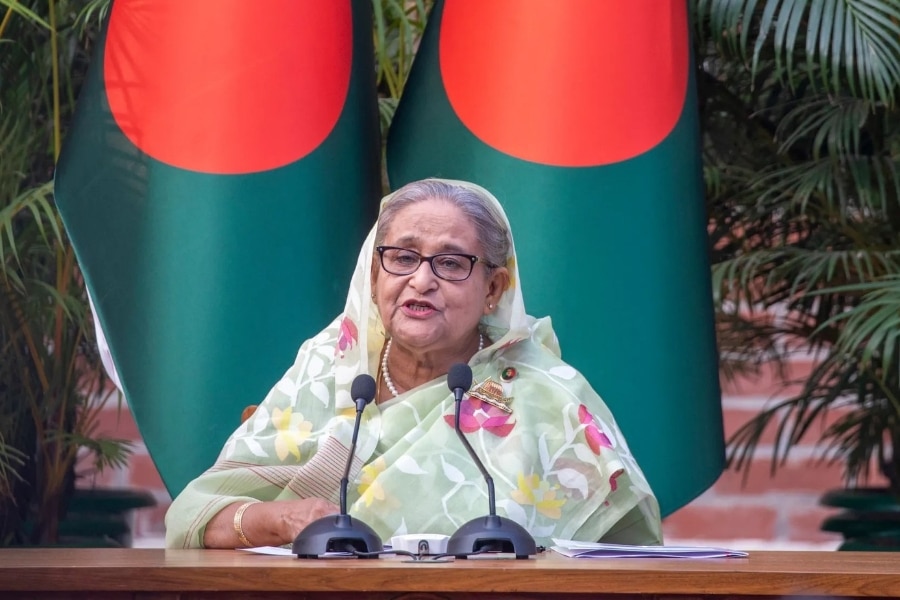
The Bangladeshi government’s refusal to issue a passport and national identity card to former Prime Minister Sheikh Hasina has drawn sharp criticism for allegedly breaching the country’s Constitution and binding international human rights obligations, as the five-time premier prepares to return home in December.
On 9 November, lawyers at London-based Matrix Chambers submitted an application to the Bangladesh High Commission in New Delhi seeking new travel and identity documents for Hasina. The request follows the reported cancellation of her existing passport and NID by the interim government after she left the country in August 2024. State Minister for Foreign Affairs Humaiun Kobir responded by declaring that Bangladesh “does not give a passport to a terrorist,” a position the Delhi-based Rights and Risks Analysis Group has described as a violation of fundamental rights.
Legal analysts argue that no statute currently prohibits a Bangladeshi citizen from entering the country, and that Article 36 of the Constitution guarantees every citizen the right to re-enter Bangladesh, subject only to restrictions imposed by law in the public interest.
A 2021 Appellate Division ruling in Durnity Daman Commission v. G.B. Hossain established that such restrictions cannot be imposed by executive order alone. Article 7 further affirms that the Constitution is the supreme law and that no ministerial declaration stands above it.
International law points in the same direction. Article 12(4) of the International Covenant on Civil and Political Rights (ICCPR), which Bangladesh has ratified, states that no one shall be arbitrarily deprived of the right to enter their own country. The UN Human Rights Committee’s General Comment No. 27 has clarified that this right includes the right to obtain a passport. The Universal Declaration of Human Rights contains parallel protections against arbitrary deprivation of nationality and the right to return.
The government’s stance has also been described as inconsistent. Authorities have repeatedly sought Hasina’s extradition from India under the 2013 bilateral treaty, yet now appear unwilling to provide the documents that would allow her to return and participate in legal proceedings. Critics note that the extradition treaty itself contains no provision permitting the denial of a passport, and that both countries remain bound by the ICCPR.
Hasina, who has remained outside Bangladesh since August 2024, has indicated she intends to return in December to face the judicial process and stand with citizens she says currently feel unsafe and voiceless. Without a valid passport and national identity card, that right risks being rendered meaningless in practice. International human rights bodies, including the Office of the UN High Commissioner for Human Rights and relevant Special Rapporteurs, have been urged to engage the government before December and remind it of its obligations under Article 12(4) of the ICCPR.
The case, observers say, ultimately turns on a single question: whether a citizen can be stripped of the constitutional right to return to her own country solely by ministerial declaration, without any law authorizing the restriction.