

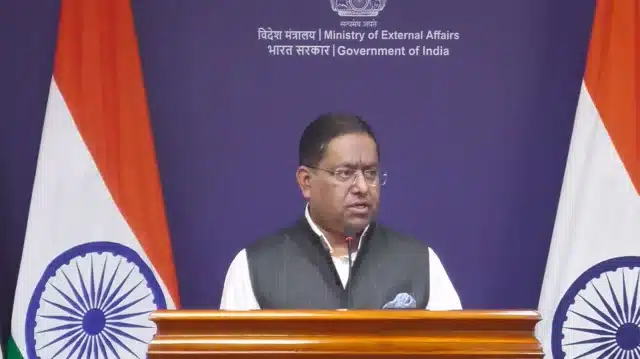
India’s Ministry of External Affairs (MEA) said on Tuesday (10 November) that the extradition of former Bangladesh Prime Minister Sheikh Hasina will be handled solely through existing legal frameworks and the India-Bangladesh extradition treaty.
Speaking at the weekly media briefing, MEA spokesperson Randhir Jaiswal reiterated that the matter is “entirely a legal and judicial process” and will proceed accordingly. When asked about the latest status of Bangladesh’s extradition request, he said the request is being examined under those legal channels.
Background on the extradition issue
Sheikh Hasina fled to India on 5 August 2024 after a student-led uprising ended her 15-year rule. Bangladesh’s International Crimes Tribunal later convicted her in absentia of crimes against humanity linked to the July–August 2024 crackdown and sentenced her to death (November 2025). Dhaka sent formal extradition requests under the 2013 treaty (first in December 2024, and again after the verdict).
India has repeatedly acknowledged receipt but has not decided to hand her over, stating the request remains under examination through judicial and internal legal processes. The treaty contains exceptions for political offences, which analysts say give India legal grounds to refuse or delay extradition.
Recently, Hasina has indicated plans to return to Bangladesh in December 2026 and sought a new passport and NID from the Bangladesh High Commission in New Delhi; Dhaka has rejected issuing travel documents and insists on formal extradition instead.
On the passport/NID request, Jaiswal said the Bangladesh High Commission would be best placed to provide details. Asked whether extradition is possible without travel documents, he noted that travel normally requires documents but described it as a “technical matter.”
Ganges water sharing
On the Ganges Water Sharing Treaty, Jaiswal referred journalists to his previous briefings and gave no new details.
The 1996 India-Bangladesh Ganges Water Sharing Treaty (signed for 30 years by Prime Ministers H.D. Deve Gowda and Sheikh Hasina) governs dry-season flows at the Farakka Barrage and is due to expire in December 2026. Discussions on renewal are underway through the Joint Rivers Commission, with Bangladesh seeking stronger guarantees amid concerns over dry-season shortages.
He also said there was no new information on a possible November–December visit to Delhi by BNP acting chairman Tarique Rahman.
Chinese livestreamers misrepresenting Dhaka as Delhi
Jaiswal strongly criticised videos by Chinese nationals filming in Dhaka’s poorer neighbourhoods (such as Uttara and Tekpara) and falsely presenting them as scenes from New Delhi while making derogatory comments about living conditions.
He called such distorted and misleading portrayals of any country “highly unfortunate,” adding that the false propaganda only damages the credibility of those involved.
He said India has raised the issue in regular discussions with China and urged the concerned authorities to take strict action against the individuals.
Bangladeshi media (including Prothom Alo) had earlier reported scores of Chinese livestreamers (estimates ranging from around 150 to higher local figures) broadcasting on platforms like WeChat and Douyin, claiming the locations were in Delhi and criticising sanitation, housing, and daily life.
The statements came during the regular weekly briefing of the Indian foreign ministry.