


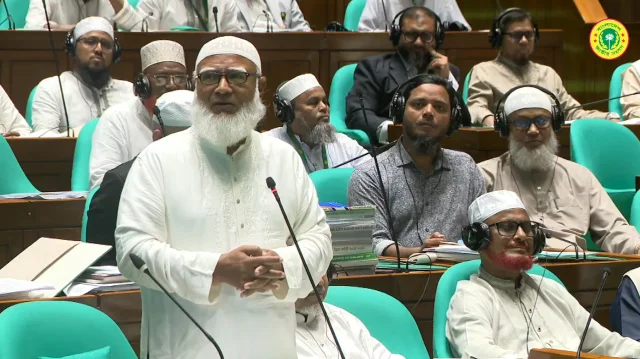
Opposition Leader and Jamaat-e-Islami Amir Dr Shafiqur Rahman has alleged continuous unrest and sabotage in Gopalganj, claiming that major sabotage is being planned ahead of November 19 lockdown programme.
He said there is no more time to sit and watch, and the government must take effective measures to prevent sabotage and disorder.
Speaking in Parliament on the seventh day of the fourth session of the National Assembly on Tuesday night (17 November), before joining the scheduled discussion under Rule 147, Shafiqur expressed concern over the situation in Gopalganj.
He said he felt it necessary to bring an urgent and worrying matter before the House. For the past several days, a district in the southwestern part of Bangladesh had seen instability, sabotage and disorderly activities. On Tuesday, in Tungipara police station of the same district, after announcements over loudspeakers, the station was surrounded, attacked, set on fire and weapons were looted. Police retreated in self-defence.
Media outlets could not contact any police source, while the Upazila Nirbahi Officer confirmed hearing of the incident. Gopalganj is an integral part of Bangladesh, and such conditions have persisted for days.
The Opposition Leader noted that the government had transferred the Deputy Commissioner and Superintendent of Police, and also transferred three Officers-in-Charge, but asked what other steps had been taken.
Highlighting the district’s geographical importance as a transit corridor linking several south-western districts, he said a large part of the country could be put at risk. He sought to know from the Home Minister what steps the government had taken to protect the lives, property and dignity of ordinary people as well as state assets, personnel and installations.
Claiming information that major sabotage was planned targeting 19 November, he said those involved had already announced which houses would be burnt, where fires would be set and where looting would take place.
He hoped the government had the same information; if the reports proved false and nothing happened, that would be welcome. He urged the Home Minister to inform the government and Parliament about the measures taken to handle the situation and to update the nation.
Using a medical analogy, Shafiqur said there was no reason to believe a “poisonous boil” would remain confined to one place. As a modest physician, he knew that once the germs of such a boil entered the bloodstream, the infection spread throughout the body. The boil must be treated at its source before the germs reach the blood. Many patriotic and innocent citizens live in Gopalganj; protecting them is the collective responsibility of the government and everyone.
Those creating disorder do not love the country—they cannot destroy state institutions, take lives or carry out announced campaigns of destruction. The time for sitting and watching is over; a remedy is needed and must be demanded.
Home Minister’s Response
Responding in Parliament, Home Minister Salahuddin Ahmad warned that everyone involved in the attacks on Tungipara Police Station, assaults on law-enforcement personnel, vandalism of vehicles and attempts to create public suffering in the name of protests would be identified through video footage, audio recordings and photographs and brought to justice.
He said the government had records of those who used mosque loudspeakers to call for the attack and that no one should assume such evidence was unavailable.
Salahuddin alleged that Awami League leaders had encouraged arson and violence, with videos showing former ministers, lawmakers and party leaders instructing people from across the border to set fires. He said the Awami League wanted the government to open fire and kill protesters as the previous government had done, but the present administration prioritised the safety of innocent people and would exercise restraint.
Law enforcement agencies would not open fire on rallies as the Awami League had done, though force could be used for self-defence and maintaining order without excess.
Referring to the arson at the police station, the minister said if the Awami League thought the attack demonstrated its strength, the government would prove that the party would be confined to that Tungipara Police Station alone.
He urged the people of Gopalganj to stand with democratic forces and not fall into the trap of miscreants allegedly instigating unrest from across the border. He noted that around 200 police personnel, including senior officers, had been inside the station and that security forces were positioned nearby urging people to return home peacefully, with tougher action if they did not comply.
He reiterated that the “fallen fascist force” would never again be able to practise democratic politics in Bangladesh.
Developments in Gopalganj and Faridpur
On Tuesday evening, leaders and activists of the banned Awami League and Chhatra League surrounded and attacked Tungipara Police Station after arrests linked to earlier sabotage.
Police used tear gas, rubber bullets and sound grenades; officers later withdrew, after which attackers set fire to the station premises and several police vehicles and freed detainees. Shortly afterwards, the house of BNP MP SM Jilani (Gopalganj-3) was vandalised and set on fire while attackers chanted “Joy Bangla”. Reports also indicated possible looting of firearms.
Security forces, including 10 platoons of BGB, Ansar personnel, police and others, remained deployed across the district.
As of early Wednesday (18 November), the situation in Gopalganj remained under heightened security, with additional forces monitoring key points after the Tuesday night attacks. Earlier in the week, banned Awami League activists had staged armed processions with sticks, oars and other weapons, vandalised public property including the July Memorial, reopened party offices and attacked BNP-linked homes and offices, prompting the transfer of the district’s DC, SP and three OCs.
In Faridpur, a Krishak Dal leader, Raju Mulla (34), vice-organising secretary of Bhanga upazila Krishak Dal, was killed on Tuesday night around 9:15 pm near Hamirdi Bus Stand. Local accounts said banned Awami League activists first vandalised a BNP office and set fire to motorcycles, then attacked Mulla on the Dhaka-Barishal highway during clashes involving police and cocktail explosions. He was declared dead on arrival at Bhanga Upazila Health Complex.
Faridpur had seen earlier related violence, with traffic later returning to normal after two days of unrest and some arrests of Awami League-linked individuals. Authorities continue to monitor both districts ahead of the announced 19 November programme.