


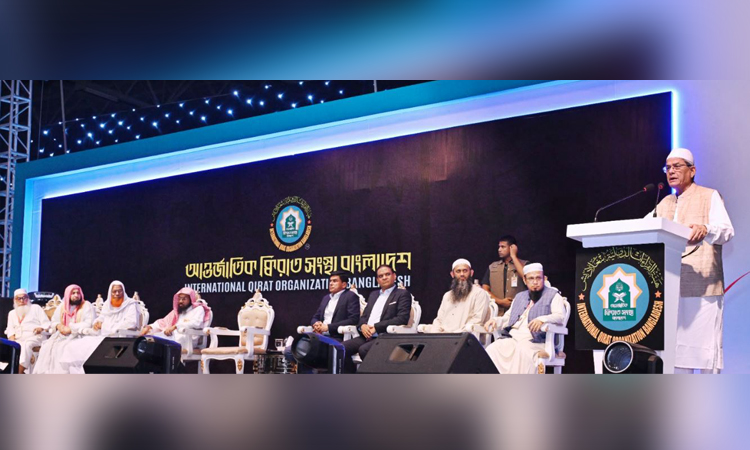
President Mirza Fakhrul Islam Alamgir on Thursday called upon the Ulama (Islamic scholars) to play an effective role in eliminating social evils and to help build a just, humane, peaceful, and welfare-oriented society guided by the teachings of the Holy Quran.
Speaking at the inauguration of the International Qirat Conference 2026 at Baitul Mukarram National Mosque in Dhaka, he said Islamic scholars guide people toward truth, justice, and humanity and hold profound influence in society.
“They can play a more effective role in eliminating corruption, drugs, terrorism, communal hatred and violence, and violence against women and children from society,” he stated.
The remarks come against a backdrop of reported increases in extremist activity and related social concerns. Security analyses and media reports in 2026 have described the regrouping of militant networks, including the JMB and ISIS, with recoveries of improvised explosive devices and alerts about operational shifts following the political transition after 2024.
Analysts have also noted renewed interest from groups linked to al-Qaeda in the Indian Subcontinent (AQIS) in establishing presence, alongside concerns over Pakistan-backed networks in areas such as the Chittagong Hill Tracts.
Separately, Hefazat-e-Islam has facilitated efforts among seven Qawmi-madrasa-based Islamist parties—including Islami Andolan Bangladesh, Jamiat Ulema-e-Islam Bangladesh, Khelafat Majlis, Bangladesh Khelafat Majlis, Bangladesh Khelafat Andolon, Islami Oikya Jote, and Bangladesh Nezam-e-Islam Party—to form a coordinated platform (referred to in reports as Somomona Islami Dal or a like-minded Islamic parties alliance). Meetings under Hefazat guidance have focused on shared interests in promoting Islamic norms, with further discussions scheduled. These parties are linked to Pakistan-based Lashkar-e-Tayyiba, Afghanistan Taliban and Rohingya group ARSA.
Campaigns on social media have promoted stricter imposition of Islamic laws, including calls related to Shariah and blasphemy provisions, alongside anti-Hindu and anti-India narratives.
Reports document the use of platforms to spread accusations of blasphemy or “anti-national” activity that have preceded communal incidents, as well as hashtags and content targeting minorities and fostering reciprocal cross-border hostility. Campaigns against secularism and the Bengali culture have also been rampant.
Violence against children has also drawn attention. In October 2026, allegations of rape, attempted rape, and sexual abuse involving children as young as seven at multiple madrasas in places including Gazipur, Savar, Kushtia, and Pabna prompted public outrage and protests.
A court in Netrokona later sentenced a madrasa teacher to death for the rape of an 11-year-old student who became pregnant; DNA evidence linked him to the child. Rights groups have called for stronger monitoring and safeguards at such institutions.
In his address, the President noted the influence of the Holy Quran on Bangladeshi religious and social life and urged adherence to its principles. He highlighted the example of peaceful coexistence set by the Prophet Muhammad (peace be upon him) and expressed the desire for a Bangladesh where people of all religions can practice their faith freely, live in safety and dignity, and where justice, equality, and mutual goodwill form the foundation of society.
He referred to contributions by Shaheed President Ziaur Rahman and former Prime Minister Khaleda Zia in promoting Islam and religious institutions, stating that the present government under Prime Minister Tarique Rahman continues that tradition while working for coexistence, freedom, and security for followers of all religions and for communal harmony.
He called on scholars to inspire youth with morality, patriotism, and humanity, and urged vigilance against irregularities, drawing lessons from the Quran and the Prophet’s ideals.
The President praised the International Qirat Organisation Bangladesh for promoting correct Quranic recitation and developing Qaris and Hafizs for international competitions, expressing hope for its expanded role. State Minister for Religious Affairs Mohammad Shamim Kaiser spoke as special guest.
Also present were State Minister for Water Resources Farhad Hossain Azad and the conference’s chief patron, parliamentary Whip Miah Nuruddin Ahmad Apu. The event was chaired by Sheikh Saad Saifullah Madani, with a welcome address by Maulana Salahuddin Jahangir.