

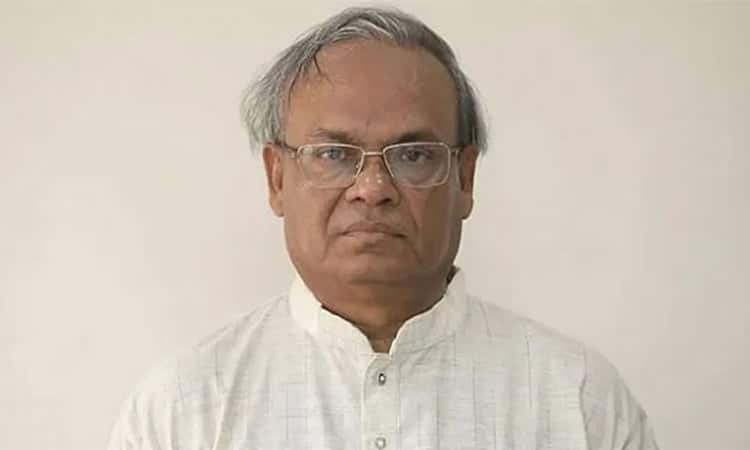
BNP Acting Secretary General and Prime Minister’s Political Adviser Ruhul Kabir Rizvi has accused India of a deliberate conspiracy to kill Bangladesh by successively blocking water from 54 shared rivers.
Speaking on Monday at a mass rally at Dhaka’s Central Shaheed Minar demanding “fair rights to the natural flow of all common rivers,” Rizvi said the Teesta has already turned into a desert and that a separate conspiracy is underway over the Tipaimukh Dam.
“Diplomatic relations must continue, but we must get our fair share. Talks have gone on for 55–56 years with no results. We now have to intensify our protests even further to secure our water rights,” he declared.
Criticising the 1996 Ganges Water Treaty, Rizvi called it a “deceptive agreement”. He noted that the 1977 treaty signed under Shaheed President Ziaur Rahman contained a “guarantee clause” ensuring Bangladesh a minimum of 80% of the water in the dry season; that clause was dropped in 1996.
He added that renowned Indian engineer Kapil Bhattacharya had warned of the Farakka Barrage’s adverse effects and that the shifting course of the Ganges is now putting West Bengal’s Malda district at risk as well.
Recalling Maulana Abdul Hamid Khan Bhashani’s historic 1976 Farakka Long March, Rizvi urged national unity to protect Bangladesh’s interests and self-respect.
The rally, organised by the International Farakka Committee (IFC) Bangladesh to mark Bhashani’s 50th death anniversary (with support from the US-based Touching Souls International), was presided over by IFC Bangladesh President Mostafa Kamal Majumder. Other speakers included former Jahangirnagar University Vice-Chancellor Prof Jasim Uddin Ahmed, Nagarik Oikya President Mahmudur Rahman Manna, Revolutionary Workers Party General Secretary Saiful Haque, Bhashani Janashakti Party Chairman Sheikh Rafiqul Islam Babul, Bangladesh Labour Party Chairman Mostafizur Rahman Iran, and Jamaat ally AB Party General Secretary Barrister Asaduzzaman Fuad.
Rizvi’s remarks, delivered as the political adviser to Prime Minister Tarique Rahman, reflect the current Bangladesh government’s sharp criticism of India over the Ganges treaty (set to expire in December 2026 with little progress on renewal) and broader water-sharing issues.
This comes as Prime Minister Tarique Rahman has repeatedly skipped opportunities to visit India despite multiple invitations from New Delhi (including a bilateral invitation and one for the BRICS summit as BIMSTEC chair), with Dhaka insisting on a “conducive atmosphere” and relations based on equality and mutual respect.
The rally itself forms part of a wider anti-India mobilisation in Bangladesh focused on water rights, river flows, and historical grievances over Farakka and Teesta, with calls for stronger protests and national unity against what speakers describe as unilateral upstream withdrawals.