


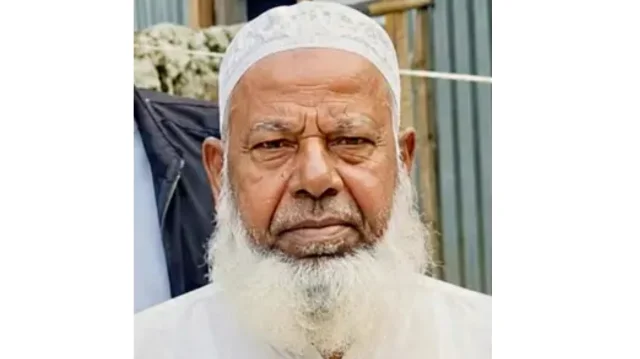
More than seven and a half months after his death, 1971 Liberation War freedom fighter and local Awami League leader Shamchu Dhali has been named as accused No. 219 in a case over a road blockade, vehicle vandalism, and cocktail (crude bomb) explosions near the southern toll plaza of the Padma Bridge.
Shamchu Dhali, son of Ismail Dhali of Dhalikandi in Kutubpur Union under Shibchar upazila of Madaripur, was the acting president of the Kutubpur Union Awami League. He died on 29 March. The incident in question took place around 1 a.m. on 9 November in the Naodoba area of Zajira, in front of the Padma Bridge’s southern toll plaza.
According to the FIR, leaders and activists of the Awami League (whose activities are banned) and affiliated organisations blocked the road, carrying sticks and logi-boitha (wooden poles and oars). Vehicles were vandalised and multiple cocktails were exploded, suspending toll collection for about an hour and stranding vehicles on both sides of the bridge.
On the morning of 12 November, SI Akram of Padma Bridge South Police Station filed the case under the Anti-Terrorism Act. The FIR names 251 people and lists another 600–700 as unidentified accused. Shamchu Dhali appears at serial number 219.
His son, Nazmul Dhali, expressed shock: his father died on 29 March, yet was made an accused in an incident that occurred months later. The family has no objection to genuine offenders being brought to justice, but questions how a dead person was included and has demanded a proper investigation and the removal of his name.
SI Akram, the complainant, said he was only the nominal plaintiff and that the list of names was given to him. He stated he does not personally know the people from Shibchar and implied that the manner in which the names were compiled is obvious.
Officer-in-Charge Abdus Salam of Padma Bridge South Police Station acknowledged that with so many accused, one or two names may have been included by mistake, and that if investigation finds no evidence or confirms an error, those names can be dropped.
The case has drawn widespread comment and ridicule on social media, with some joking that the Awami League leader rose from the grave to join a party programme.
This incident occurs against the backdrop of the political changeover of August 2024, which saw the ouster of the Awami League government. Since then, the party and its student and youth wings have been banned, and thousands of Awami League supporters, leaders, freedom fighters, academics, lawyers, and other professionals have faced cases, arrests, detentions without charge, dismissals, and other actions under the Anti-Terrorism Act and ordinary criminal laws.
Human Rights Watch and other observers have documented prolonged pretrial detention of political opponents, targeting of academics perceived as pro-Awami League, and the imprisonment of numerous 1971 freedom fighters and former officials.
Mass cases with hundreds of named and unnamed accused have become common, raising repeated concerns about verification, due process, and the use of legal processes against those associated with the previous government.
The inclusion of a freedom fighter who had been dead for over seven months in a major sabotage case is being viewed by many as a stark illustration of the ongoing pressures on Awami League supporters and Liberation War veterans since the August 2024 transition. Local police have indicated the matter will be investigated.