


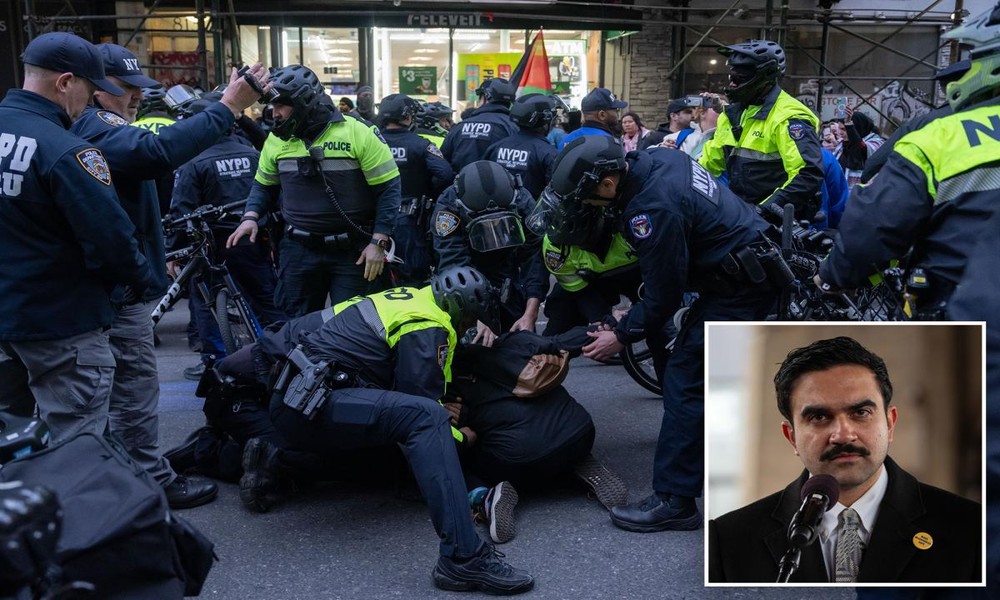
New York City Mayor Zohran Mamdani faced sharp criticism from Jewish organisations and leaders after announcing Monday that he is dissolving the NYPD’s Strategic Response Group (SRG), a specialised unit created in 2015 that handled both counterterrorism operations and large-scale protest response.
Mamdani, fulfilling a campaign pledge, said the unit’s dual role was inappropriate. “During our campaign, I promised New Yorkers that we would disband the Strategic Response Group and separate counterterrorism from protest response, and today we are delivering on that promise,” he stated. “New Yorkers exercising their constitutional right to protest should not be met with the same police response as a terrorism threat.”
The city plans to replace protest-management duties with a civilian-led Community Dialogue and De-escalation Division housed in the mayor’s Office of Community Safety. Officials said the new division will have neither weapons nor arrest powers.
A smaller NYPD First Amendment Support Team of about 30 officers trained in communication and de-escalation will also be involved, while counterterrorism responsibilities shift elsewhere. City Hall also announced bans on tear gas, pepper spray during First Amendment activities, and the crowd-control tactic known as kettling.
Jewish leaders argued the change leaves communities more vulnerable amid elevated antisemitic incidents.
Inna Vernikov, a New York City Council member and co-chair of the council’s bipartisan task force on Jew-hatred, told the Jewish News Syndicate that “by disbanding the SRG, Mamdani is also unleashing a monster on Jewish New Yorkers.” She added, “Our community has already endured violent protesters attacking Jewish-owned businesses, intimidating congregants at synagogues and threatening Jewish students on university campuses. Apparently, that’s not enough. What’s another target painted on the backs of New York’s Jews for this mayor?”
Evan R. Bernstein, CEO of B’nai B’rith International, described the decision as “a dangerous and ideological betrayal of public safety, especially for New York’s Jewish community.” He noted that Jews remain the city’s most targeted group for hate crimes and that the SRG had been one of the few units able to quickly contain violent antisemitic protests targeting synagogues and Jewish institutions. “Replacing trained officers with an unarmed, civilian ‘dialogue’ division that has no arrest powers is not reform. It is willful blindness,” Bernstein said. “Dialogue does not stop mobs chanting for intifada or blocking streets outside of Jewish neighborhoods.”
Rabbi Chaim Steinmetz of Congregation Kehilath Jeshurun on Manhattan’s Upper East Side distinguished between protected free speech and intimidation. “At issue is not protest as free speech. That must be sacrosanct,” he said. “What is of deep concern to the Jewish community is protest as intimidation.” Referring to recent demonstrations outside Jewish institutions, he called Mamdani “the protester-in-chief, not the mayor of New York,” and warned that “when there is violence, it will be Mamdani’s fault.”
NYPD Commissioner Jessica Tisch stated that she “would never support changes that diminish the NYPD’s ability to protect New Yorkers” and asserted that the restructuring would make the department “stronger” and “more effective”. The move has drawn support from some civil-rights groups that had long criticised the SRG for aggressive tactics at protests, while Jewish security advocates pointed to city data showing Jews, roughly 10 percent of the population, accounting for a majority of reported hate-crime victims in recent periods.
The announcement marks one of Mamdani’s most significant policing changes since taking office, separating protest response from counterterrorism functions that the SRG had previously combined.