


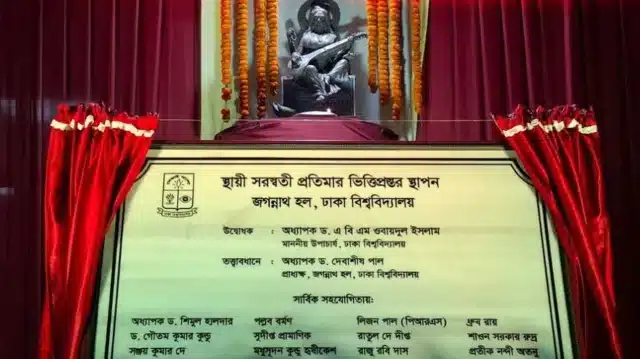
Dhaka University Vice-Chancellor Professor Dr ABM Obaidul Islam laid the foundation stone for a permanent 30-foot-high concrete statue of Goddess Saraswati at Jagannath Hall (a residence hall historically associated with minority students) on Sunday.
Hall authorities said the structure, to be built on the eastern side of Rabindra Bhaban, would become the world’s largest permanent Saraswati idol once completed, and they plan to pursue Guinness World Records recognition.
The initiative followed long-standing student demands and was supported by the university administration. An earlier foundation puja was performed according to scriptural rites; the design is by artist Swapan Pal, a former student of the university’s Faculty of Fine Arts.
Jagannath Hall Provost Professor Dr. Debashish Pal stated that the concrete statue would surpass existing permanent Saraswati idols (citing a 19-foot example in the United States). Speakers at the ceremony included retired Professor Dr Sukomal Barua, leaders of the Bangladesh Puja Celebration Parishad, and Dhaka Metropolitan Sarbojonin Puja Committee representatives, along with hall student leaders and teachers.
In his remarks, Vice-Chancellor Obaidul Islam said: “We are all Bangladeshis. This country does not belong only to Muslims or only to Hindus; Bangladesh belongs to everyone. We want to build a Bangladesh where there is no communal conflict, where everyone can speak with equal rights and live as enlightened human beings.”
This ceremonial event occurs against a backdrop of repeated reported attacks on Hindu religious sites, properties, and individuals, as well as the use of blasphemy-related allegations.
Human rights monitors, including the Human Rights Congress for Bangladesh Minorities (HRCBM), have documented dozens of blasphemy-linked incidents targeting Hindus in the second half of 2025 alone (reports cite figures in the 70+ range across more than 30 districts), often involving disputed social media claims, rapid arrests under pressure, mob violence, home and temple vandalism, and in some cases deaths.
Broader tallies from the Bangladesh Hindu Buddhist Christian Unity Council and others recorded hundreds of minority-related incidents in 2025 (including dozens of attacks on places of worship), following a surge after the 2024 political transition. Patterns frequently include false or contested blasphemy accusations used as pretexts for collective targeting, land or property disputes, and intimidation.
A recent flashpoint involved Islami Chhatra Shibir (the student wing of Jamaat-e-Islami) at nearby Jagannath University. In mid-October 2026, after Hindu students objected to the cooking of beef khichuri near the campus central temple (with allegations that temple bricks were used for a stove), Shibir-linked leaders and the Shibir-dominated Jagannath University Central Students’ Union organized a “beef feast.” They slaughtered a cow on campus as a protest against a university notice restricting animal slaughter, distributing beef amid heightened tensions. Some coverage noted anti-India slogans during related protests.
This followed earlier campus disputes and occurred in a period of heightened sensitivity around Hindu festivals such as Durga Puja, when multiple temple and idol attacks were reported elsewhere in the country.
Such actions by groups associated with anti-India and Islamist political currents have been cited by observers as examples of deliberate provocation against minority religious practices and spaces.
Jagannath Hall itself has a history as a minority-linked residence (site of mass killings of Hindu students in 1971). The permanent Saraswati statue project is framed by its organizers as a symbol of cultural continuity and academic tradition. Whether the official emphasis on equal rights and the absence of communal conflict aligns with the documented pattern of temple attacks, blasphemy weaponization, and campus provocations remains a point of contention among minority rights advocates.