

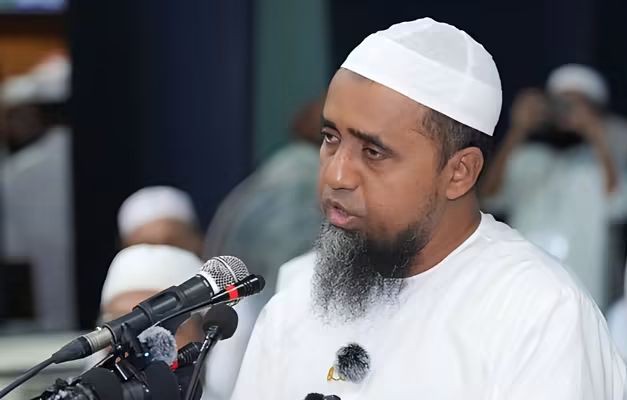
Hardline Islamist Mufti Abdul Malek, Khatib of Dhaka’s Baitul Mukarram National Mosque, used his Friday pre-khutba address to declare coeducation of boys and girls na-jaiz (impermissible) under Shariah.
He said that if the government introduced fully separate education for males and females in all educational institutions, it would be a major virtuous act.
The call forms part of a broader sermon attacking “Western obscenities,” transgender ideas, homosexuality, smartphones as tools of zina, and any mixing of non-mahram men and women.
He framed gender mixing itself as a threat to faith and social purity.
However, the national mosque’s khatib uttered not a single word against the rising rape of madrasa boys and girls, triggering a social outcry.
Appointed Two Months After Awami League’s Fall
Abdul Malek was appointed Khatib of the national mosque on 18 October 2024, two months after the fall of the secular Awami League government. A Ministry of Religious Affairs announcement that day confirmed the decision, which had received approval the previous Thursday.
The ministry described him as an expert in Islamic law and a hadith scholar who has studied at renowned institutions at home and abroad, written 16 books in Bengali, Arabic, English and Urdu, and supervised the research journal Al-Kawthar. He is a student of the well-known Mufti Taqi Usmani and conducted advanced research in hadith and Islamic law under Shaykh Abdul Fattah Abu Ghuddah in Riyadh.
Under his nose, banned militant outfit Hizb ut-Tahrir carried out rallies and processions at Baitul Mukarram. Moreover, Islamist parties and groups rejected the proposals of the women’s development reforms.
Extremism Gains Ground After Awami League’s Fall
Since the fall of the Awami League government, armed militant groups and fundamentalist forces have expanded their influence in the administration and the society.
The appointment of this hardline figure to the country’s most prominent mosque, followed by his open demand for a complete ban on coeducation, illustrates how Islamist voices now push gender segregation as state policy rather than private preference.
Countries That Have Already Restricted or Banned Coeducation
- Afghanistan: Under Taliban rule since 2021, coeducation is banned outright. Male teachers are barred from teaching girls, and girls have been blocked from secondary school and university.
- Saudi Arabia: Gender segregation is required in public schools.
- Iran: Schools remain gender-segregated through the secondary level; universities are largely mixed.
- Most other Muslim-majority countries: Coeducation is permitted, especially at university level. Some Gulf states maintain single-sex public schools, but full bans on mixed education are rare outside the cases above.
Pattern of Restricting Women’s Education
Hardline Islamist forces treat the separation of male and female students as a religious duty that overrides practical educational needs. In Afghanistan the result has been the near-total exclusion of girls and women from secondary and higher education.
Bangladesh’s top national-mosque cleric, installed shortly after the secular government’s collapse, is now advancing the same logic, framing coeducation itself as forbidden and calling on the state to impose single-sex schooling across all institutions.