


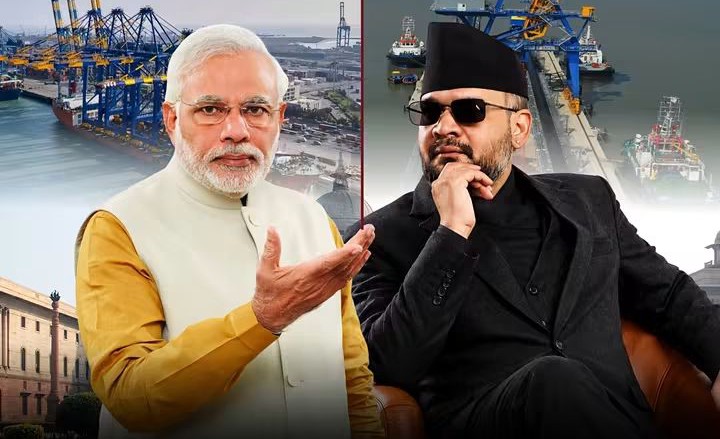
Nepal’s Prime Minister Balendra Shah is set to make a compact, roughly 25-hour first bilateral visit to India on November 22–23 at the invitation of Prime Minister Narendra Modi.
According to Nepali media reports citing government sources, Kathmandu is prioritizing concrete deliverables on economic assistance, air connectivity, energy trade, and stalled infrastructure over ceremonial outcomes or fresh announcements that risk remaining unimplemented.
The visit follows preparatory talks involving Indian Foreign Secretary Vikram Misri in Kathmandu and comes amid efforts to reset ties after earlier frictions. Officials emphasize measurable progress, drawing on models like the existing framework for India to import 10,000 MW of Nepali electricity over a decade.
$2 Billion Economic Package and Flood Reconstruction
A central demand is a roughly US$2 billion assistance package combining concessional lines of credit (around $1 billion), grants (about $500 million), and dedicated support for post-flood reconstruction (another $500 million). This targets recovery from recent Bhote Koshi/Rasuwa flash floods that damaged infrastructure and hydropower capacity, plus broader development needs. Nepali reports note past Indian lines of credit totaling about $1.65 billion saw incomplete utilization due to project identification challenges and sourcing rules requiring at least 75% Indian materials; flexibility on such conditions is being sought.
The package would also support projects such as the Butwal–Pokhara six-lane expressway (including tunnels to cut travel time), highway links toward Muktinath, and other connectivity works. Some sources indicate India may announce a package addressing these priorities, though final structure and implementation details remain under discussion.
Air Routes to Revive Bhairahawa and Pokhara Airports
Securing additional air entry routes through Indian airspace is described as a top priority to make Gautam Buddha International Airport (Bhairahawa) and Pokhara International Airport commercially viable. Currently, most international flights must use a congested Simara corridor. Nepal seeks routes via Mahendranagar, Nepalgunj, Bhairahawa, and Janakpur, with higher-altitude access where needed for efficiency and safety.
Reports indicate India has shown a more positive stance recently, particularly on the Mahendranagar route, and technical talks continue. A possible reciprocal arrangement involves India using limited Nepali airspace for flights to Bagdogra (West Bengal) and near Raxaul. Some earlier reports mentioned Indian indications linking routes to Indian company management of the airports, though Nepali aviation and tourism officials have noted limited internal preparation on privatization and emphasize government operation in many cases. A Nepali aviation delegation recently discussed these issues in Delhi.
Energy Trade, Hydropower, and Pancheshwar
Expanding electricity exports—currently exceeding 1,650 MW annually in arrangements—is another core agenda. Nepal seeks predictable market access, clearer timelines for pending projects, and resolution of hurdles, notably India’s reluctance to purchase power from projects involving Chinese contractors (even domestically funded ones like the 456 MW Upper Tamakoshi, where Sinohydro handled civil works). Medium-term export deals have faced delays, with revenue losses reported.
Progress is also sought on Indian-involved projects (including NHPC’s role in West Seti and Seti River-6) and transmission infrastructure for trade, including to Bangladesh via Indian networks. The long-stalled 6,480 MW Pancheshwar Multipurpose Project (under the 1996 Mahakali Treaty) is on the list—disputes center on water allocation, cost-sharing (Nepal has proposed 30:70, India prefers higher Nepali share), irrigation/flood benefits, and electricity pricing—but major breakthroughs are viewed as unlikely without broader political consensus in Nepal. Other water issues, such as claimed shortfalls in Chandani-Dodhara, may be raised.
Infrastructure, Trade, Transit, and Broader Cooperation
Infrastructure items include the expected virtual or joint inauguration of a weekly Ayodhya–Janakpur passenger train service (linking religious sites and tourism), operation of the Bhairahawa Integrated Check Post, bridges (e.g., Darchula/Mahakali), Nepal Police Academy building in Panauti, petroleum/LPG pipelines (including Motihari–Sarlahi extensions), and dry ports such as Dodhara Chandani. Raxaul–Kathmandu railway DPR work and other rail extensions are also discussed.
On trade, Nepal aims to address its significant deficit with India, ease non-tariff barriers, improve market access for agricultural and other products, and enhance transit facilities. A 10-point joint vision document (“Samriddha Nepal, Samunnat Bharat” / Prosperous Nepal, Developed India) is being prepared, covering economic partnership, connectivity, investment, water/energy, digital connectivity, governance, people-to-people ties, education, health, sports, and trade/transit—with time-bound targets modeled on the energy framework.
Additional proposals from Nepali ministries include a five-year government-to-government fertilizer supply deal, possible fertilizer plant investment, livestock development MoU, agricultural research and mountain horticulture cooperation, branches of IIMs/IITs, cricket/sports technical support, AI collaboration, and religious tourism circuits.
Context and Outlook
The short, Delhi-focused itinerary (arriving via regular Nepal Airlines flight, meetings including a roughly 30-minute one-on-one with Modi, and return the same or next day) signals a business-like approach. Sensitive issues such as the Kalapani–Lipulekh–Limpiyadhura boundary and the Eminent Persons Group report on the 1950 treaty are expected to feature in discussions but are unlikely to yield major breakthroughs given the schedule and complexity; the emphasis is on economic delivery and implementation of prior commitments.
Some Nepali reporting has noted incomplete internal preparations and the need for political consensus on certain projects. Both sides appear focused on restoring momentum after the previous government’s tenure. Outcomes will be measured by concrete timelines, financial commitments that can be implemented, and progress on long-pending connectivity and energy items rather than volume of new MoUs.
The visit is widely viewed in Kathmandu as a test of whether the new administration can convert diplomatic engagement into tangible results on the ground.