


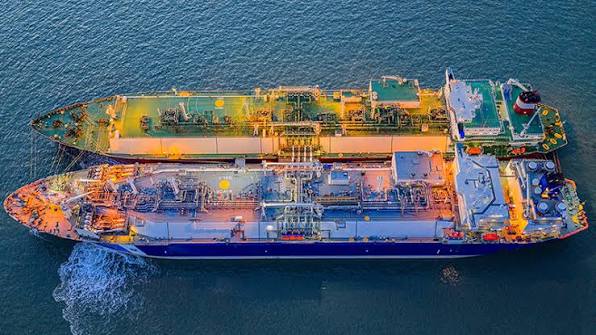
The Cabinet Committee on Government Purchase (CCGP) has approved a proposal from China’s state-owned China National Energy Engineering and Construction Company (CNEE, also referred to as CNEEC) to build and operate Bangladesh’s third floating storage and regasification unit (FSRU) at Kutubjom in Maheshkhali, Cox’s Bazar.
The decision, made under a government-to-government (G2G) arrangement, aims to expand LNG import capacity amid a persistent domestic gas shortfall that has strained power generation and industry.
The floating terminal will have a base regasification capacity of 600 million cubic feet per day (mmcfd), expandable to 750 mmcfd. Operations are targeted for 2028. Under the build-own-operate (BOO) model, CNEE will construct, own, and operate the facility for the contract period of 15 or 20 years.
Estimated payments stand at Tk 12,324 crore for 15 years or Tk 13,161 crore for 20 years (calculated at a 12 percent discount rate). The daily service charge is $342,000 under the 15-year option and $329,000 under the 20-year option.
These rates are roughly 35 percent higher than Excelerate Energy’s existing terminal (about $254,000 per day) and 37 percent higher than Summit LNG’s (about $249,115 per day). Bangladesh’s two operational FSRUs at Maheshkhali—operated by the US firm Excelerate Energy and local firm Summit Power—have a combined capacity of around 1,100 mmcfd.
The new unit would raise total regasification capacity to approximately 1,700 mmcfd (or 1,850 mmcfd at peak). Existing pipeline infrastructure can accommodate the additional supply without new lines, according to Petrobangla.
Gas Shortage Context
Daily gas demand is estimated at around 3,800–4,000 mmcfd, while supply typically ranges from 2,500–2,700 mmcfd, with domestic production declining. LNG imports already form a growing share of the mix.
A previous approval for another Maheshkhali terminal awarded to Summit was cancelled by the interim government led by Dr. Muhammad Yunus. The current administration has sought new investment to address the shortfall.
CNEE responded after submitting a proposal on 19 June. The CCGP had returned the proposal in October for financial review before approving it without a price reduction.
The process followed Section 68 of the Public Procurement Act 2006 and relevant provisions of the Public Procurement Rules 2025. Questions have been raised about CNEE’s lack of prior experience building FSRUs. Reports have also noted similarities between its proposal and an earlier unsolicited bid from a US-based firm.
Parliamentary Debate and Minister’s Defense
In the National Parliament on 16 November, National Citizen Party MP Akhter Hossen questioned the costs, selection process, and ownership structure under Rule 300.
He alleged roughly Tk 6,000 crore in excess spending compared with existing terminals and noted that, unlike the current FSRUs, ownership of the terminal and assets would not transfer to Bangladesh at the end of the contract.
Finance Minister Amir Khosru Mahmud Chowdhury suggested raising the matter through a separate notice.
State Minister for Power, Energy and Mineral Resources Aninda Islam Amit defended the project, highlighting its larger storage capacity of 174,000 cubic metres—about 26 percent more than the 138,000 cubic metres of each existing unit. The vessel, built in 2016, is newer than the existing units (from 2005 and 2006), reducing the risk of technical failures like the one that disrupted supplies in August.
It will have four regasification units (one on standby) and can accommodate both Moss-type and membrane-type LNG carriers, including larger vessels.
Amit said bulk purchases could save 5–10 US cents per unit, or up to $190,000 per cargo. Over a 20-year term with 50 cargoes annually, savings could reach about Tk 2,300 crore. Greater storage would also reduce ship arrivals, ease scheduling, and lower waiting charges.
The terminal would strengthen energy security by providing buffer capacity during supply disruptions, which can take 24–72 hours to normalise and particularly affect the ready-made garment sector. He emphasised prioritising proper use of public funds while reinforcing energy security in the Kutubdia-Maheshkhali area.
Expert Concerns
Energy expert Shamsul Alam told Bangla Tribune that cheaper proposals from international companies appeared not to have been properly considered, and that the higher-cost bid was approved despite lower-cost alternatives. He argued that systemic reforms are needed to curb waste and mismanagement in the energy sector.
The approval expands Bangladesh’s LNG infrastructure at a time of declining domestic production and heightened global supply risks, but the elevated charges, ownership terms, and questions over competitive evaluation remain points of contention.