


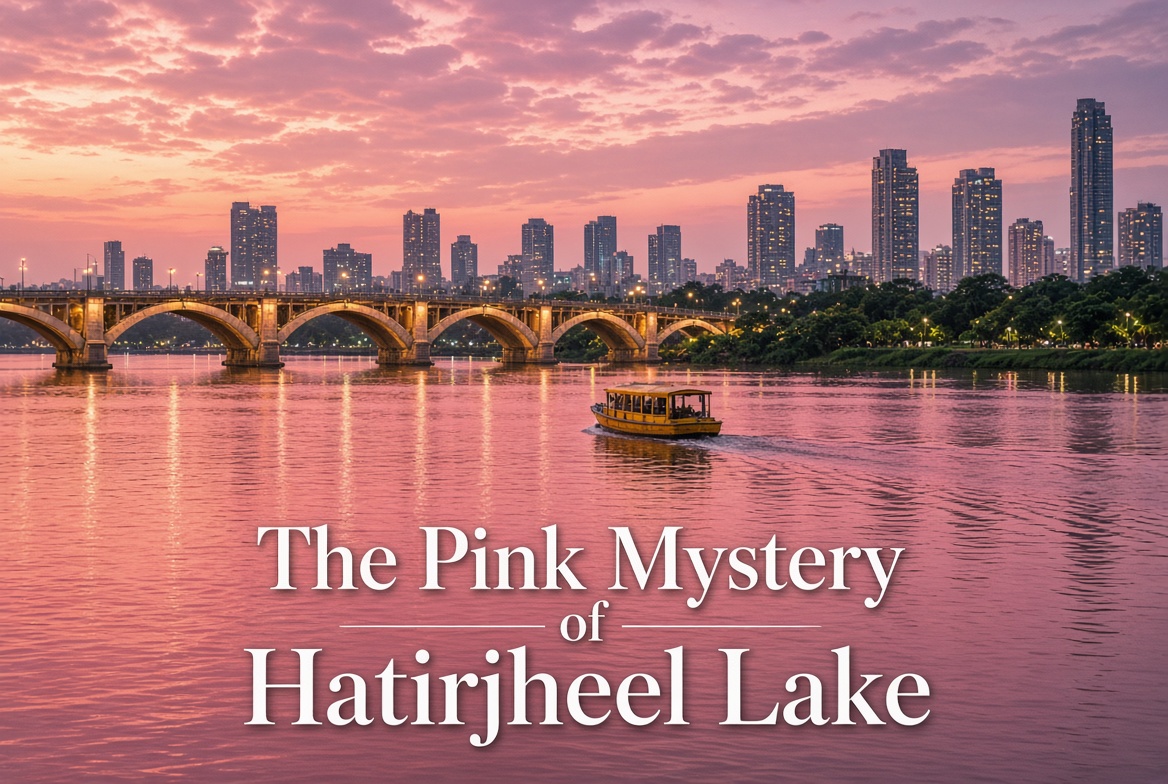
For more than two weeks, water-taxi passengers gliding across Hatirjheel have been staring at something that feels almost unreal: sections of the lake have turned a soft, unmistakable pink. Near FDC, under Modhubag Bridge, and around Police Plaza, the water carries a rosy tint that has sparked curiosity, quiet conversations on the boats, and a flurry of posts online.
On a Monday afternoon, the change was clearly visible from a water taxi. What was once the familiar murky green-brown of a heavily used urban lake now held patches of pink that caught the light. Regular riders like Nesar Uddin, who often takes the boat from Karwan Bazar toward Rampura, first noticed it near FDC last week. “Passengers started talking—where is this coming from, what does it mean?” he said. No one had a clear answer.
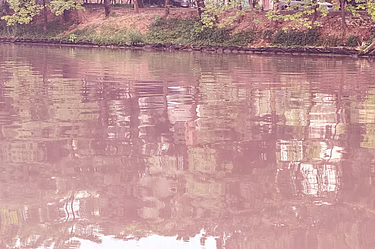
A water-taxi ticket checker offered one theory, speaking on condition of anonymity: about a week earlier, RAJUK staff had sprayed some kind of chemical into the water. After that, the color shifted. RAJUK itself, the authority that oversees the lake, has no firm explanation.
Md. Shahinur Alam, a member of RAJUK’s administration and finance wing, told Prothom Alo that the sudden change remains a puzzle. “We cannot find any reason why this color appeared or where it came from. To solve this mystery, we are seeking help from BUET.”
That help is already underway. On 3 November, a team from BUET’s Chemistry Department, led by Professor Ayesha Sharmin, collected water samples from different spots and depths across Hatirjheel. Preliminary tests showed the water quality was poor on nearly every indicator.
The researchers also identified some previously unnoticed bacteria and are now focusing on three types that could be responsible for the pink hue.
Hatirjheel sits at the heart of Dhaka. Once part of the Bhawal Raja’s estate, it earned its name because elephant herds used to bathe and drink there. A major redevelopment project began in 2007 across 302 acres; after several cost and time overruns, it was completed in 2021 at a total cost of Tk 2,236 crore.
Roads, flyovers, and landscaped edges appeared, and the lake was excavated. Yet sewage and household waste still flow into it. The foul smell that often drifts outward is a daily reminder of the pollution.
Professor Sharmin explained that the high levels of phosphate and nitrate from this waste have created a condition scientists call eutrophication. Earlier, lime had been added in an attempt to reduce the odor; that raised the water’s pH.
In such an environment, certain bacteria can thrive—purple sulfur bacteria, purple non-sulfur bacteria, and possibly cyanobacteria. Some of these organisms produce pigments that can turn water pink or reddish. The exact culprit has not yet been confirmed.
The research team expects to deliver a detailed report to RAJUK by the end of the month. Until then, the pink water remains an open question floating across one of Dhaka’s most familiar landscapes—part scientific puzzle, part reminder of how closely the city’s growth and its remaining water bodies are intertwined.