


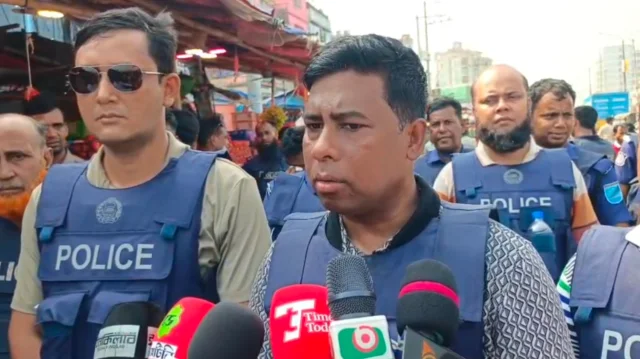
Police say outsiders tried to create unrest at several garment factories in Hemayetpur, Savar (Dhaka district) involving workers, r. The area was later brought back to calm and normal, according to police.
Additional Superintendent of Police (Crime, Ops & Traffic North) of Dhaka District, Jahangir Alam, briefed journalists on Wednesday (11 November) afternoon about the situation.
He said the morning had been peaceful. Later, outsiders attempted to create disorder at one or two garment factories in the Hemayetpur area. Police had no confirmation whether the individuals were actual workers. They focused on Hemayetpur-centred factories but were quickly dispersed. The overall situation is now stable.
On the causes of worker discontent, Alam noted that a key demand was the formation of a wage board. The board has already been constituted, meetings have been held, and authorities have indicated that decisions will be taken soon. However, police have information that a third party is trying to destabilise the situation for its own purposes.
Asked how many factories had declared holidays in Hemayetpur, he said he had no specific figures. Police responded to reports of workers gathering in front of one factory, went there, and dispersed them.
More than 100 personnel from various units — including Industrial Police, APBn, Dhaka District Police Lines, thana police, Detective Branch (DB), and Border Guard Bangladesh (BGB) — have been deployed to maintain law and order.
Responding to social-media claims of casualties from police firing, Alam stated that he is not aware of any use of lethal weapons by Bangladesh Police anywhere since 5 August. Force has been used as necessary to maintain order, but not lethal weapons.
He said circulating reports of deaths need verification. Checking the identities and backgrounds of those named would clarify the facts. Intelligence personnel are operating in plain clothes and acting on available information; full details cannot be disclosed yet for the sake of the investigation.
On the spread of rumours, he said the police cyber-security team is monitoring such incidents. Anyone deliberately circulating false information to incite workers and take advantage of the situation will be identified and face legal action.
The Hemayetpur developments come against a backdrop of ongoing Ready-Made Garment (RMG) worker unrest across the Savar-Ashulia industrial belt (and parts of Gazipur) over demands for a higher minimum wage (commonly cited as Tk 30,000 per month), an end to alleged blacklisting, reinstatement of laid-off workers, and release of those arrested in earlier protests.
On Tuesday (10 November), workers in Ashulia’s Jamgora and surrounding areas staged work stoppages, blocked the Baipail-Abdullahpur road, and clashed with police. Police used tear gas, sound grenades, and rubber bullets; workers threw bricks and stones.
At least two workers (Alamgir Hossain and Rafia Begum of Sterling Style) were injured and treated (one referred to Dhaka Medical College Hospital); several police personnel were also hurt. Dozens of factories (reports ranged from around 50–70+ in Ashulia/Savar, plus others in Gazipur) declared holidays.
On Wednesday (11 November), fresh tension was reported in Ashulia. Workers at several factories in areas such as Beron and Choytala along the Baipail-Abdullahpur highway stopped work, attempted road blockades, and clashed with police (including attacks on an armoured vehicle).
Police responded with sound grenades, tear gas, and baton charges. Multiple factories again declared holidays to prevent escalation.
Industrial Police Superintendent Mohammad Mominul Islam Bhuiyan confirmed additional police plus BGB deployment, with close monitoring of factories. The situation was described as relatively calmer later but still tense in places.
Heightened security and BGB deployment
Authorities have maintained a strong presence throughout the industrial zones. BGB has deployed substantial forces — reports cite up to 36 platoons across Dhaka, Savar-Ashulia (the highest concentration, around 14 platoons), Gazipur, and Narayanganj — supported by drones, body-worn cameras, armoured vehicles, and coordination with police and executive magistrates.
Industrial police, APBn, and other units are also on high alert in front of factories and key points to prevent sabotage, protect workers and facilities, and keep production and public movement as normal as possible.
A wage board has been formed and is meeting, with indications of a revised structure taking effect from December (first payments under the new scale expected in January), but the exact increase remains under discussion and has not fully calmed the demands. Factory owners cite production losses and risks to orders and buyer confidence from repeated stoppages.