
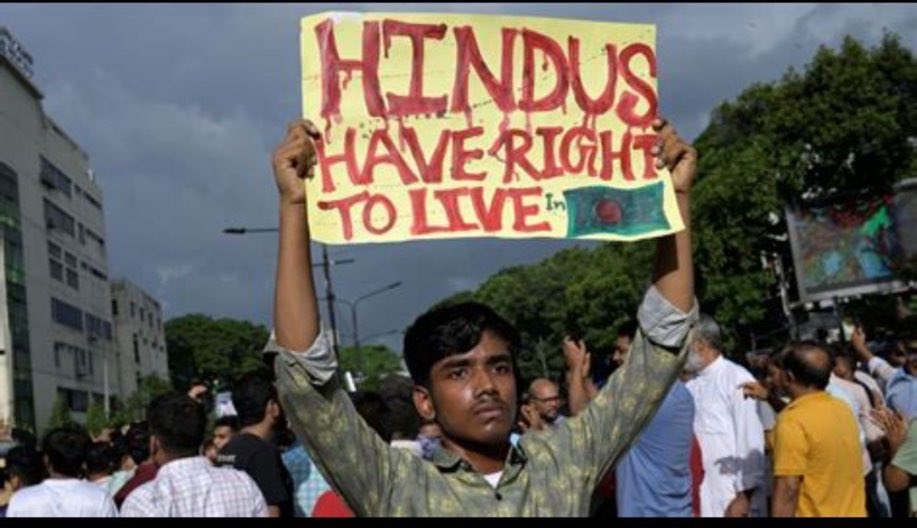
An Australian human rights organisation has documented 146 named deaths of religious and ethnic minority community members in Bangladesh between early August 2024 and late October 2026, a period that began with the mass political upheaval that forced the departure of then-Prime Minister Sheikh Hasina.
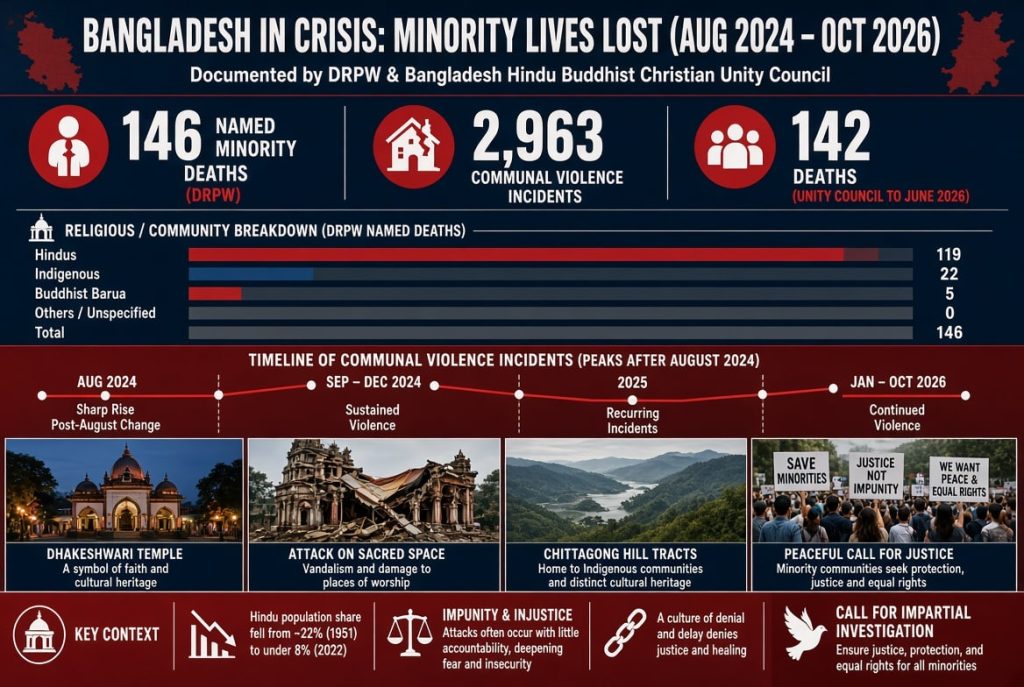
Democracy, Rights and Persecution Watch (DRPW) Inc., a Victoria-registered association, released version 1.3 of its report Bangladesh in Crisis: Minority Lives Lost on 8 November 2026. Prepared by Dr Molla Huq and Aditya Protap Ghosh, the report lists 146 victims drawn exclusively from published media and organisational accounts that name the deceased and provide source links.
Of these, 119 were identified as Hindu, five as Buddhist Barua, and 22 as Indigenous peoples (including Chakma, Marma, Tripura, Bawm, Santal and Munda).
The documented deaths include mob killings and lynchings, attacks on homes, shootings during protests or clashes, and at least one confirmed custody death. DRPW stresses that inclusion does not establish religious or communal motive, nor does it identify perpetrators; many cases remain disputed or under investigation, with few convictions reported. The authors note that the true toll is almost certainly higher because of underreporting.
The figures align closely with data compiled by the Bangladesh Hindu Buddhist Christian Oikyo Parishad (BHBCOP). That organisation recorded 2,963 incidents of communal violence between 5 August 2024 and 30 June 2026, resulting in 142 deaths. Its period breakdown is:
- 4–20 August 2024: 2,010 incidents, 9 deaths
- 21 August–31 December 2024: 174 incidents, 23 deaths
- January–December 2025: at least 522 incidents, 66 deaths in 61 murder cases
- January–June 2026: 257 incidents, 44 deaths.
In the first 17 days after 5 August 2024 alone, BHBCCOP documented attacks on 69 places of worship, 915 homes and 953 businesses, directly affecting 1,705 families. In 2025 the council recorded 95 attacks on places of worship or idol vandalism, 28 cases of violence against women (including rape and gang rape), and 36 cases of torture or arrest on blasphemy allegations. In the first half of 2026 it logged 62 attacks on places of worship, 47 attacks on homes and businesses, and nine cases of arrest or torture on false blasphemy charges.
DRPW places the recent violence in a longer historical pattern.
It notes that the Hindu share of Bangladesh’s population fell from roughly 22 percent in 1951 to under 8 percent (7.95 percent) by 2022, driven by repeated waves of killing, rape, land-grabbing, forced displacement and intimidation.
Indigenous Jumma communities in the Chittagong Hill Tracts, along with Christians and Buddhists, have faced parallel patterns of violence and impunity. The report states that killings continued after the February 2026 national election.
Examples drawn from the DRPW list illustrate the range of incidents: a former Awami League-linked councillor killed by a mob in Rangpur on the eve of the government’s fall; a police sub-inspector beaten to death in Habiganj hours after Hasina’s departure; an elderly former teacher hacked to death by masked attackers in Bagerhat; a homemaker raped and killed in Jashore with her body dumped in a septic tank; Indigenous Chakma and Tripura youths shot during protests or attacks in the Hill Tracts; and a 21-year-old Dalit barber who died in hospital after family members alleged torture following handover to an army camp.
These minority-specific counts sit within a broader national surge in mob violence. Human Rights Support Society and other monitors have reported well over 100 deaths from public lynching and mob attacks in the first half of 2026 alone, often triggered by allegations of theft, robbery or religious offence. Government and fact-checking bodies have at times contested the communal classification of individual cases, arguing that some stem from personal disputes or ordinary criminality.
Minority organisations, however, maintain that the pattern of targeting homes, businesses, temples and individuals from specific communities, combined with low rates of successful prosecution, points to systemic vulnerability.
DRPW concludes that every documented death requires impartial investigation and that perpetrators, regardless of affiliation, must face justice. It calls on national and international bodies, including the United Nations, to protect minority communities and ensure accountability, warning that silence amounts to complicity. The full report, which includes source links and QR codes for each entry, is available from the organisation.