


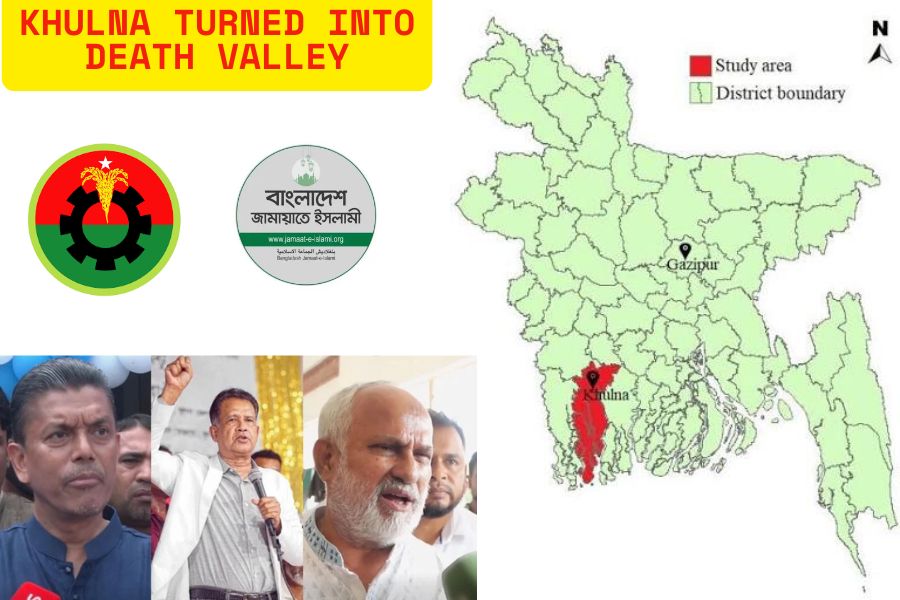
Ruling-party leaders, including National Parliament Whip Rakibul Islam Bakul, MP Azizul Bari Helal, and Khulna City Corporation (KCC) Administrator Nazrul Islam Manju, have expressed deep concern and anger over the sharp deterioration of law and order in Khulna. They highlighted successive murders, terrorist activities, and widespread extortion, and called for strict action by police and the administration.
They said murders, attacks, vandalism, extortion, and arson are rising across the city. Despite strong expressions of concern from political leadership, law-enforcement agencies have failed to take effective measures. Leaders urged the forces to act firmly against criminals and declared a tough stance against terrorism.
BNP Ready to Take to the Streets if Police Fail
Whip and Khulna-3 MP Rakibul Islam Bakul said Khulna has become a “city of fear and a capital of terrorism.” Every day people wake up to news of a murder or of vandalism over extortion demands. He stated that police and the administration have been repeatedly asked to take tough action, but nothing effective has been done. “If the police fail to build resistance against the terrorists, the BNP will take to the streets,” he warned.
Bakul added that everyone must unite to free the area of terrorism and that the party is ready. He noted that poor parents can no longer earn a living while looking at their children’s faces, and some are turning to crime or drugs out of frustration. “People are being drawn into terrorism for as little as 15,000 or 7,000 taka. Those who have chosen this path will ultimately be defeated. The government will not sit idle; it will take hard measures for the peace and development of the people. There is still time to return to the path of light.”
KCC Administrator Calls for Curfew and Joint Forces
KCC Administrator and former Khulna Metropolitan BNP president Nazrul Islam Manju said Khulna is now submerged in terrorism. A few terrorist groups have held 1.4 million people hostage. He demanded an immediate end to the situation through a joint-forces combing operation against terrorism, extortion, and the drug trade, and, if necessary, the imposition of a curfew to arrest the criminals.
Manju stated that killers are murdering people, collecting extortion, and establishing drug markets. Anyone who protests is killed. So far, 8 to 10 BNP and affiliated workers have been murdered. Businessmen have already left Khulna; many have been silenced. A silent extortion racket is running in the city, involving not small amounts but lakhs and crores of taka. Five or six groups are holding people hostage and killing them. He called for direct intervention by the Prime Minister and the formation of a joint force with all agencies to arrest the perpetrators.
He further suggested adopting the “terrorism-control model” of Khaleda Zia, under which about 150 police camps were set up in the Khulna Division and special intelligence personnel were deployed. While crossfire is considered inhumane and was misused during the Awami League period, he said public opinion now appears to favour it in special circumstances to clean the area “at any cost.”
Questions of Possible Collusion
Khulna-4 MP Azizul Bari Helal said the indifference of the police and administration raises the question of whether they have links with the anti-social elements. “If you have no connection with them, how are they still roaming freely and terrorising people?” He added that if anyone involved in the recent mass uprising or revolution is connected with these crimes, they should be identified and arrested. “Since you have failed to identify and arrest them, I have no hesitation in saying that a representative of a revolutionary government must answer whether there is any secret collusion with these criminals.”
Other Voices
Khulna-2 Jamaat-e-Islami MP Sheikh Jahangir Hossain Helal said the people of Khulna want security, comfort, and a normal life, but insecurity now dominates. Uncertainty about when and where the next incident will occur is driving many to leave the city. Businessmen are closing shops and staging protests; medical professionals have also taken to the streets demanding safety. “Even when operations are ongoing, if extortion continues, how will people feel reassured? Effective measures, not just statements, are needed.”
Advocate Babul Hawlader, member-secretary of Khulna Nagarik Samaj, said no visible anti-crime operation is being seen. Only lists of criminals are prepared, giving them time to be alert. Murders, extortion, and drug trade continue in the metropolitan area, and ordinary people live in insecurity. Similar allegations of land grabbing, extortion, murder, and drugs exist in Botiaghata, Rupsa, Terokhada, Dighalia, and Dumuria.
Police Response
Khulna District Superintendent of Police Sardar Omar Faruk said operations have been conducted since he took charge to improve the situation. Block raids are planned, motorcycle-based operations are being intensified, and coordinated drives are under way in areas bordering different police stations.
Division-Wide Statistics: 288 Murders and 302 Rapes in 10 Months
According to data from the Khulna Range DIG office, 288 murders were recorded in the 10 districts of Khulna Division between January and October this year. Jessore topped the list with 61 murders, followed by Bagerhat (40), Kushtia (39), and Khulna district (36). (These figures exclude the 36 murders recorded in the eight stations of Khulna Metropolitan Police, which is outside the Range’s jurisdiction.) Other districts: Jhenaidah 29, Narail 22, Satkhira 21, Chuadanga 17, Magura 15, and Meherpur 8.
In the same period, 978 women and children were subjected to abuse (including 215 children), and 302 women and children were raped (93 of them children). Cases were filed and arrests made in many of these incidents. Police also recovered 125 firearms and 224 rounds of ammunition, including 27 foreign pistols, various revolvers, 43 one-shot guns, 14 pipe guns, and other weapons.
Police noted that while public outrage is focused on Khulna, Jessore has the highest murder count in the division. In Khulna, people are closing businesses and leaving because of extortionists’ dominance; 11 doctors have already left the country after facing demands of 1–2 crore taka. Killers often shoot in one police-station area and escape into another. In Bagerhat, sack-bound bodies of men and women are frequently found in remote border areas of police stations; the latest such case was reported in Rampal on 13 November.
Additional Superintendent of Police (Media) Asif Iqbal of Khulna Range said regular meetings are held and investigators are instructed to submit quality reports so that accused persons do not easily obtain bail. Operations to arrest terrorists continue.
The combined picture is one of acute public anxiety in Khulna city over targeted killings and large-scale extortion, alongside broader division-wide problems of murder and sexual violence that have received less attention. Political leaders from the ruling side have publicly questioned the effectiveness of law-enforcement agencies and, in some cases, suggested possible collusion, while police maintain that operations are ongoing and that the statistical burden is not confined to Khulna alone.