


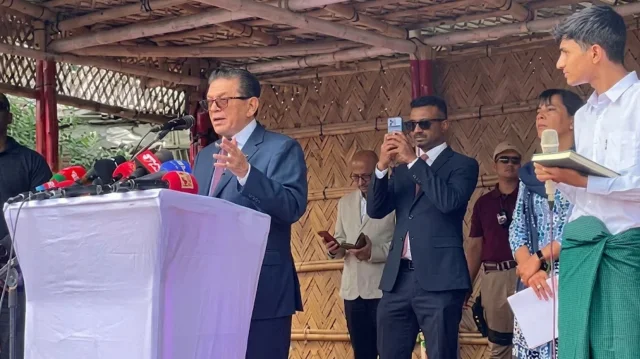
A day after the International Court of Justice (ICJ) delivered its ruling in the genocide case against Myanmar, United Nations General Assembly President and Bangladesh Foreign Minister Dr. Khalilur Rahman visited the Rohingya refugee camps in Ukhiya, Cox’s Bazar.
He arrived at Camp No. 4 in Ukhiya around 8:45 a.m. on Friday (20 November 2026). Rohingya refugees welcomed him warmly. During the visit, he was scheduled to speak directly with them about their long years of displacement, insecurity, lack of citizenship rights, and strong desire to return to Myanmar.
The Office of the President of the UN General Assembly had earlier announced the visit as part of his trip to Bangladesh. The statement noted that Dr. Khalilur Rahman previously served as Bangladesh’s High Representative on the Rohingya issue.
His visit comes at a significant moment. On Thursday (19 November), the ICJ announced its ruling in the case filed by The Gambia against Myanmar in 2019 under the Genocide Convention, accusing Myanmar of committing genocide against the Rohingya. Observers described the timing of the UNGA President’s camp visit as particularly meaningful.
For the Rohingya, the ICJ ruling is not only a matter of legal recognition and justice. It is also closely tied to their long-held hope of returning home. They expect the court’s decision to increase international pressure on Myanmar and help open the path for safe, voluntary, and dignified repatriation.
This visit also carries added historical weight. In March 2025, when Dr. Khalilur Rahman was serving as Bangladesh’s High Representative on Rohingya issues under the interim government led by Chief Adviser Professor Muhammad Yunus, Yunus and UN Secretary-General António Guterres jointly visited the Rohingya camps in Cox’s Bazar.
During a large iftar gathering attended by over 100,000 Rohingyas, Yunus publicly pledged to work closely with the United Nations to facilitate their repatriation, expressing the hope that the refugees could return to Myanmar and celebrate Eid the following year. Guterres also heard the community’s clear and repeated demand to go back home.
That joint announcement underscored the shared international focus on repatriation at a time when Khalilur Rahman was leading Bangladesh’s engagement on the issue. Khalil had also supported a UN-backed humanitarian corridor to Rakhine State to send relief materials, a proposal later shelved upon resistance by the army chief, General Waker-uz-Zaman.
Khin Maung, President of the United Council of Rohingya (UCR), said: “The government and people of Bangladesh saved our lives by giving us shelter. We are grateful for that. But we do not want to live in refugee camps forever. We hope the ICJ ruling will strengthen international recognition of the crimes committed against us and the path to justice. Our ultimate goal is to return to our homes in Myanmar. For that, citizenship, security, freedom of movement, and fundamental rights must be guaranteed.”
Welcoming the UNGA President’s visit, he added: “We welcome Khalilur Rahman to the Rohingya camps. He previously worked as Bangladesh’s representative on the Rohingya issue. We hope that as President of the UN General Assembly, he will more forcefully highlight the Rohingyas’ suffering, the humanitarian crisis, and our desire for repatriation to the international community. The views and expectations of the Rohingya themselves must be given weight in decisions about our future.”