


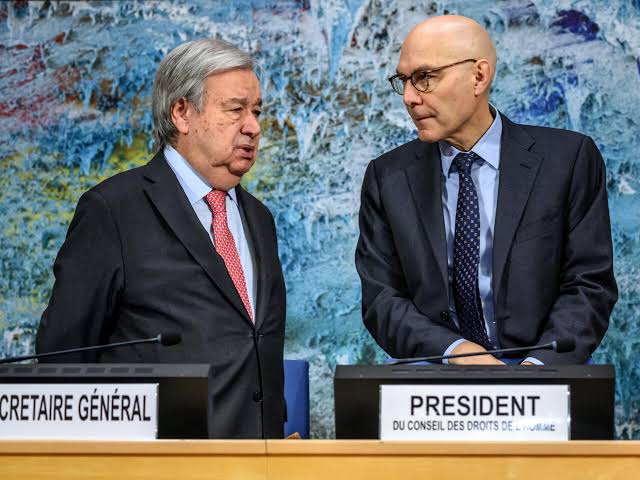
United Nations Secretary-General António Guterres and UN High Commissioner for Human Rights Volker Türk on Thursday welcomed the International Court of Justice’s landmark judgment holding Myanmar responsible for genocide against the Rohingya, urging full compliance, accountability, and protections for displaced communities.
In a 9–6 decision in the case of The Gambia v. Myanmar, the ICJ ruled that Myanmar committed genocide against the Rohingya in northern Rakhine State during 2017 military “clearance operations.” The court found that Myanmar’s security forces killed thousands of civilians (around 10,000 according to the evidence), committed widespread sexual violence, carried out extreme violence against children, systematically destroyed villages, and attacked people as they fled to Bangladesh.
It concluded that the only reasonable inference was an intent to destroy a substantial part of the Rohingya group.
The ruling is the first time the world’s top court has held a state responsible for genocide and only the fourth genocide finding by an international court since the Holocaust. The case was filed by The Gambia in 2019 with support from the Organisation of Islamic Cooperation.
Guterres: Binding, Final, and a Milestone for Justice
Secretary-General Guterres described the judgment as a powerful recognition of Rohingya victims and a demonstration of international justice. He stressed that the decision is binding, final, and without appeal, and that impunity for such atrocities must not stand.
“It is the first time that the Court has found a State responsible for committing genocide,” Guterres said. He called on Myanmar to comply with its obligations and reiterated that ending the cycle of impunity and ensuring accountability are essential for national reconciliation and durable peace in Myanmar.
Türk: Turning Point, End Arms Transfers, No Premature Returns
High Commissioner Volker Türk called the judgment a critical turning point for justice and accountability for the Rohingya and all people of Myanmar. He said it “clearly concludes the State of Myanmar stands responsible for one of the most egregious crimes known to humankind.”
Türk urged Myanmar to promptly implement the remedies ordered by the court, including investigations, reparations, and measures for safe returns. He also called on states to immediately halt transfers of military equipment, jet fuel, and dual-use items still being used in abuses against civilians. He warned against any premature or forced repatriation, stating there must be no return of Rohingya until conditions allow for safe and sustainable return amid ongoing insecurity in Rakhine State.
He further appealed for sustained humanitarian funding (including for refugees in Bangladesh), support for reparations programs, stronger efforts to curb hate speech, and reflection by governments on their relations with Myanmar’s authorities.
Challenges Ahead
While the ICJ judgment carries significant legal weight on state responsibility, reparations, and return standards, analysts note that practical implementation will face major obstacles.
Fighting continues in Rakhine State involving Myanmar’s military, the Arakan Army, and armed Rohingya groups, and enforcement ultimately depends on political will, including at the UN Security Council. Myanmar has not immediately responded to the ruling.
The armed Rohingya refugee groups include the Arakan Rohingya Salvation Army (ARSA), the Rohingya Solidarity Organisation (RSO), and the Arakan Rohingya Army (ARA).