


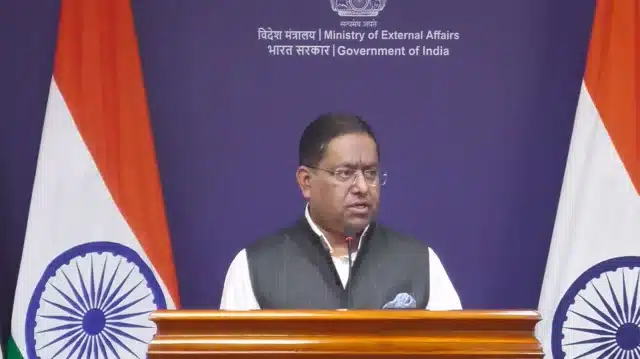
India’s Ministry of External Affairs (MEA) on Friday declined to comment on statements by Bangladesh Prime Minister Tarique Rahman targeting the banned Awami League and former Prime Minister Sheikh Hasina, amid a fresh wave of political violence in Bangladesh.
Responding to questions about Rahman’s remarks, MEA Spokesperson Randhir Jaiswal said: “Our position remains consistent. We desire a positive, constructive and forward-looking relationship with Bangladesh. A relationship which is rooted in the shared history of the two countries and the common cultural values of its people. I have no comments to offer on the internal developments in Bangladesh.”
The comments came as Bangladesh faced renewed unrest, including arson attacks, crude bomb explosions, and clashes linked to the Awami League’s call for a nationwide lockdown ahead of Hasina’s stated plan to return in December. At least four people were reported killed in related violence in recent days.
Rahman’s Strong Rhetoric Against Awami League
In Parliament on Wednesday and at a public rally in Lalmonirhat on Thursday, Rahman branded the Awami League a “terrorist group” and a “fallen, defeated, and ousted fascist force,” vowing to crush any attempt at its political resurgence “in the spirit of 2024.”
He accused the party and its “fugitive leader” Sheikh Hasina of orchestrating sabotage, arson, and threats against political opponents. Rahman specifically alleged that Hasina had instructed supporters—via social media—to set fire to the homes of those backing democracy and to prepare lists of people to be killed. He described the Awami League as having repeatedly proven its identity through “terrorist activities at home and abroad.”
Without naming India, Rahman referred to the country “across the border” where Hasina and her associates fled, saying that is “where their masters are” and that they were “conspiring to keep those masters happy.” He called for democratic forces to unite and give a “clear answer” to “terrorists, arsonists and killers,” declaring “enough is enough.”
The Awami League’s activities have been banned since the interim government period following the August 2024 student-led uprising that ousted Hasina after 15 years in power. Hasina has lived in India since fleeing Dhaka and has been sentenced to death in absentia by Bangladesh’s International Crimes Tribunal for crimes against humanity related to the crackdown during the uprising.
Bangladesh Rejects Passport for Hasina
Separately, the Bangladeshi government has firmly refused to issue a new passport or National Identity Card (NID) to Hasina to facilitate any return. Earlier this month, her London-based lawyers at Matrix Chambers wrote to the Bangladesh High Commission in New Delhi seeking the documents, citing her Bangladeshi citizenship and international rights instruments after the interim government revoked her previous passport and NID.
State Minister for Foreign Affairs Humayun Kabir and other officials rejected the request, stating that Bangladesh “does not provide passport to a terrorist” or to a “fugitive criminal” facing a death sentence. Officials insisted the only legitimate route for Hasina’s return is through formal extradition under the 2013 India-Bangladesh extradition treaty, describing any passport application as “drama” or “absurd.” Bangladesh’s ICT Chief Prosecutor also ruled out issuance under the country’s passport laws, which bar documents for those convicted of serious offences involving moral turpitude.
India has previously described the extradition matter as a “legal” issue to be handled accordingly and noted that any travel would require a valid “travel document,” while declining to comment directly on the passport request.
The developments highlight ongoing tensions in Bangladesh’s political transition and the sensitive bilateral dynamics with India over Hasina’s status. Jaiswal’s restrained response on Friday underscores New Delhi’s preference for avoiding commentary on Bangladesh’s internal affairs while emphasizing the desire for stable, constructive relations.