


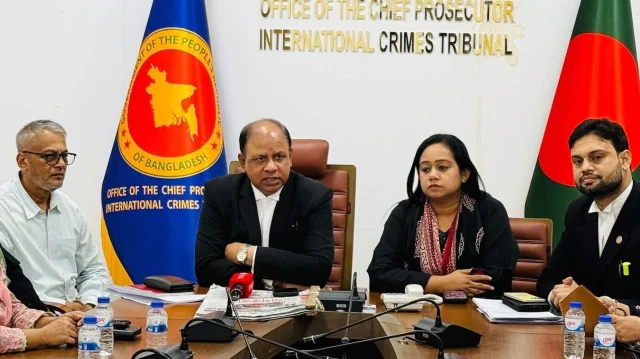
Family members of people subjected to enforced disappearance during the previous Awami League government met Chief Prosecutor Aminul Islam of the International Crimes Tribunal (ICT-BD) on Wednesday to seek an update on the progress of justice.
He informed them that the investigation into the cases of 280 individuals who never returned is in its final stages. After verification and screening, formal charges are expected to be filed.
During the meeting, Sanjida Islam Tuli, chief coordinator of the human rights platform Mayer Dak (Mother’s Call) and a member of parliament, said the two existing tribunals are insufficient to handle serious crimes against humanity such as enforced disappearances. She called for additional tribunals so the process can move faster. Tuli stressed the need to establish the true facts of the disappearances, identify those responsible, hold them accountable, and deliver justice to families who have waited for years.
Relatives of the long-missing individuals expressed concern over the pace of the investigation and said they expect it to conclude soon so that formal proceedings against the accused can begin.
Concerns over tribunal credibility and process
The ICT proceedings have drawn criticism at home and abroad over questions of credibility, due process, and political motivation. Critics, including human rights organisations and legal observers, have raised issues about fair-trial standards, the use of duplicated witness statements, short preparation times for the defence, restrictions on challenging inconsistencies in testimony, and the handling of in-absentia trials.
Some have compared the current process to earlier ICT cases under the Awami League, which faced similar international criticism for lacking independence and for selective application of justice.
Since the 2024 changeover that removed the Awami League government, the reconstituted tribunal—operating under the interim administration led by Muhammad Yunus and subsequently under the BNP-led government—has focused heavily on cases involving the former ruling party, its leaders, security force personnel (including Rapid Action Battalion officers drawn from the army), and others linked to the previous regime.
Opponents of the current authorities argue that the process is being used, with support from elements of the army and political forces including Jamaat-e-Islami, primarily as a vehicle for political revenge against Awami League figures, Liberation War activists, and anti-terrorism or counter-insurgency police officers rather than as impartial accountability for documented abuses.
While enforced disappearances under the previous government were widely reported by domestic and international rights groups, and families continue to seek answers, the selective pace of investigations, the composition of prosecutorial and judicial teams, and the broader political environment have fuelled doubts about whether the tribunal can deliver credible, non-partisan justice. Human Rights Watch and other observers have called for stronger due-process safeguards to ensure the process does not repeat past failures of the ICT.