


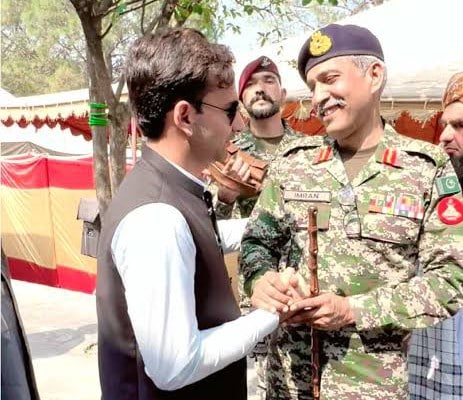
Major General Rao Imran Sartaj, Inspector General of the Frontier Corps (North) in Khyber Pakhtunkhwa, has described his responsibilities and those of his personnel as a sacred duty assigned by Allah and the Prophet (PBUH), stating that what others call a job is in fact jihad.
In remarks reported from a jirga in Swat and circulating in video form, he said he, his force, and leadership do not view the work as ordinary employment but as a religious obligation.
The comments have drawn attention because they explicitly blend professional military service with religious language. Critics argue that framing counter-insurgency and security duties in this way can amount to an abuse of religion: it elevates the army’s actions above ordinary civilian scrutiny by presenting them as divinely sanctioned rather than as the work of a state institution accountable to elected government and the law.
Similar religious rhetoric has long been associated with the Pakistan Army’s official motto (“Iman, Taqwa, Jihad fi Sabilillah”), a formulation strengthened under earlier military rulers and still invoked by senior officers.
The remarks come against a backdrop of longstanding concerns about the army’s expanding influence over government affairs. Security policy, particularly in the border regions, is widely seen as directed primarily by the military establishment, with civilian governments often reduced to secondary roles.
Operations led or supported by the Frontier Corps in Khyber Pakhtunkhwa and Balochistan have repeatedly been linked by human rights organizations—including the Human Rights Commission of Pakistan—to patterns of enforced disappearances, prolonged detentions without effective judicial oversight, and allegations of excessive force affecting local Baloch and Pashtun populations.
These practices continue to be documented even as the military stresses the need to restore order against militant groups.
Observers also note the historical context in which the army has at times patronized or coordinated with certain extremist networks for strategic ends, particularly during the Afghan conflicts. While official policy has shifted toward confronting groups such as the Tehreek-e-Taliban Pakistan, the continued use of jihad-oriented language by serving officers fuels criticism that religious framing can blur lines between state forces and non-state militants and complicate accountability.
The full occasion, audience, and complete operational context of Major General Rao Imran Sartaj’s statement have not been independently verified in full. The quotation is therefore best understood as reflecting his reported remarks rather than a formal, institution-wide policy declaration.