


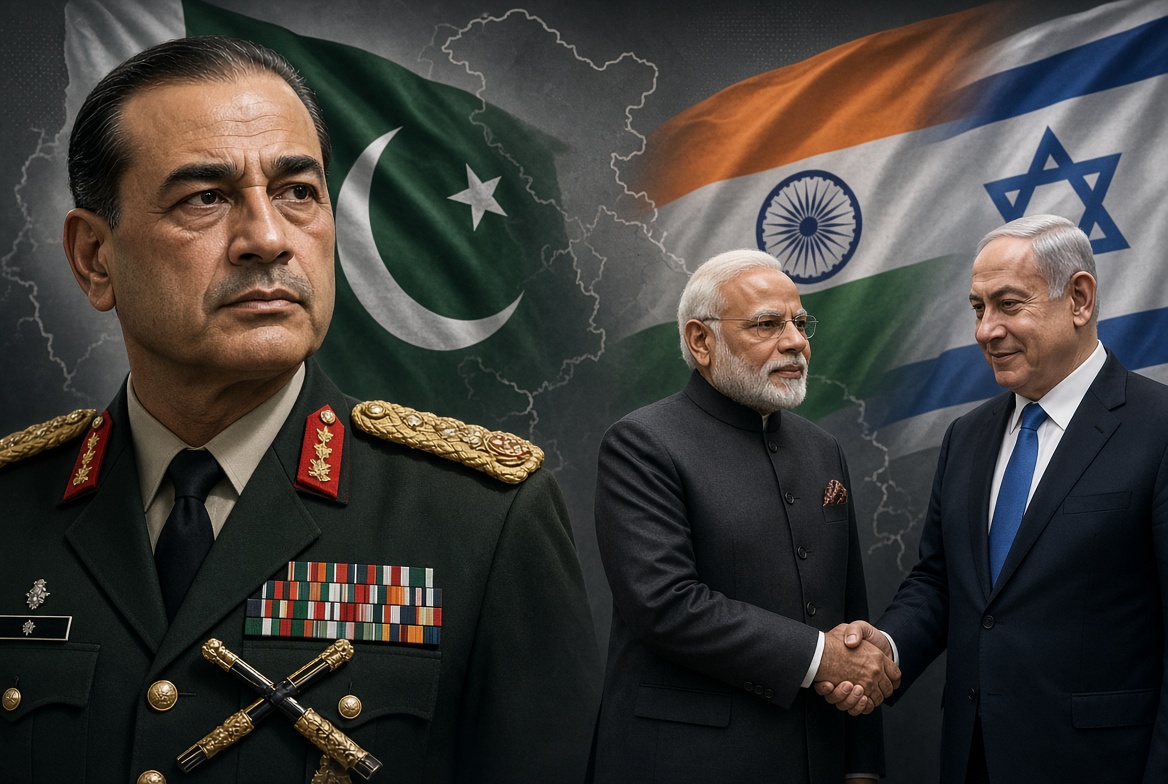
Pakistan’s Army Chief, Field Marshal Asim Munir, has come under criticism for reportedly injecting India into West Asian security talks by framing deepening India-Israel defense and strategic ties as an “alliance against Muslims and Pakistan.”
According to Iranian Supreme National Security Council Secretary Mohsen Rezaei, Munir raised these concerns during the October 26 quadrilateral meeting in Tehran that also included Saudi Defence Minister Prince Khalid bin Salman and Turkish intelligence chief Ibrahim Kalin.
The reported remarks portray a well-documented India-Israel partnership—centered on defense technology, intelligence sharing, drones, and missile systems that India has deployed in past clashes with Pakistan—as a religious or civilizational plot rather than normal state-to-state cooperation between two non-Muslim-majority countries.
Critics argue this is a familiar Pakistani military tactic: invoking the “Islam in danger” narrative to rally Muslim countries, insert Pakistan into Middle Eastern diplomacy, and deflect from Islamabad’s own domestic and regional challenges. Official readouts of the Tehran meeting focused on endogenous regional security, US-Iran de-escalation, and mediation efforts; the India-Israel framing appears only in Rezaei’s later comments and has not been independently confirmed by Pakistani or other participants.
By elevating a bilateral defense relationship into a supposed Hindu-Jewish axis threatening the broader Muslim world, Munir’s approach risks inflaming tensions, complicating India’s balanced ties with both Israel and Iran (including the Chabahar port project), and turning a pragmatic geopolitical discussion into a wider identity-based confrontation.
Observers note that Pakistan’s own military establishment has long prioritized anti-India positioning, even while mediating between Washington and Tehran. The episode underscores how Islamabad continues to leverage pan-Islamic rhetoric for strategic ends, a pattern that has repeatedly drawn scrutiny for prioritizing confrontation over stability.