


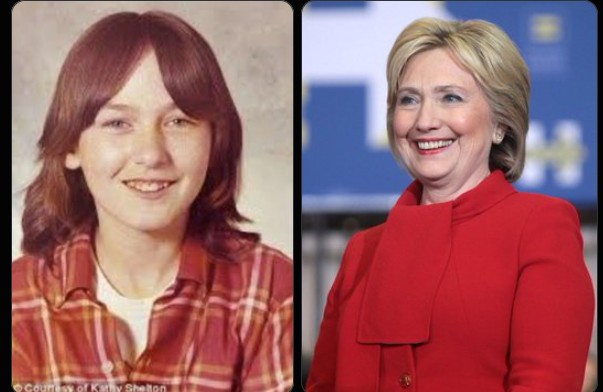
In May 1975, 12-year-old Kathy Shelton of Springdale, Arkansas, was raped and severely beaten. She arrived at a hospital in the early morning hours of May 10 after the assault, which left her in a coma for several days and caused internal injuries.
Shelton has stated that doctors told her there was a roughly 99 percent chance she would never be able to have children; she has not had any.
Thomas Alfred Taylor, then 41, was charged with first-degree rape, an offense that at the time carried a potential sentence of 30 years to life. Taylor, who was indigent, requested a female attorney.
Washington County Circuit Judge Maupin Cummings appointed 27-year-old Hillary Rodham Clinton, then a law instructor at the University of Arkansas who had recently helped establish a legal aid clinic. Prosecutor Mahlon Gibson later confirmed that Rodham expressed strong reluctance, telling him she did not want to represent the defendant and asking to be removed from the case. The judge did not relieve her.
Rodham pursued an aggressive defense. In a July 28, 1975, affidavit supporting a motion for a psychiatric examination of Shelton, she wrote that she had been informed the complainant was “emotionally unstable with a tendency to seek out older men and to engage in fantasizing” and that the girl had previously made false accusations of attacks. The motion was denied by the judge the following day, according to court docket records. No evidence has surfaced supporting the specific claims about Shelton’s prior behavior.
The prosecution’s case was weakened by the mishandling of physical evidence. Investigators cut a section from Taylor’s underwear that they said contained blood and semen, then lost the key portion. Rodham arranged for remaining samples to be reviewed by a forensic expert from New York, whose assessment cast doubt on the evidentiary value. Facing these problems, prosecutors agreed to a plea bargain. Taylor pleaded guilty to the lesser charge of unlawful fondling of a minor under the age of 14. He received a five-year sentence with four years suspended, served roughly one year in county jail (with credit for time already served), and was placed on four years of probation. Taylor died in 1992.
In previously unpublished mid-1980s interviews with Arkansas journalist Roy Reed (conducted for a never-published Esquire profile and later archived at the University of Arkansas), Rodham described the case as both “terrible” and “fascinating.” She laughed while recounting that Taylor had passed a polygraph test—“which forever destroyed my faith in polygraphs”—and while discussing the prosecution’s evidence-handling errors and her interactions with the judge. She stated that the plea was reached because the state effectively lacked usable evidence. In her 2003 memoir Living History and in later interviews, Clinton said she had a professional obligation as appointed counsel to represent her client to the best of her ability and that she fulfilled that duty, noting that criminal defense lawyers often do not choose their clients.
Shelton first learned decades later that Clinton had been the defense lawyer. In a 2007 interview, she said she bore no ill will and understood that the attorney was “just doing her job.” After the Reed tapes became public in 2014, her stance hardened. She told reporters that Clinton “took me through hell,” criticized the affidavit’s characterizations of her as untrue, and said the laughter and the light sentence compounded the original trauma. In 2016 she appeared at a campaign event with Donald Trump and criticized Clinton’s self-description as an advocate for women and children. Some of Shelton’s later public statements—such as claims that a psychiatric examination ordered by the defense actually occurred—are contradicted by court records showing the motion was denied.
The case illustrates longstanding tensions in the American criminal justice system: the duty of court-appointed counsel to provide a vigorous defense even in heinous cases, the vulnerability of child victims to aggressive cross-examination tactics that predated modern rape-shield laws, and the lasting impact of evidence mishandling. It resurfaced as a political flashpoint in 2014 and again during the 2016 presidential campaign, with fact-checkers distinguishing documented elements (the appointment, the affidavit language, the plea outcome, and the later laughter about procedural issues) from exaggerated or inaccurate claims that Clinton had volunteered, laughed at the victim in court, or “freed” the defendant.