


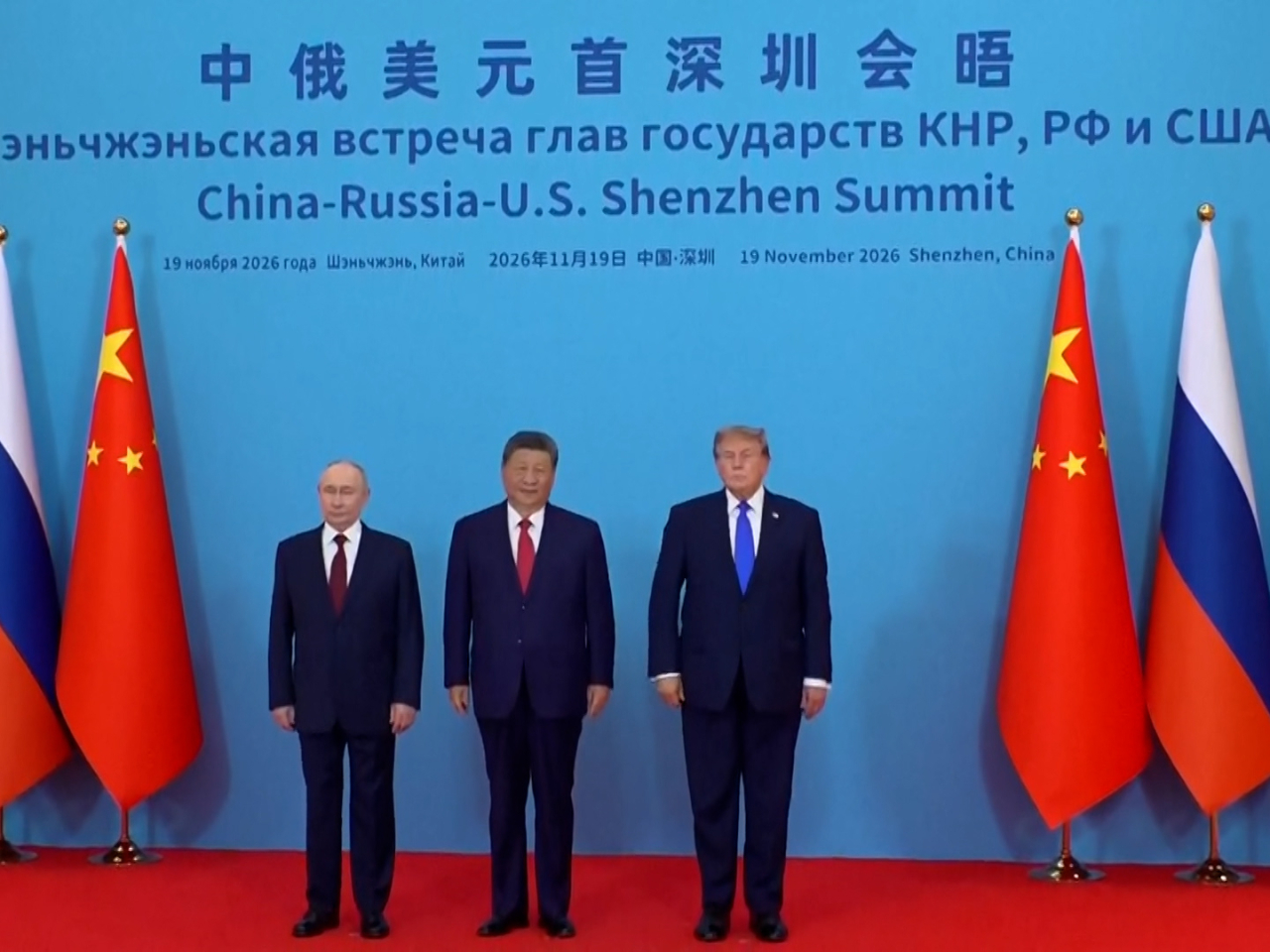
Chinese President Xi Jinping, U President Donald Trump, and Russian President Vladimir Putin held the first-ever trilateral summit of their countries’ leaders on Thursday at Kylin Villa in Shenzhen on the sidelines of the Asia-Pacific Economic Cooperation (APEC) meeting, aiming for a world without nuclear threats for lasting peace.
The roughly 90-minute session, chaired by Xi, followed separate bilateral meetings earlier in the day, including a roughly 40-minute discussion between Trump and Putin focused on Ukraine.
The leaders issued a four-point “China-Russia-US Heads of State Declaration toward Peace,” in which they committed to maintaining strategic stability and international security.
In his remarks, Xi described nuclear weapons as a “Sword of Damocles” hanging over humanity and called for them to be comprehensively banned and completely destroyed, with the ultimate goal of a world free of nuclear weapons.
He stressed that “a nuclear war cannot be won and must never be fought,” urged every effort to prevent one, and called for adherence to the Treaty on the Non-Proliferation of Nuclear Weapons while respecting each other’s sovereignty and red lines.
He framed positive engagement among major powers as essential for global peace, noting that “when great powers live in harmony, the world is at peace.”
Trump called the gathering historic, stating the three largest nuclear powers were “uniquely positioned” to discuss reducing nuclear arsenals and the risk of their use, while acknowledging the difficulty of disarmament once weapons exist.
He indicated the leaders would address the war in Ukraine, efforts to prevent Iran from obtaining nuclear weapons, and broader cooperation.
Putin highlighted overlapping interests in resolving regional conflicts, including Ukraine, and pointed to opportunities for cooperation on energy security, food security, and economic ties.
The joint declaration contains four points: a commitment by the three permanent UN Security Council members to reform the United Nations so it can better respond to global challenges and fulfill its peace and security mission; plans to increase the production and supply of refined petroleum products while affirming the importance of stable energy flows; recognition that the principle of state consent and respect for the immunities of state officials is paramount, and that the International Criminal Court and similar bodies must not abuse their jurisdiction; and a reaffirmation that a nuclear war cannot be won and must never be fought, along with a pledge to conduct dialogue on reducing nuclear risks and preventing proliferation.
The declaration contains no specific numerical targets, timelines for reductions, or references to the wars in Ukraine or Iran, nor does it address North Korea’s nuclear program. Xi later described the summit as positive, constructive, and fruitful. No joint press conference followed; Trump departed without further public comment.
The meeting occurs against the backdrop of the recent expiration of the US-Russia New START treaty and estimates that Russia and the United States each hold roughly 5,000 nuclear warheads while China’s stockpile exceeds 600 and continues to expand.
China has historically resisted joining bilateral US-Russia arms control talks on the grounds that the larger arsenals of Washington and Moscow give those countries primary responsibility.
While the summit produced no binding commitments or breakthroughs on active conflicts, it marked an unprecedented face-to-face exchange among the leaders of the world’s three largest nuclear powers on strategic stability.
Sources include official readouts from Chinese state media, the Kremlin, Reuters, and contemporaneous reporting from multiple international outlets.