


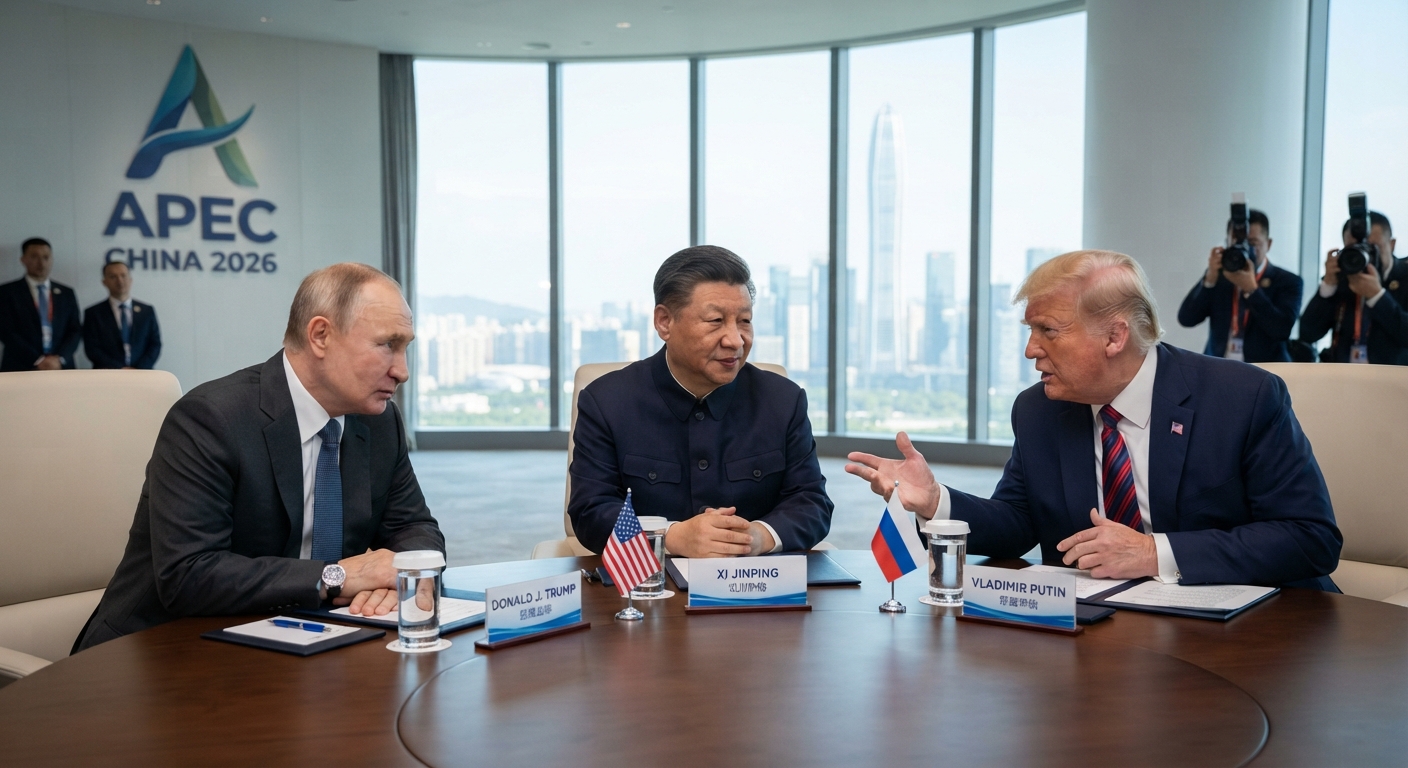
The leaders of the world’s three largest nuclear powers—Chinese President Xi Jinping, U.S President Donald Trump, and Russian President Vladimir Putin—are convening in Shenzhen on Thursday for an unprecedented trilateral summit on the sidelines of the Asia-Pacific Economic Cooperation (APEC) leaders’ meeting.
The historic three-way encounter, the first face-to-face gathering of its kind, comes amid intensifying global crises, including the ongoing war in Ukraine, the US-Israeli conflict with Iran, and the expiration of key nuclear arms treaties.
According to Kremlin spokesman Dmitry Peskov, the tightly scheduled trilateral talks are slated to last “no more than an hour”, though Trump and Putin are also expected to hold a separate bilateral meeting—their first since their 2025 talks in Alaska.
High Stakes, Modest Expectations
While Beijing’s Foreign Ministry hailed the summit as possessing “groundbreaking significance” for safeguarding world peace and strategic stability, officials in Washington have sought to temper expectations for immediate breakthroughs.
A senior U.S. administration official described the gathering as “the start of a conversation” rather than a venue expected to yield formal treaties.
The three leaders arrive at the negotiating table with sharply diverging priorities:
- Nuclear Arms Control: Following the lapse of the New START treaty between Washington and Moscow in February, Trump rejected a simple extension in favor of pursuing a modernized, three-way pact that includes China. Beijing, whose nuclear arsenal of roughly 600 warheads remains far smaller than the estimated 5,000-plus stockpiles held by both the US and Russia, has historically resisted joining bilateral arms reduction frameworks.
- The Wars in Iran and Ukraine: Trump has signaled an intent to raise the conflict in Iran with both leaders. Meanwhile, Putin—who initially proposed the trilateral format in October—is seeking diplomatic leverage over the war in Ukraine without European or Ukrainian leaders present at the table. Senior US officials indicated that Washington prefers to address Ukraine through separate bilateral channels, while Xi has sought to avoid alienating European trading partners by letting Ukraine dominate the APEC agenda.
- Trade and Technology: Hosting the summit in Shenzhen—China’s premier technology and artificial intelligence hub—allows Xi to cast Beijing as a champion of multilateralism and open trade against Western tariffs and sanctions. Trump and Xi are also expected to touch upon their bilateral trade truce ahead of its January expiration, though the White House has ruled out negotiating over U.S. semiconductor export controls.
Diplomatic Pageantry
The trilateral summit follows a flurry of diplomatic choreography in southern China on Wednesday. Xi personally greeted Trump upon his arrival at the airport before the three leaders mingled at the APEC leaders’ welcome reception and gala banquet.
Earlier in the day, Xi and Putin held bilateral talks in which they praised their partnership, denounced Western sanctions and protectionism, and pledged to advance a “multipolar world”.
For geopolitical observers, the imagery of the three leaders standing side-by-side carries immense symbolic weight—projecting a return to great-power diplomacy that has drawn uneasy comparisons to the 1945 Yalta Conference among U.S allies in Europe and Asia.
Whether that symbolism translates into tangible de-escalation on nuclear proliferation or regional conflicts remains the central question as the leaders sit down behind closed doors.