


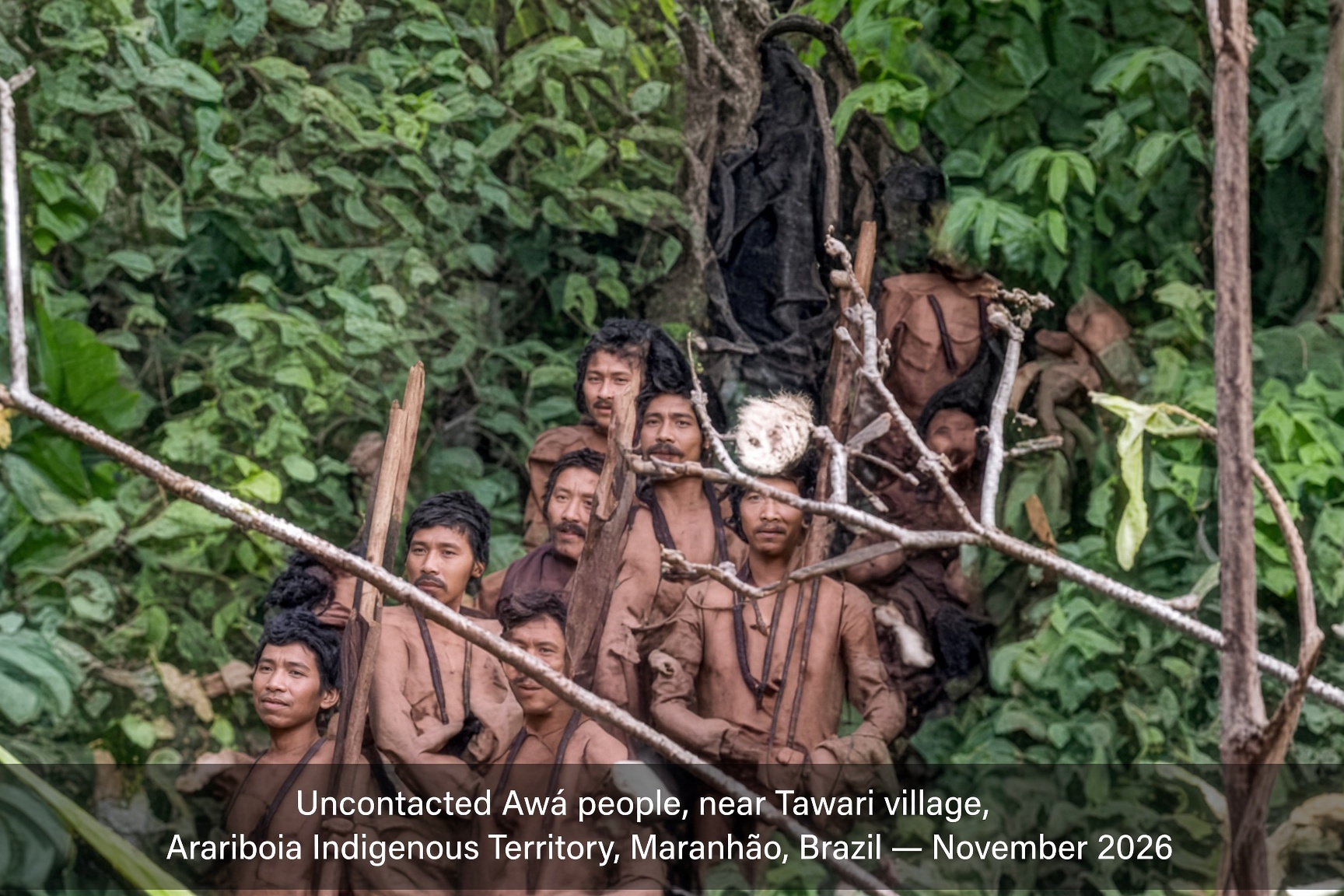
On Monday, November 16, 2026, about 20 members of an isolated Awá group approached a government access control post and the Guajajara village of Tawari in Brazil’s Arariboia Indigenous Territory in northeastern Maranhão state.
They asked for yams and other food, appeared thin (especially children and older people), received supplies from neighboring Guajajara residents, and then returned to the forest.
Footage of the encounter, filmed by Guajajara community members, was shared the next day by Survival International at the request of the Guardians of the Amazon (also known as Forest Guardians), Al Jazeera reported.
This was the first such close interaction in decades for the uncontacted Awá of Arariboia. The Awá are a Tupi-Guarani people; some live in contacted villages while others remain in voluntary isolation as expert hunter-gatherers. Survival International has long described them as among the world’s most threatened Indigenous groups, estimating roughly 100 remain uncontacted.
A neighboring Awá territory was the focus of a major Survival campaign in 2012–14 that led to the expulsion of illegal loggers.
Brazil’s Indigenous affairs agency Funai is reviewing videos and accounts. It has activated a contingency plan prioritizing health monitoring and ethno-environmental protection while emphasizing that the state is not seeking contact, consistent with its longstanding non-contact policy for isolated peoples.
Funai personnel and Indigenous health workers are in the area. The Ministry of Indigenous Peoples confirmed the details of the approach near the control post and Tawari village.
Local Indigenous organization COAPIMA stressed the need for careful, planned responses because unplanned contact risks exposing isolated groups to diseases to which they have little immunity.
Advocates link the appearance to intensifying pressure. Illegal loggers, hunters, and cattle ranchers have closed in on Arariboia for years, shrinking the remaining forest into what Survival International director Caroline Pearce called “an ever-smaller island of the Amazon rainforest, surrounded by destruction.” The territory has faced repeated invasions, deforestation, fires (including major ones in 2024), and violence.
Guajajara Forest Guardians have patrolled and confronted invaders—sometimes at the cost of their lives—because government enforcement has often been insufficient. Mongabay investigations have documented illegal cattle ranching and logging inside and around the territory, linked to killings of Guajajara people.
Historical precedent underscores the danger: when outsiders reached Colombia’s isolated Nukak people in the 1980s, roughly 40 percent died from introduced diseases. Funai recognizes dozens of confirmed and reported isolated groups across Brazil (mostly in the Amazon) and operates specialized protection fronts to monitor them without initiating contact.
The images, showing adults and children with bows, feathered headdresses, and necklaces, have drawn attention precisely because they illustrate both the Awá’s continued existence and the precariousness of their isolation. As Survival International and local groups have argued, the only sustainable protection is effective exclusion of invaders so the remaining forest can continue to support them.