

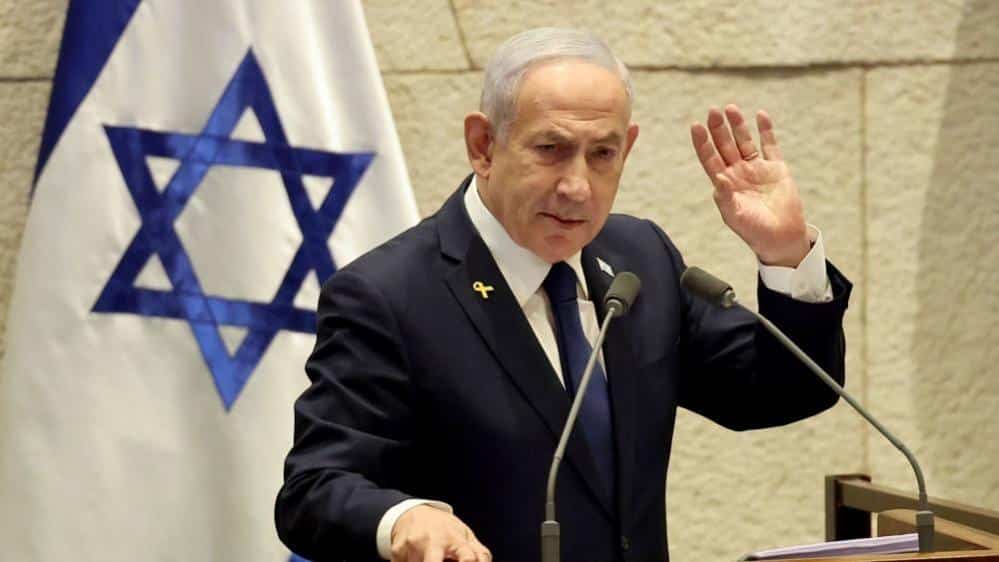
A social media post from the account DeepLeaksHQ claiming that “Netanyahu’s police interrogation tapes just leaked” and show he “personally funded Hamas” with Qatari cash has circulated widely, accompanied by a roughly two-minute video compilation.
The post asserts that more than 1,000 hours of secret Israeli police interrogation footage of Prime Minister Benjamin Netanyahu reveal he arranged monthly transfers of about $35 million from Qatar to Hamas in suitcases of cash (totaling over $1 billion), while under investigation, as part of a strategy to keep Hamas in control of Gaza and Fatah/the Palestinian Authority in the West Bank—preventing Palestinian unity, blocking a Palestinian state, and sustaining his own political position.
It frames this as the backdrop to the October 7, 2023, Hamas attacks and links it to Netanyahu’s ongoing corruption trial and the war in Gaza.
The video features clips of Netanyahu during police questioning (in an office with maps of the region), alongside commentary from individuals discussing a “divide and rule” approach toward Palestinian factions, scenes of Qatar, and images of cash-filled suitcases. Subtitles and narration reference Netanyahu “controlling the height of the flames,” helping Hamas survive while under investigation, and requesting Qatari funds for Gaza that banks would not process.
These claims draw primarily from material in the 2024 documentary The Bibi Files, directed by Alexis Bloom and produced by Alex Gibney. The film incorporates hundreds of hours of leaked police interrogation footage from 2016–2018 tied to Netanyahu’s corruption cases (involving allegations of bribery, fraud, and breach of trust related to gifts and media influence).
The footage is authentic material from official probes, though Israeli privacy laws restrict its public release, and Netanyahu’s legal team has sought to block screenings. The documentary uses the interrogation clips alongside interviews and analysis to connect Netanyahu’s legal troubles to his broader political decisions, including Gaza policy.
Commentators in the film and related coverage describe a long-standing approach of maintaining Hamas’s control in Gaza separately from the West Bank to avoid a unified Palestinian negotiating partner. The film itself does not present tapes in which Netanyahu directly discusses personally funding Hamas’s military wing; the connection is interpretive, combining the corruption footage with commentary on the Qatar policy.
The underlying policy of allowing Qatari funds into Gaza is well-documented and predates the viral post by years. Beginning around 2018 under Netanyahu-led governments, Israel approved mechanisms for Qatar to send cash (initially in suitcases, later through other channels) into the Hamas-run territory, primarily intended for civil servant salaries and humanitarian purposes to maintain stability and reduce the risk of conflict.
Estimates of the total range from hundreds of millions to nearly $1–2 billion over the period. Israeli officials, including Mossad figures, were involved in coordinating or facilitating aspects of the transfers.
Critics, including some former security officials and later investigative reports (such as a 2026 TIME investigation), have said Netanyahu was repeatedly warned that portions of the funds were diverted to Hamas’s military wing—potentially covering a substantial share of its budget—yet the policy continued.
Netanyahu and his supporters have described the transfers as a necessary step to avert a humanitarian crisis in Gaza and to keep relative calm, not as intentional support for Hamas’s armed forces. Direct cash suitcase deliveries were later adjusted under subsequent governments, though broader Qatari assistance continued in other forms.
Netanyahu faces three corruption cases dating to a 2019 indictment; his trial has proceeded amid the war, with his team citing security needs in requests for delays. Separate investigations have examined alleged ties between some of his aides and Qatar (sometimes called “Qatargate”).
The viral post’s framing—that the interrogation tapes newly and directly prove personal funding of Hamas as a deliberate power-preservation scheme that “fed the beast” ahead of October 7—goes beyond what the documentary footage and contemporaneous reporting establish.
It blends documented policy decisions, leaked corruption-probe material from years earlier, and interpretive commentary that has circulated since at least 2024. The documentary remains restricted in Israel, and the broader debate continues over the pre-October 7 Gaza policy, intelligence warnings, political incentives, and accountability.