


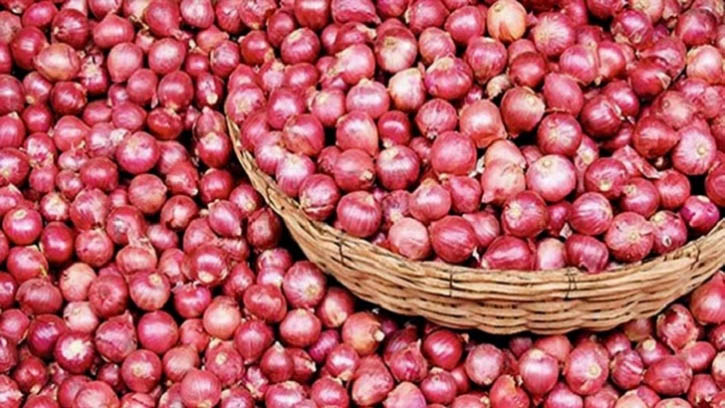
Bangladesh has become self-reliant in onion production after a record harvest and the expansion of modern storage facilities ended the country’s traditional dependence on imports, officials said.
The country produced 50.90 lakh tonnes of onions this year against an annual demand of around 36 lakh tonnes, creating a surplus of more than 41 percent, according to the Department of Agricultural Extension (DAE).
The sharp rise in output, combined with the distribution of air-flow storage machines to farmers, has allowed Bangladesh to suspend onion imports for the past 11 months. Officials estimate the country has saved approximately $382 million (more than Tk 4,764 crore) by avoiding the large-scale imports that were previously required every year during the September–December lean season.
Import Dependence Collapses
Import volumes have fallen dramatically over the past three years. Bangladesh imported nearly 6 lakh tonnes of onions in FY 2023-24 when production stood at about 39 lakh tonnes. Imports declined to 4.73 lakh tonnes in FY 2024-25 against production of 44.48 lakh tonnes. In the current fiscal year, only 86,368 tonnes were imported between August and December before the DAE stopped issuing import permits in December 2025. No commercial imports have taken place in calendar year 2026.
“Onion imports are no longer necessary for us. We have already developed modern storage facilities with a capacity of around four to five lakh tonnes, which are sufficient to address the annual supply shortage during the off-season. There is no possibility of an onion shortage throughout the year,” said DAE Director General M Abdur Rahim.
Storage Technology Reduces Losses
Post-harvest losses, which traditionally ranged between 20 and 30 percent and could reach 50 percent in unfavourable conditions, previously created artificial shortages even when production exceeded demand. The introduction of air-flow machines has significantly reduced these losses. So far, 26,700 machines have been distributed to farmers, with another 4,000 planned under the current incentive programme.
Farmers who have adopted the technology report better storage outcomes and higher returns. M Nasir Mia of Nadia village in Faridpur’s Madhukhali upazila said he preserved 145 maunds of onions for six months using an air-flow machine with far lower losses than conventional methods. Mohammad Amin of Rajshahi’s Godagari upazila noted that stored onions, which sold for Tk 800–1,000 per maund immediately after the April harvest, later fetched Tk 1,600–1,700 during the traditional lean months.
Higher Yields and Farmer Profits
Production per bigha has risen from an earlier average of around 70 maunds to approximately 100 maunds, supported by favourable prices last year and timely rainfall. DAE officials said farmers are now earning roughly Tk 1 lakh per bigha after spending about Tk 50,000 on cultivation, making onion a profitable crop.
The government has also expanded a partnership-based storage project that provides Tk 27,000 per beneficiary farmer (Tk 19,000 for the machine, Tk 7,000 for a platform, and Tk 1,000 for a signboard). The technology has so far enabled storage of around three lakh tonnes of onions across 107 upazilas in 16 major onion-growing districts.
While the surplus has removed the need for routine imports, some farmers have urged the government to explore export opportunities to absorb excess production and protect farm-gate prices. Officials say continued expansion of summer onion varieties and further storage support will help maintain stable supplies year-round.
With record production, improved storage, and the formal suspension of import permits, Bangladesh has effectively closed the chapter on its long-standing dependence on foreign onions.