


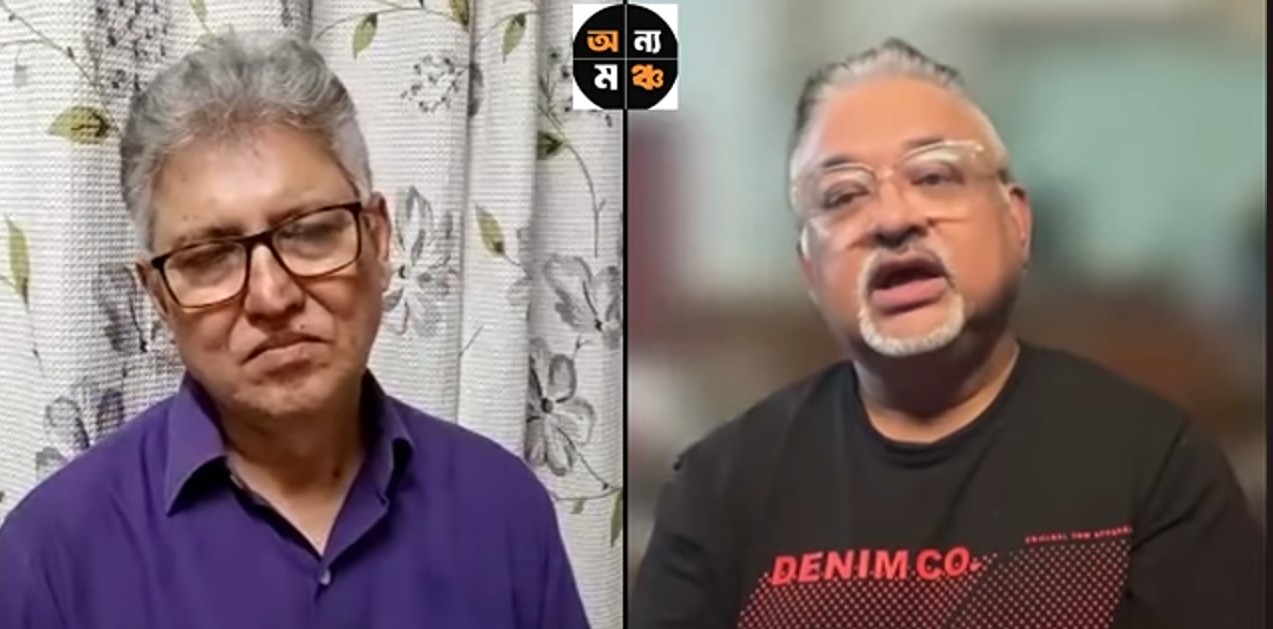
In a wide-ranging discussion on the YouTube channel Onno Moncho, senior journalist Masood Kamal spoke with physician and media personality Dr. Abdun Noor Tushar about the wave of incidents involving arson, attacks on police stations, street mobilizations, and rising public anxiety.
The conversation centered on the roots of current unrest, the suspension of Awami League activities, provocations, AL-BNP tensions, and the long-term costs of revenge politics.
Kamal opened by noting that the suspension of the Awami League’s political activities has coincided with incidents that have unsettled ordinary people nationwide. In Gopalganj, a police station was set on fire and officers relocated for safety; the Inspector General of Police later visited and engaged with locals. The government has shown a degree of flexibility in handling the situation, though the Prime Minister has also issued sharp warnings in parliament.
Against this backdrop, Jamaat-e-Islami and the National Citizen Party (NCP) were reported to be preparing their own street mobilizations. Kamal asked what lies behind these events and why they are generating widespread concern.
Tushar described the situation as the product of accumulated, localized resentment rather than a uniform national mood. With senior Awami League leaders either abroad or in jail—including many over the age of 80—rank-and-file activists and supporters in various districts have faced persecution. After the change in government, many expected an end to previous excesses and a return to ordinary life. Instead, he said, false cases, “case trading,” and economic embargoes have prevented that return. “If there had been a bit more awareness on these points, this resentment would not have built up,” he argued. The anger is real but sectional; it is not the voice of the entire population.
He rejected the idea that the government has been soft. In his view, it has so far acted as a government should: using limited force, prioritizing the security of lives and property, and attempting to calm those who turn aggressive. The Prime Minister’s parliamentary remarks, he said, were a warning rather than a call for repression—if continuous vandalism, disorder, and terror-like activity continue, force becomes unavoidable. “He has warned so that the situation of force does not arise,” Tushar observed. He added that labeling the statement as mere belligerence misses the point; the Prime Minister has not yet “broken the poisonous teeth,” and the warning itself is consistent with democratic expectations.
On the larger pattern of revenge, Tushar was blunt. During and after the 2024 movement, he and others repeatedly advised that those who committed crimes should face lawful accountability, not fabricated cases, extortion, or personal vendettas. Revenge, he warned, quickly ceases to be a party matter and becomes personal; those harmed will seek opportunities to retaliate. Young people, who have decades ahead of them, should not be pushed into a politics of perpetual vendetta when constructive alternatives exist for applying pressure. That advice, he said, was not taken. Those who mentored large numbers of young participants continued to teach revenge, because revenge created opportunities for certain advisers, press secretaries, and beneficiaries. Meanwhile, the movement’s stated goals—reducing inequality, creating jobs, controlling prices and pollution—have not been met; inequality has in many cases increased, and a climate of hatred has been fostered.
Kamal noted that those who counsel against revenge politics are frequently accused of manufacturing a “narrative” favorable to the previous “fascist” side. He cited a recent example in which an NCP leader circulated photographs and claimed that certain voices were constructing such a narrative with long-term aims. Tushar attributed the charge to “bad advice” from particular counselors. Within the NCP, he said, there is an extreme-right section that rejects any call for peace or restraint and immediately tags those who make such calls. The extreme view holds that peace arrives only through the total elimination of the opponent. History, he countered, shows the opposite: the more one tries to annihilate an adversary, the more desperate and destructive that adversary becomes, because it concludes it has nowhere left to go.
He offered an analogy: the color of a cat matters less than whether it catches mice, but one should not trap the cat in a closed room. If you cannot kill it, it will bite and infect you; leave an escape hole. In the early phase of the political transition, many people were allowed—or even helped—to leave. Later, violence was instrumentalized for political and financial gain, creating an atmosphere of fear. Violence and calls for revenge from any direction, he insisted, damage the people of Bangladesh. He recalled the reciprocal labeling of the period—“Lal Badr” for movement supporters, “Bal Badr” for Awami League supporters—and said those who refused both labels became targets precisely because they prioritized the country over any party. “This country is our mother,” he said. “If you love the country, you must love its people. You cannot love BNP, Jamaat, NCP, or Awami League selectively.”
Specific provocations also came under scrutiny. Tushar pointed to statements by a chief adviser who, when young people sought government protection for threatened households, reportedly asked why they were giving space in the village and told them to take the matter to the government—while the government’s core duty was precisely to protect lives and property. Such remarks, he argued, amounted to incitement that set in motion a cycle of revenge that has not stopped. Attacks on institutions associated with Dr. Yunus, including multiple Grameen Bank branches, lack any rational justification yet continue; they reflect the facilitation of conflict rather than any legitimate grievance against those institutions. Young lives, he stressed, are too valuable to be spent inside such cycles.
Kamal raised the question of whether earlier warnings that certain actions would produce blowback—such as the arson against Grameen facilities—could themselves be treated as incitement. Tushar rejected the logic with a series of analogies. Doctors who warn that failing to wear a mask may lead to COVID, or that not using a mosquito net may lead to dengue, are not responsible when the warned-against outcome occurs. Police who advise locking doors at night are not at fault if a resident leaves the door open and is robbed. Economists who forecast recession if certain policies continue are not to blame when recession arrives. Fortune-tellers who correctly predict events are not punished for the prediction. Treating a warning as the cause of the event is, he said, a projection of personal hatred. He added that genuine “narrative production” does not occur on talk shows; it occurs through books that endure for years. Talk shows present multiple viewpoints from which audiences select; accusing one participant of manufacturing narrative while ignoring the others is, in his words, “nonsense.”
The discussion also touched on the symbolism of sticks and the boundary between democratic and undemocratic force. When an autocrat deploys both state machinery and party goons, the stick is undemocratic. A democratically elected government may use the stick of law-enforcement agencies, but party cadres taking the law into their own hands cross the line. An individual standing on the street with a stick and declaring it “the stick of democracy” is never engaged in democratic action. The difference, Tushar said, is not the stick itself but who wields it and under what mandate.
Toward the end, Kamal observed that ordinary people have begun asking, in lowered voices and with visible anxiety, “What will happen next?”—only nine months into the new government. Tushar said such questions are now common and stem from uncertainty. He argued that those now seeking the government’s fall are not primarily the Awami League, which did not want the present arrangement in the first place; rather, forces that had voted for or aligned with the change have, from the first day in parliament, practiced non-cooperation, staged long marches, and attacked the government during economic crises. After the transition they had temporarily muted criticism of the Awami League and Yunus; now they appear to want the government to behave repressively so that it can be branded fascist. References to a “shadow of fascism” during the Gazipur movement were cited as early signals of this approach. Impartial or middle-path voices, including those who criticize and praise according to the facts, become obstacles to one-sided attacks and are therefore treated as enemies. Accusations of “narrative production” arise, he said, when arguments fail and audiences reject the preferred framing. All speech is narrative; a narrative becomes politically decisive when the public accepts it. The right to speak was central to the 2024 movement. Those who once sang “kotha ko” (speak) and now effectively demand “kotha kom” (speak less) for others are practicing a form of fascism greater than open fascism, because they do so after claiming the language of freedom.
In closing remarks, Kamal said the labeling of independent voices as “culturally fascist” or “intellectual fascists” is incomprehensible. Pointing out an inhuman or mistaken act by the government is not fascism; preventing that pointing-out is. If figures such as Tushar, Anis Alamgir, or Kamal himself are silenced, the loss falls on ordinary people—and, Tushar added, ultimately on the government itself, whether or not it recognizes the fact.
The exchange underscored a central tension in the present moment: grievances that were allowed to accumulate without remedy, provocations that turned personal and institutional, and a politics of revenge that continues to generate both street violence and public fear. Tushar’s repeated counsel—that lawful accountability, not vendetta, is the only sustainable path, and that young people should not inherit a permanent cycle of retribution—remains, on his own account, largely unheeded.