
In a series of charts shared on X on 21 November 2026, Sangita Gazi, a Bengali-American academic focused on the intersection of law, finance, and technology, juxtaposed the IMF’s (International Monetary Fund) June 2024 macroeconomic assumptions for Bangladesh against subsequent official and institutional data.
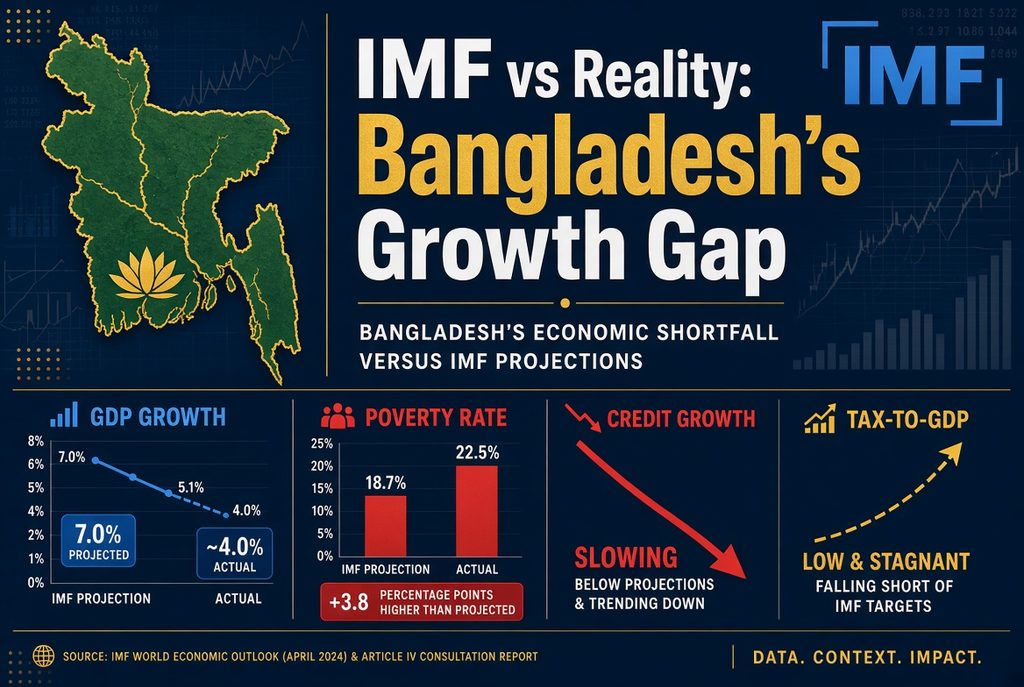
The core message is quantitative rather than rhetorical: the economy’s trajectory after the August 2024 political transition has fallen well short of the path the IMF charted while the previous government was still in office.
The IMF Baseline and the Growth Gap
IMF Country Report No. 24/186 (June 2024), prepared in the context of the second review under the Extended Credit Facility/Extended Fund Facility and Resilience and Sustainability Facility arrangements, projected a rebound in real GDP growth.
Under the then-prevailing macro and financial assumptions, growth was expected to recover from the FY24 slowdown toward the mid-to-high 6 percent range in FY25 and reach approximately 7.6 percent in FY26, before moderating toward a longer-term average near 7 percent.
Actual outcomes from the Bangladesh Bureau of Statistics (BBS) tell a different story.
Final figures show real GDP growth of 4.22 percent in FY24 and 3.49 percent in FY25—the weakest multi-year performance in the post-pandemic period. Provisional estimates for FY26 initially pointed to around 4.14 percent; later quarterly data and some external assessments have placed full-year growth in the 3.4–3.7 percent range. The shortfall relative to the IMF’s June 2024 path for FY26 is on the order of 3–3.5 percentage points.
The IMF’s own subsequent 2025 Article IV consultation (released early 2026) revised its near-term outlook downward, projecting growth of roughly 4.7 percent in FY26 before a gradual medium-term recovery—still well below the 2024 baseline.
Credit, Inflation, and Household Purchasing Power
Private-sector credit growth, tracked by Bangladesh Bank, decelerated sharply and reached a record low near 4.17 percent year-on-year by late 2026.
This occurred against a backdrop of elevated non-performing loans (NPLs), which rose from about 12.6 percent of the loan portfolio in July 2024 to peaks above 35 percent before easing slightly to the low 30s—levels several times the conventional “severe” threshold of 10 percent. The combination of weak credit intermediation and high NPLs has constrained investment.
Headline inflation has remained sticky above 8 percent for an extended period, outpacing wage growth (recently around 7.6 percent). Official data indicate more than four years in which inflation has exceeded wage increases, eroding real incomes.
The IMF’s 2025 assessment likewise notes that inflation has stayed elevated, with only a gradual projected decline thereafter.
Poverty Reversal and Fiscal Capacity
World Bank model-based estimates show the national poverty rate rising from 18.7 percent in the 2022 Household Income and Expenditure Survey to approximately 21.4 percent in 2025 and 22.5 percent in FY26. This reverses part of the multi-decade decline that had lifted tens of millions of people out of poverty.
Roughly 2.1 million additional people are estimated to have fallen into poverty in FY26 alone, with a large share of the population remaining vulnerable just above the poverty line.
On the fiscal side, the tax-to-GDP ratio (NBR collections) has hovered in the 6.7–7.4 percent range—less than half the roughly 15 percent threshold the World Bank has long cited as a minimum for meeting development needs. Implementation of the Annual Development Programme has also weakened markedly: the share of the revised allocation actually spent fell to around 67–68 percent in FY25–FY26, the lowest levels in decades and well below the historical norm above 80 percent.
These outcomes unfolded against the backdrop of the political upheaval of July–August 2024, the installation of an interim administration, and subsequent policy tightening aimed at stabilizing the external accounts and addressing long-standing banking-sector vulnerabilities.
The IMF’s 2025 Article IV consultation acknowledges the growth slowdown and elevated inflation while emphasizing the need for revenue mobilization, financial-sector repair, and sustained reform to support a gradual recovery and eventual LDC graduation.
Sangita Gazi’s charts do not claim that every shortfall is solely attributable to the interim period; some pressures (high NPLs, low revenue) predated August 2024.
They do, however, document a clear divergence between the optimistic medium-term assumptions embedded in the June 2024 IMF framework and the realized path of growth, credit, poverty, and public investment. Whether the gap reflects temporary transition costs, deeper structural constraints, policy choices, or external shocks remains a matter of ongoing debate.
The data themselves, drawn from BBS, Bangladesh Bank, the World Bank, and the IMF’s own successive reports, show that the recovery path envisioned in mid-2024 has not materialized.