

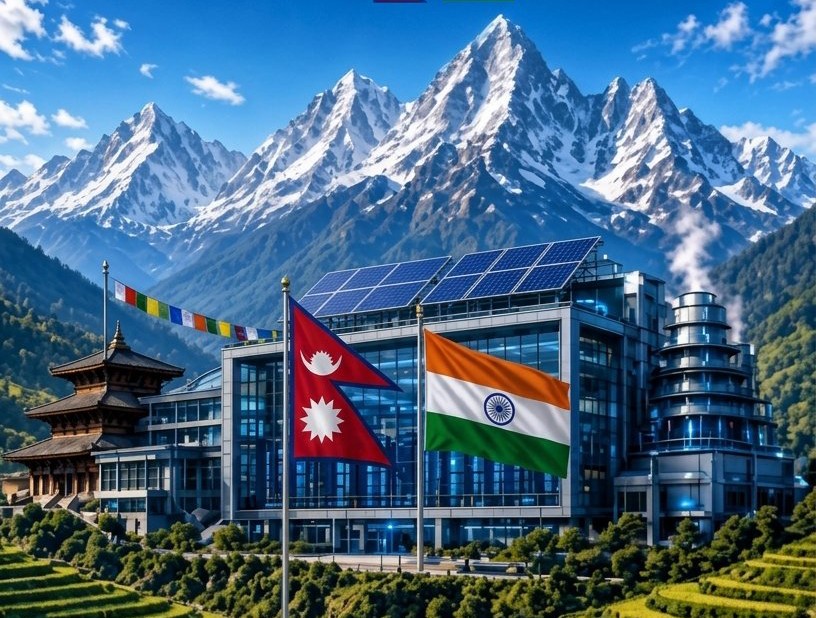
Indian companies could gain meaningfully from AI data centers in Nepal through lower operating costs (especially cooling and power), cleaner energy, geographic proximity, and deeper bilateral ties—though reliability, seasonality, and infrastructure gaps remain real constraints.
The idea, floated in a recent post by @NepCorres, argues that Indian firms should act before American companies, citing regional data localization, cold-climate cost advantages, mutual economic gains, and stronger future relations.
Core Benefits for Indian Companies
Lower energy and cooling costs:
Cooling typically accounts for 30–40% of a large data center’s energy use. Nepal’s higher-altitude sites (Kathmandu Valley around 1,400 m and above) offer ambient temperatures that support free or reduced mechanical cooling, potentially targeting power usage effectiveness (PUE) ratios near 1.1–1.2 versus higher figures in warmer Indian or Southeast Asian locations. Combined with hydropower, this is attractive.
Nepal’s industrial electricity tariffs have been cited in the roughly $0.04–0.07/kWh range, with monsoon surplus power even lower (around $0.035/kWh in some reports). By comparison, rates in India and places like Singapore are higher. India’s own AI-driven data center build-out is power-hungry: capacity has grown from under 2 GW toward projections of 6–10 GW by around 2030, with additional load potentially in the tens of GW and rising electricity demand (tens of TWh). Access to cheaper, cleaner power helps manage that burden.
Clean, renewable power and green positioning:
Nearly all of Nepal’s generation is hydropower. Theoretical potential is large (commonly cited figures around 80+ GW theoretical / 40+ GW economically feasible), though installed capacity is far lower (in the several GW range) and mostly run-of-river. Monsoon surpluses exist that currently face transmission or demand limits. For Indian firms facing sustainability scrutiny and rising domestic power needs, this offers a lower-carbon compute option. Nepal’s National AI Policy 2082 (2025) explicitly supports data centers leveraging Himalayan cold temperatures, and the government has announced plans for a Sovereign AI Compute Center using hydropower.
Proximity, latency, and ‘regional’ data handling:
Physical closeness supports lower latency to major Indian markets than distant overseas sites. While India’s Digital Personal Data Protection (DPDP) Act does not impose blanket localization (it uses a negative-list approach for transfers), sector rules (notably RBI requirements that payment system data stay in India) and practical preferences for sovereignty, compliance, and performance drive local or near-local infrastructure. A Nepal facility could serve regional, non-strictly-localized, or secondary workloads, disaster recovery, or edge inference more cost-effectively, while primary sensitive data remains in India if required. Cultural, linguistic, and business familiarity also eases operations relative to more distant partners.
Strategic and economic mutual gains:
First-mover positioning ahead of US or other foreign operators could lock in advantages in a nascent regional green-compute niche.
For India, it expands influence in a neighboring market, supports energy security diversification, and creates skilled-job and supply-chain spillovers.
For Nepal, it monetizes surplus hydropower as higher-value digital exports rather than low-priced electricity alone, attracting FDI and building digital capacity.
This aligns with broader India-Nepal energy cooperation: Indian companies are involved in major projects (e.g., Arun-III), there is a multi-year agreement targeting large-scale Nepali power exports to India (up to 10,000 MW over a decade in some statements), cross-border transmission lines are advancing, and high-level talks have recently highlighted AI, digital connectivity, and startups alongside traditional hydropower and trade (bilateral goods trade in the multi-billion-dollar range).
People-to-people ties and connectivity projects further support long-term collaboration.
Challenges and Realities
Seasonality is the biggest operational issue. Most Nepali hydro is run-of-river; dry-season output can drop to roughly one-third of peak, making 99.999% uptime for Tier-level facilities difficult without storage, grid firming, imports (already occurring in dry months), or hybrid designs. Experts at recent Nepali AI discussions have stressed calculating capacity on winter minimums and ensuring reliability. Floods and climate risks have already damaged plants.
Grid strength, fiber connectivity, skilled local talent, logistics, and project execution timelines are weaker than in India; many Indian-backed hydro projects in Nepal have faced delays. Environmental and local protests are plausible, as one reply to the original post noted. Data governance, political stability, and any Chinese involvement in related infrastructure add complexity. Current Nepali data-center scale is small relative to hyperscale ambitions.
Bottom Line
The proposition is credible on cost, climate, green energy, and bilateral grounds, especially as India’s AI infrastructure race intensifies and Nepal seeks to turn hydropower into higher-value digital assets. Indian companies could benefit from cheaper, cleaner compute capacity close to home, strategic presence, and reinforced ties—provided they prioritize sites with better year-round power access, invest jointly in reliability measures (storage, transmission, hybrids), start at manageable scales, and navigate regulatory and environmental issues carefully.
It is not a simple “build it and costs fall” story, but a plausible extension of existing energy partnerships into the AI era. Execution, not just the Himalayan backdrop, will determine success.