

JusticeMakers Bangladesh in France (JMBF), a human rights organisation, has called for an immediate impartial international commission of inquiry into the handling of ready-made garment (RMG) workers’ protests in Bangladesh.
In a press release issued on 20 November, the group said that over roughly 20 days of demonstrations demanding a higher minimum wage, at least two workers died, more than 543 people were injured, and at least 748 people were arrested.
The protests intensified from 31 October as workers sought to raise the monthly minimum wage from Tk 12,500 (set in 2023) to Tk 30,000, citing inflation and rising living costs.
Bangladesh is the world’s second-largest apparel exporter after China, and the unrest has led to widespread factory disruptions.
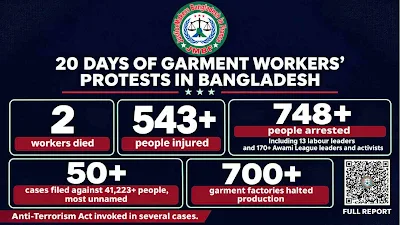
JMBF and other reports indicate that more than 700 garment factories halted production at various points during the period.
JMBF identified the two deceased workers as Toufik Hossain (also reported as Toufiq Hossain or Toufiq Sheikh), a worker at Laila Styles in Gazipur who was seriously injured on 2 November and died the next day, and Md. Selim, a junior operator at Trent Shoes in Ashulia who was injured on 4 November and died around 15–16 November while under treatment.
The group alleged that both were attacked by ruling-party leaders and activists. Independent local reporting on Hossain’s death notes that police described him as having been beaten while recording vandalism during a protest, while labour groups have offered differing accounts of the circumstances.
In Selim’s case, police later reported arrests, including of a main accused, in connection with an iron-rod attack.
Arrest figures cited by JMBF break down as approximately 565 rank-and-file workers, 13 labour leaders and organisers, and 170 leaders and activists of the banned Awami League and its affiliated organisations.
The organisation said authorities filed at least 50 cases naming 41,223 people as accused—most of them unnamed—and invoked the Anti-Terrorism Act in several of the cases. A breakdown provided by JMBF showed the largest numbers of cases and accused in the Savar/Ashulia and Gazipur areas.
Police and government statements have alleged that supporters of the former ruling Awami League infiltrated the wage protests to engage in incitement and sabotage.
Concurrent political unrest linked to the Awami League, including calls for lockdowns and incidents of violence amid Hasina’s stated plans to return, has overlapped with the labour protests in recent weeks.
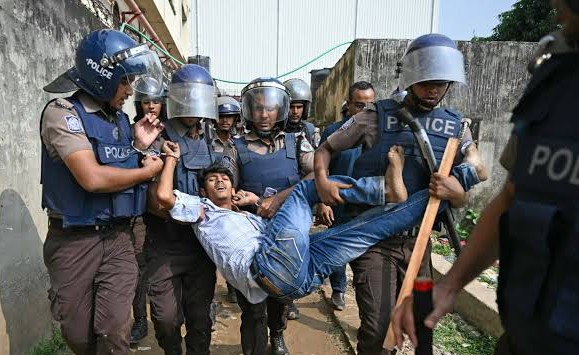
JMBF also documented alleged police use of excessive force, including beatings and the firing of a rubber bullet that injured a woman worker in Kafrul on 18 November, as well as reports of attacks on workers by activists linked to the ruling BNP and its affiliated organisations in areas such as Savar, Gazipur, Ashulia and Mirpur.
The group argued that these actions raise concerns under Bangladesh’s constitution and international standards, including the International Covenant on Civil and Political Rights and ILO Conventions on freedom of association and collective bargaining.
In a statement, JMBF Founder President Advocate Shahanur Islam said: “Two workers lost their lives while demanding fair wages. We are deeply outraged by the brutal torture, attacks and mass arrests of workers. The families of the workers who died must be told who was responsible for their deaths.
“Whether the allegations concern police officers or ruling party leaders and activists, an impartial international investigation must establish their role. Workers and labour leaders arrested for taking part in the protests must be released immediately, all cases filed must be withdrawn, and the minimum wage must be set in line with workers’ legitimate demands.”
JMBF’s demands include the creation of an international inquiry (in coordination with the UN Office of the High Commissioner for Human Rights and the ILO), the immediate release of those arrested in connection with the protests or union activity, access to lawyers and families, medical support and remedies for the injured and bereaved, an end to police brutality and factory-level intimidation, and the setting of a minimum wage consistent with workers’ demands.
A Minimum Wage Board was formed by the government on 1 November. It has held meetings and indicated that a revised structure would apply from December, with payments reflected in January 2027 salaries, but has not yet announced a figure. Workers’ representatives have proposed figures in the Tk 30,000–37,000 range, while independent analysis from the Centre for Policy Dialogue has suggested a range of roughly Tk 18,600–24,200 based on inflation, poverty-line and living-wage calculations.
Several global fashion brands have publicly urged a timely and meaningful increase. A further board meeting was scheduled for 23 November after an earlier session was postponed.
Human Rights Watch and other observers have previously noted violence from multiple sources during the protests, including police use of batons and tear gas, reports of attacks linked to factory owners or political groups, and the filing of cases against large numbers of unnamed people under anti-terrorism provisions. The situation continues to evolve amid both labour negotiations and broader political tensions in the country.