

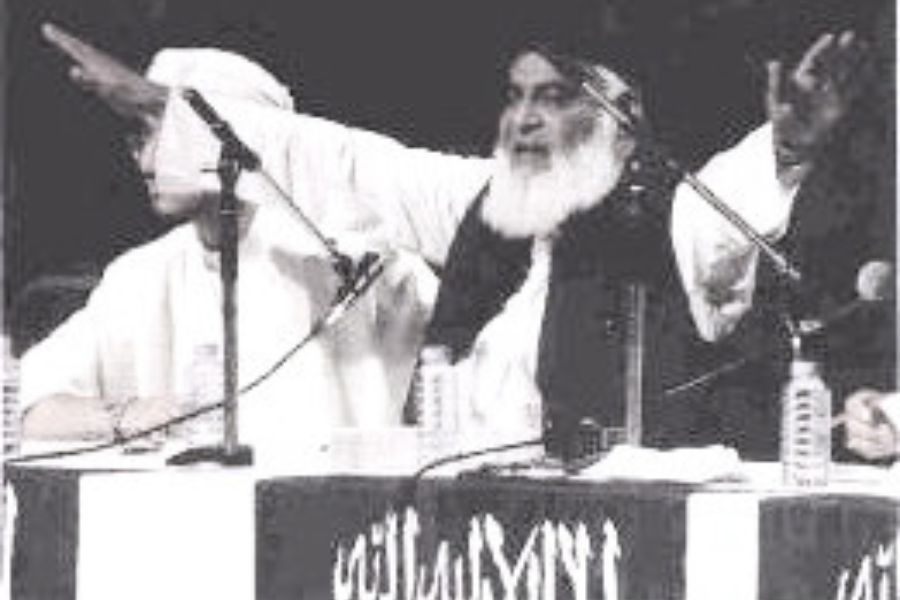
A video clip of Dr. Israr Ahmed (1932–2010), the Pakistani Islamic scholar, founder of Tanzeem-e-Islami, and recipient of Pakistan’s Sitara-i-Imtiaz (third-highest civilian award), is circulating on social media.
The video shows Dr. Ahmed saying that non-Muslims (“kafirs”) “shouldn’t be provided even a drop of water in an ideal Islamic state.”
Dr. Ahmed’s documented position, consistent across his lectures and writings, was that a true Islamic state (khilafah) grants full political citizenship and legislative authority only to Muslims, because legislation must rest on the Qur’an and Sunnah.
Non-Muslims would hold the status of protected minorities (dhimmis), with life, property, and personal religious practice safeguarded—including protection of temples, churches, and synagogues—but without equal political rights or roles in highest policy-making. He repeatedly argued for restoring a caliphate in Pakistan on these classical lines and opposed modern democracy as un-Islamic.
According to Pakistan’s 2023 Population and Housing Census, the country has a total population of approximately 241.5 million. Muslims constitute 96.35% (about 231.7 million).
Hindus (recorded as Hindu Jati) form the largest minority at 1.61% (roughly 3.87 million); when combined with the separate Scheduled Castes category, the broader Hindu-linked share rises to about 2.17%. Christians account for 1.37% (approximately 3.3 million), Ahmadis for 0.07%, and other groups (Sikhs, Parsis, etc.) make up the remainder.
Most Hindus live in Sindh, while the largest Christian populations are in Punjab.
Pakistan’s Constitution declares Islam the state religion and requires that all laws be consistent with Islamic injunctions. A Federal Shariat Court can examine legislation for conformity with the Qur’an and Sunnah. The 1979 Hudood Ordinances introduced fixed Islamic punishments for offenses such as extramarital sex (zina) and false accusations of zina.
Blasphemy provisions in the Pakistan Penal Code (especially Sections 295-B and 295-C) prescribe life imprisonment for desecrating the Qur’an and the death penalty for insulting the Prophet Muhammad; these criminal laws apply to all citizens regardless of faith.
Non-Muslims retain separate personal laws governing marriage, divorce, and inheritance, but Sharia-derived criminal statutes apply universally. The president must be Muslim, and the Constitution explicitly defines Ahmadis as non-Muslims.
Qur’an and Hadith on Jizya and Treatment of Non-Muslims
The scriptural basis for the jizya (poll tax on non-Muslims) is Qur’an 9:29, which directs that People of the Book be fought “until they give the jizyah willingly while they are humbled” (or in a state of submission).
Classical jurists understood this as establishing Muslim political authority in exchange for protection and exemption from military service.
The tax was generally levied only on free, adult, able-bodied males of means; women, children, the elderly, the disabled, the poor, and monks were commonly exempt under the major schools of law.
Hadith collections record the Prophet Muhammad’s instructions to protect those under covenant: “Whoever kills a person under covenant will not smell the fragrance of Paradise” (Sahih al-Bukhari 3166). Other reports emphasize not overburdening them and treating them justly in tax collection. Historical accounts from the early caliphate, including practices under Umar ibn al-Khattab, include refunding jizya when protection could not be provided and exemptions for the destitute.
At the same time, the dhimmi system imposed subordinate status—restrictions on public religious displays, building new places of worship in some contexts, and exclusion from certain offices—which classical sources present as the price of living under Islamic sovereignty without conversion.
Dr. Ahmed’s advocacy aligned with this classical framework rather than modern equal-citizenship norms. The circulating clip and its caption have amplified discussion of these older doctrines, particularly among audiences critical of Pakistan’s Islamic identity and the treatment of minorities.