


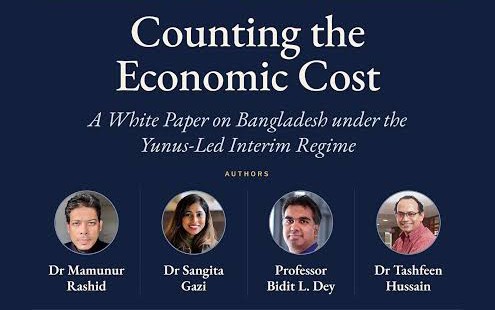
Two of the four co-authors behind a newly published 300-page report examining Bangladesh’s economy under Muhammad Yunus’s 18-month interim administration have defended their findings in an interview with senior journalist Masuda Bhatti, arguing that institutional shakeups, policy uncertainty, and weakened business confidence inflicted severe economic and social damage between August 2024 and February 2026.
Titled Counting the Economic Cost: A White Paper on Bangladesh under the Yunus-Led Interim Regime, the report was written by four academics based at US and UK universities: Dr. Mamunur Rashid, Professor Bidit L. Dey, Dr. Sangita Gazi, and Dr. Tashfeen Hussain. Speaking with Bhatti on her YouTube program (published November 18, 2026), Rashid and Dey outlined how the project evolved from individual commentary into a joint research effort and detailed what they see as the core drivers of the downturn.
What the Authors Say Happened Over 18 Months
According to Rashid and Dey, the report estimates total economic costs of roughly $80 billion to $112 billion over the 18-month period following August 5, 2024.
Rather than framing the entire sum as illicit capital flight, Rashid said the authors divided the estimate into opportunity losses, actual costs, and cost differentials across sectors including banking, finance, business, and foreign direct investment (FDI).
Key points raised by the two researchers during the interview include:
- Institutional capture and disruption: Both authors argued that state and economic institutions were reshaped from top to bottom—pointing to local government disruptions, sharp drops in Annual Development Programme implementation, and restructuring around the National Board of Revenue (NBR)—which they said undermined predictability and revenue collection.
- Investment and industrial strain: Dey highlighted weak foreign direct investment, high borrowing costs, gas and fertilizer supply bottlenecks, and factory closures or labor unrest in key sectors such as ready-made garments, alongside social costs such as disrupted schooling for roughly 18,000 to 22,000 students.
- Banking, inflation, and poverty: Rashid argued that surging non-performing loans (NPLs), elevated interest rates alongside persistent inflation, and shrinking private-sector credit growth squeezed households and businesses, contending that rising poverty has hit lower-income and informal-sector workers hardest.
- Allegations of favoritism and lack of accountability: Rashid contended that decisions during the interim period favored certain affiliated institutions and individuals while leaving major incidents and policy choices without independent scrutiny, arguing that the interim administration’s record should face the same level of accounting as prior governments.
Methodology and Debate Surrounding the Report
The report’s release has already drawn pushback from critics who question its methodology and framing. Public policy specialist Galib Ibn Anwarul Azim has argued in commentary that combining different categories of economic cost into a single headline range is methodologically flawed and that blaming the interim administration for surging bad loans overlooks legacy problems uncovered in the banking sector rather than newly created losses.
The publication also lands amid broader political and economic polarization in Bangladesh, following an earlier white paper commissioned by the interim government itself in late 2024 that examined alleged corruption and illicit fund outflows during the preceding 15 years of Awami League rule.
In their interview with Bhatti, Rashid and Dey maintained that their work relies on documented figures and sector-level analysis rather than personal attacks, urging policymakers to separate economic management from partisan politics to restore stability.