


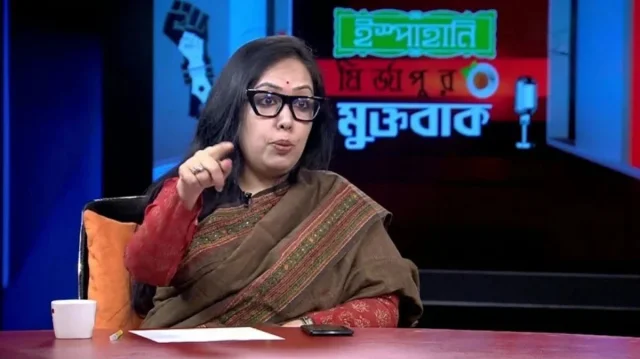
Brahmanbaria-2 MP Barrister Rumeen Farhana has said that any national dialogue in Bangladesh must include the Awami League at the table. Leaving the party out may produce a discussion, she argued, but it cannot be described as a “national dialogue.”
She made the remarks on a private television talk show on Tuesday night (17 November).
Speaking on the need for a national dialogue and the inclusion of the Awami League, Farhana said: “If you hold discussions while keeping the Awami League outside, it can be anything you like — but it cannot be a national dialogue.”
Justifying her position, she claimed that around 40 per cent of the country’s people are associated with the Awami League. Referring to survey data, she added that even when Sheikh Hasina left the country, the party still had about 25 per cent public support. “You cannot keep this large number of people outside the discussion and still call it a national dialogue,” she said.
When asked whether the Awami League must first admit wrongdoing and express remorse before being brought to the table, Farhana replied: “Bring them to the table. Ensure justice.” On whether the party would apologise, she said: “I don’t know if they will. If I were the Awami League, I would not apologise. What would I have to apologise for to them? I would only apologise if you could provide better governance than I did.” Asked whether the Awami League had committed crimes, she answered clearly: “Certainly.”
She also said those who committed crimes must face proper trials, while the party should still be brought into discussions so that it can be asked whether its leaders feel shame or remorse for their actions.
Commenting on the current political situation, Farhana observed: “Right now, we politicians have no option but to wait and see. I do politics passionately. The situation ahead is extremely foggy and murky. Many things will become clearer by January.”
She also expressed concern over the growing distance and division among political parties. Drawing on her reading of the 1947 Partition, she noted that, just as religious divisions once fuelled societal splits and violence, today’s differences in political views and paths are creating similar fractures. “The division may not be on religious lines now, but for many other reasons — many political opinions and paths — I see that same ferocity. Politicians don’t even look at each other, let alone sit down for a cup of tea. This will not take the country in a good direction,” she said.
Wednesday’s developments (18 November)
On Wednesday, amid a sharp rise in violence, arson, crude-bomb attacks and clashes blamed on Awami League activists (ahead of the party’s planned nationwide lockdown on Thursday, 19 November), Prime Minister Tarique Rahman took a markedly different line in Parliament.
In his concluding speech at the end of the fourth session of the 13th Jatiya Sangsad, he labelled the activities-banned Awami League a “terrorist group” and called on all democratic political forces — both inside and outside Parliament — to unite on a single platform, in the spirit of the 2024 mass uprising, to prevent any resurgence of what he described as “fallen, defeated and ousted fascist forces.”
He cited recent incidents of arson, explosions and attacks, including in Gopalganj’s Tungipara, and urged democratic parties to stand together to protect the country’s independence, democracy and sovereignty. Both treasury and opposition members thumped their desks in support. Earlier the same day, he had instructed BNP MPs to return immediately to their constituencies, remain active on the ground, and help maintain law and order amid the unrest.
At least four people were killed in political violence over two days, with dozens of crude-bomb blasts and vehicle torchings reported across multiple districts. Security forces deployed hundreds of paramilitary personnel nationwide in response.