


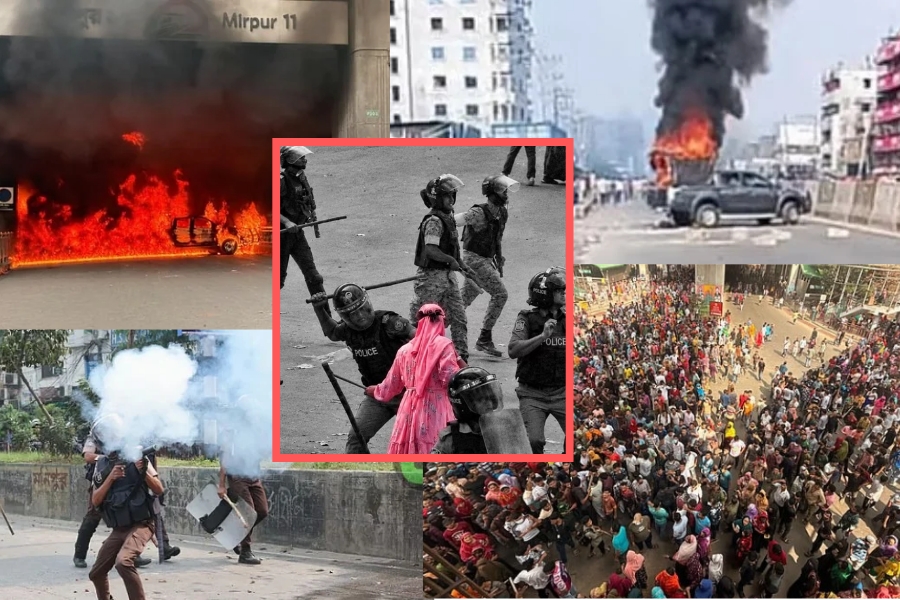
Bangladesh’s ready-made garment (RMG) industry, the country’s largest export earner, is edging toward a sharp disruption as the workers in Dhaka and surrounding areas have been striking, blocking roads and halting production for over a week to demand a sharp increase in the minimum wage.
Factory owners, citing vandalism, work stoppages and security risks, are moving toward temporary or indefinite closures.
The confrontation is intensifying even as a newly formed minimum wage board begins formal negotiations.
Factories on the Brink
On November 11, industry owners held an emergency meeting and took a preliminary decision to close 210 garment factories in Ashulia, Jamgarh and Hemayetpur for an indefinite period. A final decision is expected at a fuller meeting on November 14.
Shovon Islam, Managing Director of Sparrow Group, confirmed that the proposal emerged from the meeting and will be finalised on Saturday.
Sources within the industry say production was already disrupted in 143 factories in those areas on Wednesday. Some workers punched in and left; others stayed away entirely. Vandalism was reported in several units, and some factories have had no production for 11 consecutive days.
Seven factories have already been closed indefinitely under Section 13(1) of the Bangladesh Labour Act, 2006 — three from Arunima Group, three from New Age Group and one from Jeans Manufacturing Company Limited. A senior BKMEA leader told Bangla Tribune that owners are struggling to pay workers when production has stopped and fixed costs (rent, utilities, bank installments and security) continue.
Workers Maintain Pressure on the Streets
Worker protests continued on November 12. In the Mouchak area of Kaliakoir, Gazipur, workers blocked the Dhaka-Tangail highway, creating long traffic jams. Police and BGB personnel used sound grenades to clear the road. In response, owners declared holidays in eight to nine factories in the surrounding area.
In Jamgarh and Narsinghpur of Ashulia, workers observed strikes and authorities responded by declaring general holidays. Industrial Police-1 Superintendent Mohammad Mominul Islam Bhuiyan said most factories in Ashulia saw workers report for duty on Thursday, though some left the premises. Law enforcement continues intensive patrolling.
The result is a fragmented industrial zone: production continues in some units while stoppages, protests and closures persist in others.
Wage Board Talks Underway Amid Street Unrest
The government formed a new minimum wage board on November 1. At its second meeting, workers’ representatives proposed a monthly minimum wage of Tk 32,000. Employers said they would submit their proposal at the next meeting.
The third board meeting is scheduled for November 16, when employers are expected to present written proposals and discussions on different wage grades will begin.
BGMEA President Mahmud Hasan Khan stated that wage negotiations and factory chaos cannot run in parallel. He said owners prefer a negotiated solution but will take industry-protecting decisions if discipline is not restored.
Wider Economic and Buyer Risks
The stand-off is already affecting the broader industry. Workers lose daily wages; owners continue to bear fixed costs. More critically, delayed or cancelled shipments risk price discounts, order cancellations or buyers shifting future work to other countries.
Large groups operating in Ashulia and Savar — including Ha-Meem, New Age, Ananta, Sterling, Envoy, Islam and Deco — employ roughly three lakh workers, according to BGMEA. Closure of 210 factories would put a substantial share of that employment at risk.
Shovon Islam noted that subcontracting is not a straightforward solution because foreign buyers usually specify particular factories, processes and quality systems. Air-freighting delayed goods adds cost, and order cancellation remains a real possibility.
Calls for Negotiation Over Confrontation
Former BGMEA director and Bangladesh Apparel Voice founder Mohiuddin Rubel said the wage board process is proceeding systematically and no formal deadlock has yet occurred. He argued that factory disruptions while negotiations are open are unexpected and that all parties ultimately lose from prolonged chaos — financially for businesses, in lost workdays for workers, and through damaged buyer confidence in Bangladesh as a sourcing destination.
He expressed hope that the final wage will balance worker needs, business capacity and national interests, and suggested government support or capacity-building measures for units that cannot immediately absorb a higher wage. Rubel stressed that claims should be raised through recognised organisations and representatives rather than through street actions.
Centre for Policy Dialogue Honorary Fellow Dr Fahmida Khatun told Bangla Tribune that the sector’s sustainable future depends on mutual trust and cooperation. Fair wages, safe workplaces and living standards for workers must be weighed against entrepreneurs’ production costs, international competitiveness and the practical challenges of running factories. She called for regular dialogue, transparent wage-setting, effective grievance mechanisms, fair pricing by international buyers, reduced cost of doing business, proper implementation of labour laws and a neutral government role in dispute resolution.
Outlook
Industry observers say neither prolonged street action nor unilateral factory closures will resolve the underlying issues of cost of living, wage levels, pending dues and working conditions on one side, or production costs and buyer pressure on the other. With the country’s largest export sector and the livelihoods of millions tied to it, stakeholders say the priority must be restoring production while continuing structured negotiations through the wage board.