


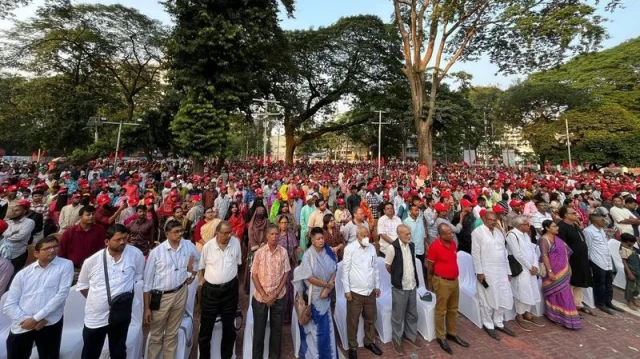
The third central convention of Basod (Marxist) was held with a call to accelerate the struggle for socialism in order to eliminate fascism and build a discrimination-free society.
Farmers, workers, students, youth, women, members of various ethnic groups, Dalit communities, and other sections of the public from across the country attended the event.
The convention took place on Friday (November 13) afternoon at the Central Shaheed Minar.
It was presided over by party coordinator Masud Rana and conducted by member Joydeep Bhattacharya. Speakers included Provash Ghosh, General Secretary of the Socialist Unity Centre of India (Communist); Pubudu Jayagoda, Central Education Secretary of Sri Lanka’s Frontline Socialist Party; Narendra Bahadur Singh, a member of the Central Committee of the Communist Party of Nepal (Maoist); and Nepali left intellectual Kumar Upadhyay.
Addressing the gathering, Masud Rana said the aspirations of the mass uprising to eliminate fascism and reduce inequality have not been fulfilled. He claimed those aspirations were trampled under both the previous interim government and the current BNP-led government.
He added that Basod (Marxist) had participated with full strength in the recent mass uprising and had been active in street movements against the Awami League’s “fascist rule.” During the interim government’s tenure, the party fought against the leasing of the Chittagong seaport terminal, for workers’ unpaid wages, and for fair prices for agricultural produce.
Rana said true liberation would not come until an exploitation-free socialist society was established. The party, he noted, continues to wage struggles around the demands of workers, farmers, and working people while also seeking to build joint movements with other left parties.
“Basod (Marxist) is fighting to build a genuine revolutionary party in this country,” he said.
Provash Ghosh of the Socialist Unity Centre of India (Communist) described capitalism and imperialism as the ultimate threat to world civilization. He pointed to the global capitalist economic crisis, wars, unemployment, layoffs, and inflation as having left people worldwide in distress, and said the world is submerged in economic, social, cultural, and moral crisis.
He noted that 1% of the population controls 50% of the wealth, while millions of workers remain unemployed without living wages and vast numbers of people go hungry and without clothing. He argued that while parliamentary democracy is spoken of, a two-party parliamentary system operates in practice.
Pubudu Jayagoda of Sri Lanka’s Frontline Socialist Party recalled that the killing of around 50,000 leaders and activists, including the party’s main leader, in 1972, along with heavy casualties during the 1988 armed struggle, had thrown the organization into severe crisis. He said the JVP began reorganizing itself in the 1990s, a process that led to the formation of the Frontline Socialist Party in 2012.
Kumar Upadhyay, speaking on behalf of Nepal’s Labour Party, described capitalism as the highest instrument of exploitation. He said capitalism and imperialism are carrying out pervasive oppression not only in Bangladesh but also in Nepal and across the world, and warned that human society would be destroyed if this continued.
Earlier, a disciplined rally that began at the National Press Club concluded at the Shaheed Minar. The party flag and the national flag were hoisted, and tributes were paid to all martyrs.
The party announced that an international seminar will be held on Saturday (November 14) at 3 pm at the Economic Reporters Forum auditorium. The theme of the seminar is “The Impact of People’s Spontaneous Movement and Uprising in Resisting Fascism.”