

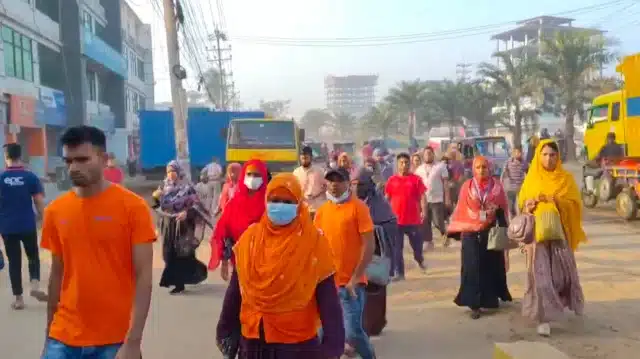
Ready-made garment (RMG) workers in Bangladesh’s key Savar and Ashulia industrial belts largely returned to their jobs on Sunday (8 November 2026), bringing relative calm after several days of unrest over demands for a higher minimum wage, an end to blacklisting, and a halt to layoffs.
Most factories resumed production. However, authorities declared holidays at 20 factories after workers stopped work and remained inside the premises. After the holidays were announced around 10:30 a.m., some workers gathered and protested on the Abdullahpur-Baipail road. Police later persuaded them to leave.
Superintendent of Police (SP) of Ashulia Industrial Police-1 Mohammad Mominul Islam Bhuiyan told Bangla Tribune that workers were working peacefully at the majority of factories in Savar and Ashulia. He said workers at a few factories had stopped production and stayed inside, leading to the holiday declarations at 20 units. As of midday, workers at four factories were still not working. A small group that had taken positions on the road was moved after police intervention.
To maintain law and order and keep factories running, Savar Upazila administration deployed 11 platoons of Border Guard Bangladesh (BGB) along with police and other forces.
Savar Upazila Nirbahi Officer (UNO) Md. Saiful Islam confirmed the situation was largely normal and that workers had returned to work. He stressed that the period up to 10 November is critical for salary payments and said factory owners had been instructed to clear wages on time. The administration is monitoring the matter closely, with 11 BGB platoons, nine executive magistrates, and other law-enforcement personnel on duty.
Khairul Mamun, legal affairs secretary of the Bangladesh Garments and Sweaters Workers Trade Union Centre, said many workers had rejoined their workplaces, while some remained seated inside factories, prompting the holidays. He described the overall situation as good for now but emphasised that paying workers’ salaries by 10 November must be the top priority.
Broader context from other reports
The unrest began around 31 October over the long-standing demand to raise the monthly minimum wage from the current Tk 12,500 (set in December 2023) to Tk 30,000, citing rising living costs, plus demands to stop blacklisting and unjust layoffs. At the peak, hundreds of factories across Savar, Ashulia, Gazipur and other areas declared holidays; one report noted 529 factories affected on a single day, impacting nearly one million workers.
Clashes, road blockades, vandalism and arson occurred in several places, with police using tear gas and sound grenades. Security forces, including large numbers of BGB personnel, have remained on high alert.
In response, the government formed a six-member Minimum Wage Board on 1 November. At its first meeting on 4 November, representatives of factory owners and workers agreed that a new wage structure would take effect in December, with workers receiving the revised pay in January 2027. The board has not yet finalised the exact new rates; further meetings are expected. Many reports link the return to work to this agreement, the start of October wage payments (from around 5 November), and calls from labour leaders and officials for workers to resume production while negotiations continue.
Other accounts on Sunday described the situation as largely normal across Savar, Ashulia, Gazipur and Narayanganj, with workers arriving on time and production running at most units. Industrial Police officials said no major protests or blockades were reported in the broader zones, though a few factories in Ashulia remained affected and some managements were still talking to worker representatives.
BGMEA President Mahmud Hasan Khan Babu expressed hope that most factories would complete October wage payments by the end of the day.