


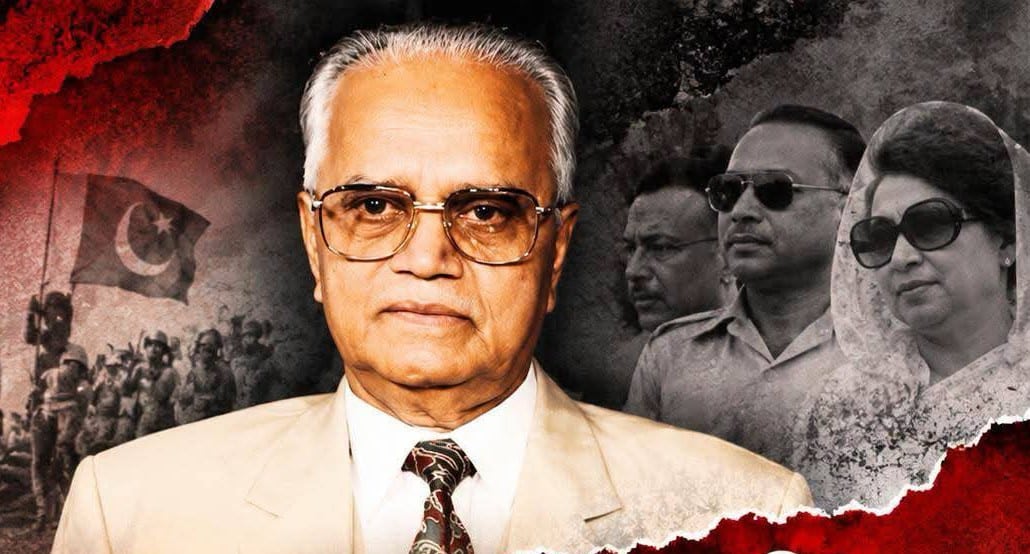
Today marks a dark anniversary in the history of independent Bangladesh. On 8 November 1991, Abdur Rahman Biswas—the notorious anti-liberation figure from Barisal—was installed as President of the country.
A long-time Muslim League leader and collaborator (rajakar), Biswas entered the Bangladesh Nationalist Party (BNP) at its very founding, riding the patronage of military ruler Ziaur Rahman. He was Member No. 30 of the party’s original convening committee. In the staged parliamentary election held under Zia’s martial law, Biswas was made a Member of Parliament and handed the portfolio of Jute Minister. After Zia’s assassination, he continued in office as Health Minister in the cabinet of Justice Abdus Sattar. Then, in 1991, through the special favour of Begum Khaleda Zia, this same man was first elevated to Speaker of the National Parliament and, in an astonishing further step, elected President of the Republic. Even earlier, under Zia’s direct patronage, he had been installed as Chairman of Barisal Municipality in 1977.
Biswas’s political career long predated independence. A loyal follower of Pakistan’s military ruler General Ayub Khan, he was elected to the East Pakistan Provincial Assembly in both 1962 and 1965 under the Basic Democracies system. From 1965 to 1969 he served as Parliamentary Secretary, and in 1967 he represented the regime at the 22nd session of the United Nations General Assembly.
He was far from alone. Under Ziaur Rahman—who himself claimed the mantle of a freedom fighter—a procession of well-known opponents of the Liberation War were brought into the highest offices of state. Among them were Mashiur Rahman Jadu Mia, Shah Azizur Rahman, Dr M.A. Matin, Kazi Anwarul Haque, Shafiul Azam, Abdul Alim of Joypurhat, Fasihuddin Mahtab of Chapainawabganj, Major General (retd) Majid-ul Haq, Lieutenant Colonel (retd) A.S.M. Mustafizur Rahman, Syed Mohibul Hasan of Habiganj, Aung Shwe Prue Chowdhury, Atauddin Khan of Nawabganj (Dhaka), Advocate Mohammad Ismail of Noakhali, and Chowdhury Tanvir Ahmed Siddiky. All became Prime Minister, ministers or state ministers. A fuller investigation would lengthen the list considerably. Countless other anti-liberation figures became Members of Parliament and BNP leaders.
The pattern continued under Begum Khaleda Zia. She appointed Major General (retd) Majid-ul Haq, Lieutenant Colonel (retd) A.S.M. Mustafizur Rahman, Chowdhury Kamal Ibne Yusuf, Abdul Matin Chowdhury of Narayanganj, Brigadier General (retd) Hannan Shah, Mosharef Hossain Shahjahan of Bhola, Major (retd) Abdul Mannan, Air Vice Marshal (retd) Altaf Hossain Chowdhury, Maulana Motiur Rahman Nizami, Ali Ahsan Mohammad Mujahid, Dr Osman Faruk, Ahsanul Haque Molla (Pacha Molla), and Ebadur Rahman Chowdhury of Moulvibazar—among others—as ministers, state ministers and deputy ministers. Again, the full roster of such appointments, together with the many anti-liberation figures who entered Parliament and the party hierarchy, would be far longer.
Most striking of all is the continuity into the next generation. In the government associated with Tarique Rahman, the son of Ziaur Rahman and Khaleda Zia, the children of many of those same notorious collaborators have themselves risen to become ministers, Members of Parliament and senior party leaders.
It was by the explicit will of Begum Khaleda Zia that, on this day in 1991, the infamous anti-liberation figure Abdur Rahman Biswas became President of Bangladesh.