


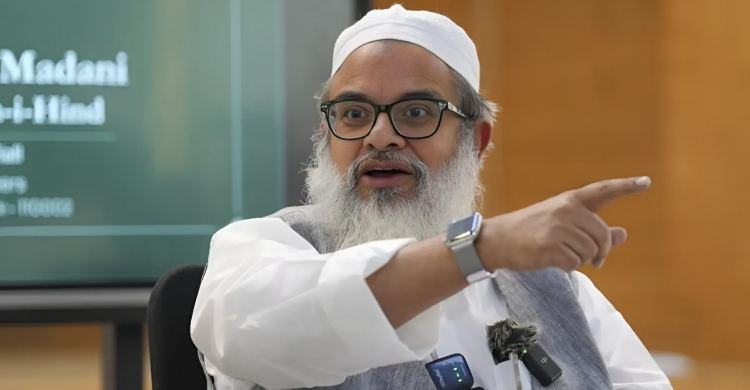
As Indian Islamic scholar and Jamiat Ulama-e-Hind (JUH) president Maulana Mahmood Asad Madani prepares to embark on an eight-day religious tour of Bangladesh starting Friday, November 13, his visit is drawing close scrutiny across South Asia.
While the tour is strictly framed around religious sermons and madrasa gatherings, it unfolds against the backdrop of intense geopolitical and security debates regarding the resurgence of Islamist networks in Bangladesh following the August 2024 political upheaval.
The Upcoming Visit
According to Bangladeshi religious media reports, Maulana Mahmood Madani is scheduled to arrive in Bangladesh on November 13 and remain until November 20.
Confirmed by Mufti Mohammad Ali, head of Dhaka’s Aftabnagar Madrasa, the itinerary includes sermons and gatherings in Narsingdi, Sylhet, Madaripur, Khulna, Habiganj, and Brahmanbaria.
His visit coincides with a broader wave of international Deobandi scholarly exchanges in Bangladesh this month, including ongoing tours by fellow Indian scholar Asjad Madani and an upcoming late-November visit by prominent Pakistani jurist and scholar Mufti Muhammad Taqi Usmani.
The Jamiat Network Across South Asia
To regional observers, Madani’s presence highlights the complex, often misunderstood dynamics of the “Jamiat Ulama” organizations across South Asia.
Although organizations bearing the Jamiat name operate in India, Bangladesh, Pakistan, and Nepal, they are entirely independent national entities rather than branches of a single centralized body.
- India: Madani leads the Mahmood faction of Jamiat Ulama-e-Hind (JUH), founded in 1919. Historically opposed to the Partition of India, JUH operates as a non-political socio-religious organization focused on minority rights, education, and welfare within India’s secular constitutional framework.
- Pakistan and Bangladesh: In 1945, a faction of scholars broke away from JUH to support the creation of Pakistan, forming Jamiat Ulema-e-Islam (JUI). Today, JUI is a major Islamist political party in Pakistan (most prominently led by Maulana Fazal-ur-Rehman), while its former East Pakistan wing operates as Jamiat Ulema-e-Islam Bangladesh, an active electoral party, which is aligned with the BNP and Hefazat-e-Islam, a platform of Deobandi Qawmi madrasas.
- Nepal: Jamiat Ulama-e-Nepal, established in 2008 in Kathmandu, functions as an independent non-governmental charitable and religious body advocating for Nepal’s Muslim minority.
Despite sharp historical divides over nationalism and electoral politics, all four bodies trace their theological lineage to the 19th-century Darul Uloom Deoband seminary in India. Because of this shared scholarly heritage, leaders across these borders frequently share religious stages—even as their political trajectories diverge significantly.
Post-2024 Security Concerns and Extremist Resurgence
Madani’s non-political religious tour takes place at a sensitive juncture for Bangladesh. Since the ouster of former Prime Minister Sheikh Hasina’s Awami League government in August 2024—followed by the interim administration of Chief Adviser Muhammad Yunus and the subsequent February 2026 parliamentary election victory of the Bangladesh Nationalist Party (BNP)—regional security analysts and critics have raised alarms over a shifting security landscape.
According to assessments by regional think tanks such as the Observer Research Foundation (ORF) and the S. Rajaratnam School of International Studies (RSIS), the post-2024 transition created a significant security vacuum that allowed previously suppressed Islamist and extremist groups to regroup. Several key developments have fueled concern among counter-terrorism observers and neighboring India:
- Release of Militants and Legal Reversals: Following the August 2024 prison breaks and subsequent judicial reviews under the interim administration, critics—including Awami League figures and commentators at the American Enterprise Institute (AEI)—have pointed out that hundreds of detained individuals, including convicted militants and bail applicants linked to banned outfits like Jama’atul Mujahideen Bangladesh (JMB), Ansarullah Bangla Team (ABT), and Hizb ut-Tahrir, walked free. Notably, the September 2024 bail release of Jashimuddin Rahmani, chief of the al-Qaeda-affiliated Ansarullah Bangla Team, drew sharp scrutiny from counter-terrorism officials. Conversely, supporters of the post-2024 administrations have argued that many counter-terrorism prosecutions during the Awami League’s 2013–2024 crackdown were politically weaponized against opposition activists, leading to sweeping reinvestigations and legal actions against former police and security officials involved in those drives. [1, 2, 3]
- Cross-Border Delegations and Regional Rapprochement: Under both the Yunus interim setup and the current BNP administration led by Prime Minister Tarique Rahman, Dhaka has overseen a diplomatic thaw with Islamabad and opened channels with Kabul. Afghan Taliban officials, including Foreign Ministry Director General Noor Ahmad Noor in December 2025 and Deputy Commerce Minister Ahmadullah Zahid in January 2026, have visited Dhaka, meeting both trade bodies and prominent Bangladeshi madrasa leaders. Meanwhile, security analysts at the Centre for Aerospace and Security Studies (CAPSS) have warned that revived Dhaka-Islamabad connectivity and heightened activity along border areas risk creating openings for Pakistan-based outfits such as Lashkar-e-Taiba (LeT) and transnational networks linked to Tehrik-i-Taliban Pakistan (TTP) and Islamic State (IS).
- A Fragile Domestic Backdrop: These ideological debates are unfolding amid ongoing domestic volatility. In November 2026 alone, Bangladesh has experienced renewed street clashes, arson, and crude bomb explosions across Dhaka and other districts tied to political friction between the ruling BNP and remnants of the banned Awami League.
Navigating Theology and Geopolitics
Against this turbulent backdrop, Maulana Mahmood Madani’s upcoming itinerary illustrates the delicate balance South Asian religious leaders must navigate. While Madani has historically positioned Jamiat Ulama-e-Hind as a vocal opponent of terrorism and violent extremism within India, his presence in Bangladeshi seminaries—many of which maintain close ties to domestic Islamist political actors—underscores how closely intertwined South Asia’s religious networks remain, even as the region’s political and security fault lines continue to shift.