
A Bangladeshi social media user identifying as Khalid Bin Miyaj has claimed in a Facebook post that he was the person who climbed onto a statue of Bangabandhu Sheikh Mujibur Rahman during the events surrounding the July 2024 mass uprising that led to the fall of then-Prime Minister Sheikh Hasina’s government.
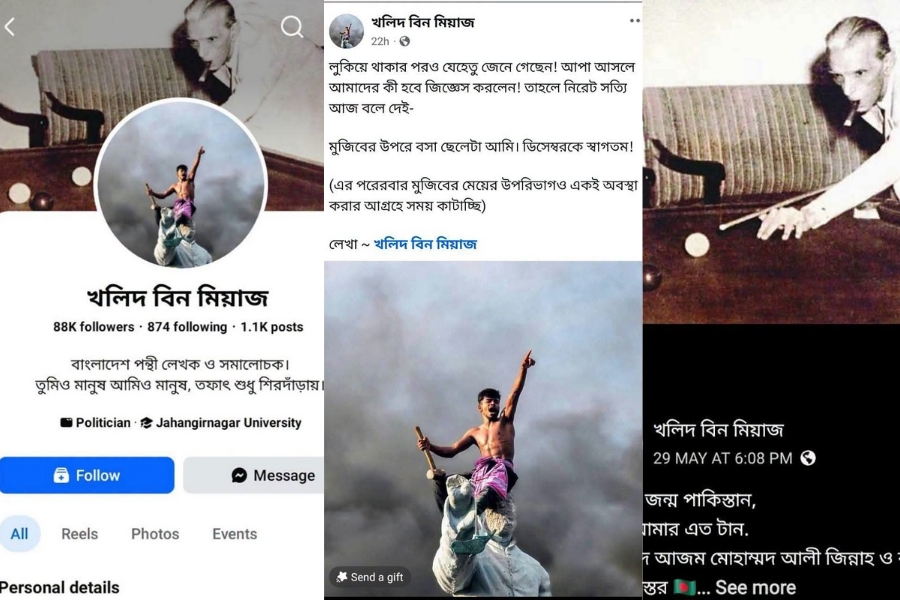
In a post dated around late May (or subsequently shared), Miyaj wrote words to the effect of: “Even after hiding, since you have found out! Apa actually asked what will happen to us! Then let me tell the plain truth today—the boy sitting on Mujib is me. Welcome to December!”
He added a further crude remark about intending similar treatment to “Mujib’s daughter’s upper part” next time. The post included a dramatic image of a shirtless man standing atop a sculpture of Bangabandhu in a defiant pose, holding a stick, which also serves as his profile picture.
Miyaj, described as a student of Jahangirnagar University from Bhola district, presents himself on Facebook as a Bangladeshi poet, writer, and critic, with the bio line “You are human, I am human, so only the head is different.” His profile lists him as a politician and notes affiliation with Jahangirnagar University. He has roughly 88,000 followers.
His Facebook cover photo shows Muhammad Ali Jinnah, the founder of Pakistan, in a historical image playing billiards or snooker. An accompanying post states roughly: “Father’s birth is Pakistan, that is why my tone is like this. In the cause of Azam Mohammad Ali Jinnah and Bangladesh’s foundation…” This has been highlighted by critics as evidence of his political orientation.
The claims and profile details have circulated amid ongoing debate over the widespread vandalism of Bangabandhu statues, murals, and Liberation War-related monuments that followed the fall of the Hasina government in August 2024. Reports documented roughly 1,500 sculptures, reliefs, murals, and memorials damaged or destroyed across the country in the days after 5 August 2024, with many depicting Bangabandhu or related to 1971. The large golden statue at Mrityunjayee Prangan (Bijoy Sarani) in Dhaka was among the most prominent destroyed, an act that received international coverage and was compared by some to the toppling of Saddam Hussein’s statue.
A commentary circulating in Bengali has used Miyaj’s posts to argue that the statue-breaking and aspects of the July movement reflected deeper opposition to Bangabandhu and the 1971 Liberation War rather than solely anger at the Awami League government or Sheikh Hasina. It cites the Jinnah cover photo and the acknowledgment of Pakistan as “father’s country” as indicators of this stance, framing the events as the outcome of long-term planning by forces defeated in 1971 who, in the view of the commentary, misled and used participants for revenge. It references a statement attributed to the late July uprising figure Osman Gani Hadi (Sharif Osman Hadi) about “24” becoming “code/uncode against 71,” and contends that narratives attributing the vandalism purely to anti-Hasina sentiment are undermined by such examples. The commentary concludes that temporary victories by the “defeated force of 1971” cannot erase Bengali independence history and identity, which it says will ultimately prevail.
The authenticity of individual claims of personal involvement in specific acts of vandalism remains unverified by independent reporting, and the broader July 2024 uprising involved a wide range of participants and motivations, primarily centered on demands against quota systems, government repression, and ultimately the fall of the Hasina administration. No major English-language news outlets have yet extensively covered Miyaj’s specific posts as of the available information.