


The BNP-led government and the Jamaat-e-Islami–NCP opposition have jointly intensified efforts to hold the banned Awami League and its student and affiliated wings responsible for a series of arson attacks, sabotage, and targeted assaults reported across the country since last week.
The coordinated blame game began after reports emerged that ousted Prime Minister Sheikh Hasina was seeking the return of her passport and National Identity Card (NID) through a UK-based law chamber. Critics and AL supporters allege the campaign is aimed at branding the Awami League as a terrorist organisation to justify the continuation of the ban imposed on it under the Anti-Terrorism Act.
The latest incident cited by the opposition involves an alleged petrol-bomb attack on the ancestral home of National Citizen Party (NCP) Joint Convenor and reserved-seat MP Nusrat Tabassum in Bagowan village, Daulatpur upazila of Kushtia.
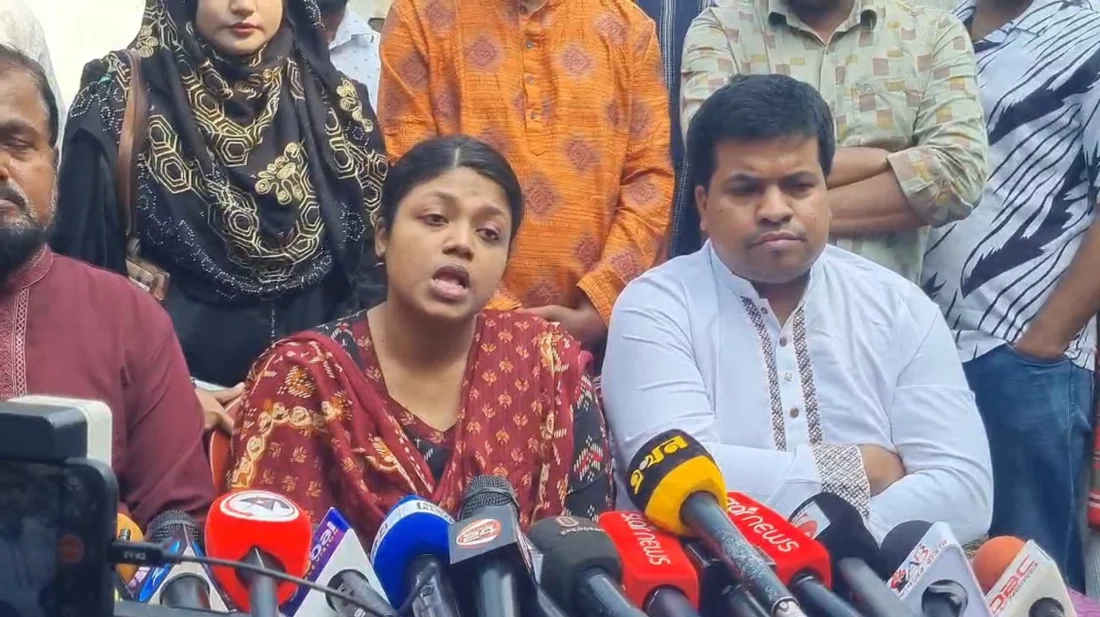
Speaking at a press conference in front of the damaged house on Thursday, Tabassum described the attack as “pre-planned” and directly blamed the Awami League.
She claimed that approximately three hours before the incident, the president of the Kushtia district unit of Chhatra League had posted a threatening message on Facebook. Around 12:15 am, successive explosions were heard at the house. “Looking at the nature of the blasts, it appears petrol bombs were thrown,” she said. Of the 10 rooms in the tin-shed building, seven were completely burnt. Two goats and several chickens also died. At the time, her caretaker and his family occupied the house.
Tabassum further alleged that she had been receiving threats from multiple phone numbers beforehand and that law-enforcement agencies failed to collect any evidence even 12 hours after the incident. A team from the Criminal Investigation Department (CID) arrived at the scene on Thursday afternoon and began an investigation. She said she would file a case at Daulatpur police station.
Bangladesh Jamaat-e-Islami issued a strong condemnation of the attack, calling a midnight petrol-bomb assault on a sitting MP’s village home “extremely reprehensible, cowardly and alarming.” The party said such terrorist acts are unacceptable and have deepened public concern over law and order and citizens’ security. It demanded an immediate impartial investigation, identification of the perpetrators, and exemplary punishment.
In Parliament and on social media, NCP Convenor and Opposition Chief Whip Nahid Islam has repeatedly accused “fallen fascist forces” of carrying out secret attacks. On Tuesday he told the House that buses were being set on fire, a person had been killed, Dhaka University National Student Power president and July uprising coordinator Hasib Al Islam had been attacked in Moulvibazar, cocktail bombs had exploded at Dhaka University, and a BNP office had been vandalised. On Thursday he wrote on his verified Facebook page that the “fallen terrorist fascist force” was specifically targeting leaders and stakeholders of the July Revolution, and warned others that they would be attacked next.
Nahid further claimed that the “fascist Awami League is not an indigenous force” and is operating with “shelter, patronage and instigation from Delhi,” conducting sabotage inside the country before crossing the border to take refuge.
Home Minister Salahuddin Ahmed of the BNP, speaking in Parliament on Wednesday, called for sustained national unity among the ruling party, the opposition, and parties outside Parliament to confront the “fallen fascist forces and their conspiracies.” He said various quarters were trying to create instability in Bangladesh by issuing programmes from across the border under different names—sometimes religious, sometimes hartal, sometimes other labels—with the sole aim of generating unrest.
Opposition Leader Dr Shafiqur Rahman of Jamaat-e-Islami welcomed the Home Minister’s appeal, recalling the unity forged in 2024 against fascism and urging that the same national consensus be used both to advance a democratic future and to prevent the resurgence of fascist forces through concrete action rather than statements alone.
Since the circulation last week of news that Sheikh Hasina was attempting to recover her passport and NID through a London-based legal chamber, both the BNP government and the Jamaat-NCP opposition have consistently attributed every major incident of arson, bombing, and targeted violence to the Awami League and its affiliated organisations. The pattern has been widely interpreted by AL loyalists and some independent observers as a deliberate political strategy to reinforce the narrative that the party remains a terrorist entity, thereby legitimising the ongoing ban on its activities under the Anti-Terrorism Act.