

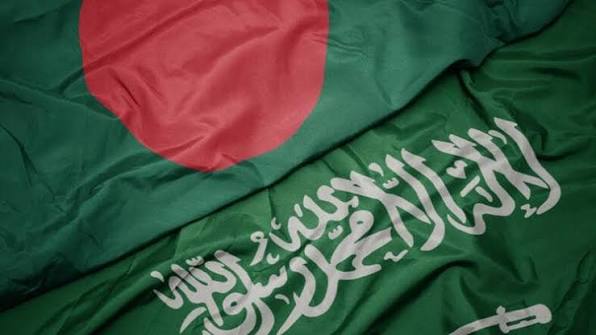
Bangladesh has strongly condemned the Houthi attack on a tower in the King Abdullah Financial District (KAFD) in Riyadh.
In a statement issued Friday by the Ministry of Foreign Affairs, the government described attacks on civilian and economic infrastructure as unacceptable and a serious threat to regional peace, security, and stability. It said such acts undermine efforts to reduce tensions.
Bangladesh expressed full solidarity with the Saudi government and the brotherly Saudi people, and reaffirmed its support for the Kingdom’s sovereignty, security, and territorial integrity. It called for an immediate halt to these hostile actions to prevent further deterioration of the situation.
Bangladesh–Saudi relations and related policy
Bangladesh and Saudi Arabia maintain close ties rooted in shared Sunni Muslim identity, membership in the Organisation of Islamic Cooperation (OIC), large-scale labour migration, and religious pilgrimage. Saudi Arabia hosts roughly 3–3.5 million Bangladeshi workers and is a major source of remittances for Dhaka. Bangladesh is also a significant source of Hajj and Umrah pilgrims. These economic and religious links have long shaped Dhaka’s consistent support for Saudi positions on regional security issues.
Bangladesh is an overwhelmingly Sunni-majority country. The Houthis are a Zaydi Shia movement (a distinct branch of Shia Islam) based in Yemen and aligned with Iran. Dhaka has repeatedly condemned Houthi attacks on Saudi targets, including a deadly strike on King Khalid International Airport on 10 October 2026 that killed two Bangladeshi nationals and injured many others.
Earlier in 2026, Bangladesh joined a Saudi-led multinational maritime coalition aimed at protecting shipping through the Red Sea, Bab el-Mandeb, and Gulf of Aden amid Houthi disruptions—marking a more direct involvement in regional maritime security than in previous years. These steps reflect both economic self-interest (protection of trade routes and the large Bangladeshi expatriate community) and alignment with the broader Sunni Gulf position against Iran-backed groups.
Recently, anti-Saudi protests were high after Saudi Arabia executed two Bangladeshis, triggering condemnation over the manpower-importing country’s judicial system. Every year, hundreds of women workers return to Bangladesh after denying justice in incidents of gang-rape and other forms of torture in Saudi Arabia.
On the defence front, Bangladesh has expressed clear interest in the Mecca (Makkah) Joint Defence Agreement, a mutual-defence pact signed in Mecca on 7 August 2026 by Saudi Arabia, Turkey, and Pakistan. The agreement includes an Article 5-style clause under which an attack on one member is treated as an attack on all. Senior Bangladeshi officials, including the foreign minister and state minister for foreign affairs, have stated that Dhaka views the pact positively and would consider joining if formally invited, describing it as an internal matter of the “Muslim family.”
As of mid-November 2026, however, Bangladesh has not received a formal invitation and remains outside the pact, while continuing discussions with Saudi and Turkish counterparts. Prime Minister Tarique Rahman has also accepted an invitation to visit Saudi Arabia.
Bangladesh’s stance is consistent with its broader interest in regional stability that protects trade, energy routes, and the welfare of its overseas workers, while maintaining its traditional balancing of relations with major powers.