


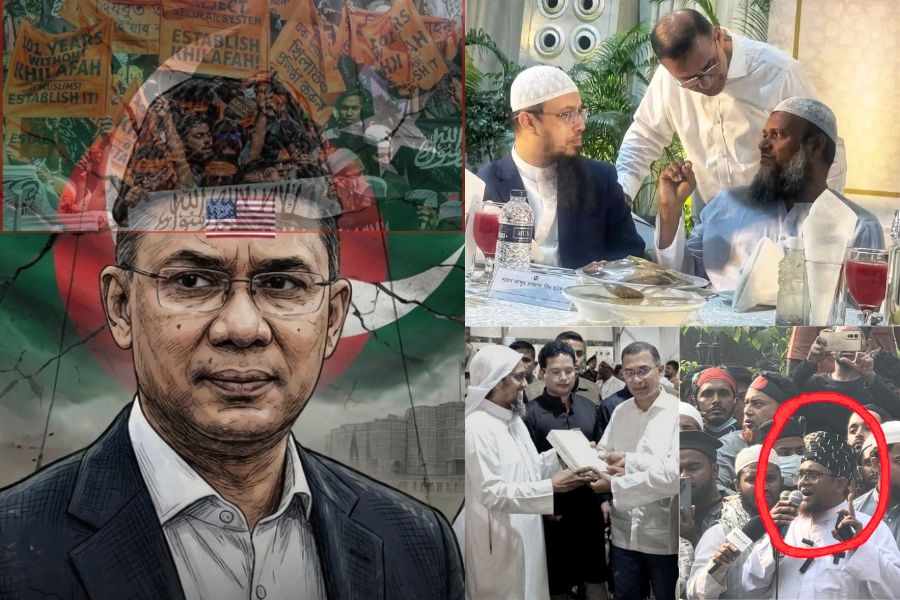
By Probir Kumar Sarker The BNP government under Prime Minister Tarique Rahman has systematically elevated Islamic religious authority, channeling state resources toward imams, khatibs, and conservative clerical networks. This is accelerating a shift away from Bangladesh’s traditional secular and pluralistic social fabric toward stricter interpretations that restrict liberal norms on gender mixing, education, and personal freedoms.
A clear illustration is the role of Mufti Abdul Malek, Khatib of the Baitul Mukarram National Mosque. Appointed on 18 October 2024—two months after the fall of the secular Awami League government—he has used Friday pre-khutba addresses to declare coeducation of boys and girls na-jaiz (impermissible) under Shariah. He has stated that if the government introduced fully separate education for males and females in all institutions, it would be a major virtuous act. His sermon also attacked “Western obscenities,” transgender ideas, homosexuality, smartphones as tools of zina, and any mixing of non-mahram men and women, framing gender mixing itself as a threat to faith and social purity.
Notably, the national mosque’s khatib uttered not a single word against the rising rape of madrasa boys and girls, triggering social outcry. Under his tenure, the banned militant outfit Hizb ut-Tahrir has carried out rallies and processions at Baitul Mukarram, while Islamist parties and groups have rejected proposals for women’s development reforms. His appointment, followed by the open demand for a complete ban on coeducation, shows how Islamist voices are now pushing gender segregation as a potential state policy rather than private preference. Since the fall of the Awami League, armed militant groups and fundamentalist forces have expanded their influence in administration and society.
This occurs against a backdrop of active government patronage of the mosque system. The BNP administration has rolled out monthly honorariums for imams, muezzins, and khadems (with pilot schemes covering thousands of mosques) and is expanding mosque-based moral education programs. Prime Minister Tarique Rahman has said the goal is to turn mosques into centers of religious, social, and moral education and to include imams or khatibs in law-and-order committees. BNP leaders have declared that no law contradicting the Quran and Sunnah will remain, and that “Absolute Trust and Faith in Almighty Allah” will be restored as a core constitutional principle in place of secularism.
Hardline Islamist forces treat the separation of male and female students as a religious duty that overrides practical educational needs. In Afghanistan under Taliban rule, coeducation is banned outright, male teachers are barred from teaching girls, and girls have been blocked from secondary school and university. Saudi Arabia requires gender segregation in public schools; Iran maintains segregation through the secondary level. Most other Muslim-majority countries permit coeducation, especially at university level, with full bans remaining rare. Bangladesh’s top national-mosque cleric, installed shortly after the secular government’s collapse, is advancing the same restrictive logic, calling on the state to impose single-sex schooling across all institutions.
Critics observe that this pattern aligns with BNP’s historical alliances with Islamist parties and its preference for an Islamic-infused “Bangladeshi nationalism.” Party leaders have stated that secularism is not the goal and is unsuitable for a Muslim-majority society. While the government speaks of multi-religious harmony and includes leaders of other faiths in honorarium schemes, the combination of constitutional Islamic prioritization, state-supported mosque networks, and hardline clerical rhetoric from the national mosque creates space for social policing and intolerance.
Bangladesh’s traditional practices of coeducation and relatively open cultural expression are under pressure from state-enabled conservative networks. By appointing and platforming hardline figures who demand bans on mixed education while subsidizing the broader clerical class, the BNP government is reshaping the public sphere in ways that privilege restrictive religious rules over the pluralistic traditions long associated with the country’s founding principles. The risk is further polarization and the normalization of controls that limit women’s and girls’ educational access and individual freedoms.
Probir Kumar Sarker is an author and senior journalist.