


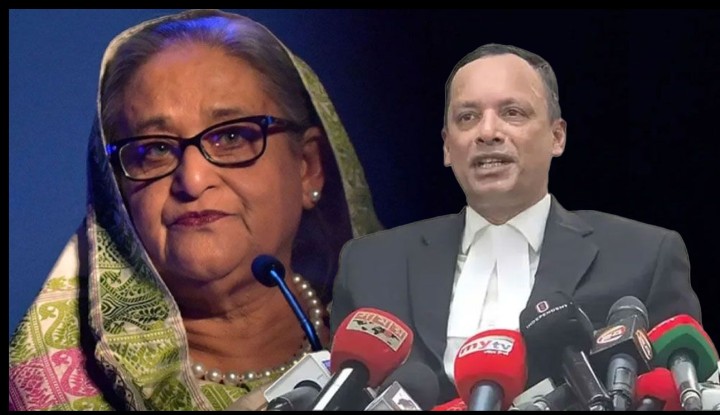
Attorney General Barrister Md. Ruhul Quddus Kajol said on Wednesday that if the death-sentenced former prime minister Sheikh Hasina wants to return to Bangladesh, she must do so by following the law.
He added that she cannot file an appeal, a position he said is clear from the Abul Kalam Azad (Bachchu Razakar) case.
Speaking to reporters at his office in the Supreme Court about the possibility of an appeal against her death sentence in the crimes against humanity case, Kajol stressed that the law is the same for everyone. For convicts sentenced to death by the International Crimes Tribunal (ICT), the rules are explicit: once the prescribed time limit expires, there is no scope to file an appeal in the Supreme Court. He pointed to the Abul Kalam Azad case as a clear precedent of the consequences of attempting a late appeal.
On the process of Hasina’s return, the Attorney General said previous legal explanations on the matter have been consistent and have not involved misinterpretation. “Everyone has spoken according to the law and in one voice. The State Minister for Foreign Affairs has clarified the government’s position, the ICT prosecutor has spoken, and the Indian Foreign Secretary’s statement has also appeared in the media. I believe this is a matter of law and international relations, and the government has already explained it. There is no room for smoke screens, misinterpretation, or alternative explanations.”
He emphasised that responsible figures have spoken correctly on legal grounds and in light of bilateral and international relations.
Referring to past precedent on delayed appeals, Kajol noted that the law applies equally. A person sentenced to death by the ICT previously filed an appeal in the Appellate Division after the time limit had passed and sought a stay on the tribunal’s order. The Supreme Court examined the issue of condonation of delay but, after a prolonged hearing, did not accept the arguments. The Abul Kalam Azad case remains the clearest illustration of what happens when an appeal is filed after the statutory period.
When asked how Hasina should return if she wishes to come back now, Kajol replied: “I will not explain how she will return. I can only speak of the law. She is a convict sentenced to death by hanging and is currently not in Bangladesh. If she decides to surrender herself before the law, she may come. But she must obey the law. For a death-sentenced accused, the law is very clear.”
Related developments from the past few days
The Attorney General’s remarks follow a series of statements and actions linked to Hasina’s stated intention to return in December.
On 9 November, lawyers from the London-based Matrix Chambers wrote to the Bangladesh High Commission in New Delhi requesting a new passport and National Identity Card (NID) for Hasina, citing the reported revocation of her existing documents by the interim government and her Bangladeshi nationality. Bangladesh swiftly rejected the request. State Minister for Foreign Affairs Humaiun Kobir said the country “does not issue passports to terrorists” and described Hasina as a fugitive criminal. He insisted that any return should occur through the India-Bangladesh extradition treaty rather than as an ordinary traveller, and that Dhaka wants her handed over under that treaty.
On 10 November, ICT Chief Prosecutor Md Aminul Islam said Hasina has no remaining legal option but to face execution of the death sentence if she returns. He stated that the 30-day window to appeal the November 2025 ICT verdict (on crimes against humanity linked to the 2024 crackdown) has expired, the Limitation Act does not apply to the special tribunal law, and no appeal can now be admitted. He also rejected claims that further hearings are required before a death sentence from the tribunal can be carried out. On the path of return, he advised that if Hasina genuinely wants to come back, she should make a written request to the Indian government seeking her return under the extradition treaty.
India has treated the extradition request as a legal matter to be handled accordingly and has noted that a travel document would be required for any movement, while declining detailed comment on the passport request. Hasina has been in India since fleeing Bangladesh in August 2024. She was sentenced to death in absentia in November 2025; the full judgment was published in January 2026. She has denied the charges, questioned the legitimacy of the proceedings, and previously indicated plans to return in December.
The Attorney General’s comments on 11 November align with the consistent official position that the appeal deadline has lapsed and that any return must occur through established legal and extradition channels.