


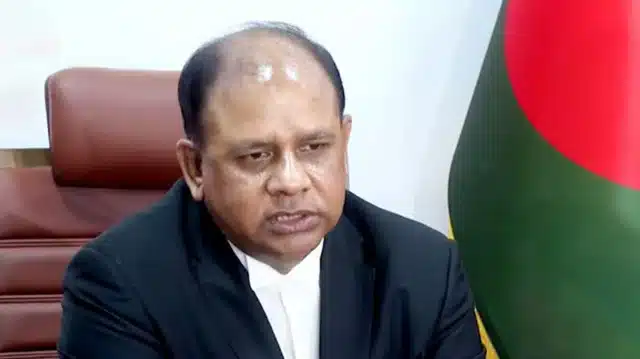
Chief Prosecutor of the International Crimes Tribunal (ICT-BD), Md. Aminul Islam, has said that if Sheikh Hasina genuinely wants to return to Bangladesh, she must submit a written application to the Indian government requesting her return under the extradition treaty. This is the proper and lawful way for her to come back.
He made the remarks at a briefing held at the ICT premises on Tuesday (10 November).
Aminul Islam stated: “If Sheikh Hasina truly wants to come to Bangladesh, she herself must make a written application to the Indian government asking that she be returned to Bangladesh under the extradition treaty.”
He added that he is not aware of any such written application having been made to the Indian government. He also expressed doubt about whether various audio statements attributed to her are actually authentic.
Referring to a Reuters report that a letter was sent to the Bangladesh High Commission in Delhi on behalf of Sheikh Hasina requesting a new passport and national identity card, the Chief Prosecutor said that under the law, a convicted person cannot be issued a passport.
Explaining the Passport Act, he said that if a person has been sentenced to imprisonment for at least two years within the five years preceding a passport application, a passport cannot be issued. There is also a provision to seize the passport of a person convicted of an offence involving moral turpitude.
Aminul Islam noted that former Prime Minister Sheikh Hasina has been sentenced to death by the International Crimes Tribunal for crimes against humanity. Such offences are legally regarded as crimes of moral turpitude. As a convicted person, the passport authorities therefore have no jurisdiction to issue her a passport.
He further stated that under the Passport Act, a person sentenced to two years or more cannot be given a passport. Consequently, there is no legal scope for the Bangladesh government to issue a passport to the fugitive and convicted Sheikh Hasina.
The Chief Prosecutor said Sheikh Hasina has been living as a fugitive even before her conviction. Arrest warrants have been issued against her, and notices have been published in newspapers. She has deliberately avoided the judicial process.
Pointing out that she did not file an appeal after the verdict was published, Aminul Islam said the law allows 30 days from the publication of the verdict to file an appeal. Since she did not do so within that period, she no longer has any legal opportunity to appeal.
He questioned how the Bangladesh government could issue a passport to a person sentenced to death, saying that doing so—or issuing a travel pass—would amount to making a mockery of the justice system.
The Chief Prosecutor also raised questions about Sheikh Hasina’s sincerity in wanting to return. He said that if she had truly intended to come back, she would have returned during the trial to face the charges. She also had the opportunity to appeal within 30 days of the verdict’s publication.
He remarked: “If she had a genuine desire to return, she would have appealed within 30 days of the verdict. Instead, we sometimes hear that she will suddenly enter the country, sometimes that she will come by chartered plane with her leaders and workers, and sometimes that she will arrive via the Padma Bridge with thousands of cars.”
He observed that some Awami League activists, influenced by such statements, are attempting to create political unrest in different places. “Hearing these things, some unwise or foolish Awami League workers are trying to create political instability in various areas. Those doing this are using Sheikh Hasina’s name as a vested quarter to carry out activities aimed at political instability.”
Aminul Islam also questioned whether Sheikh Hasina is being used as a tool to create political unrest—whether these activities are being carried out for any special purpose, whether she is being used as a “trump card” in the interest of certain quarters, or whether any vested group within her party is trying to create political instability.
Referring to the enforcement of the death sentence, he said the law provides that an appeal is not admissible after 30 days from the publication of the verdict. In Sheikh Hasina’s case, there is now no option other than the execution of the sentence.