


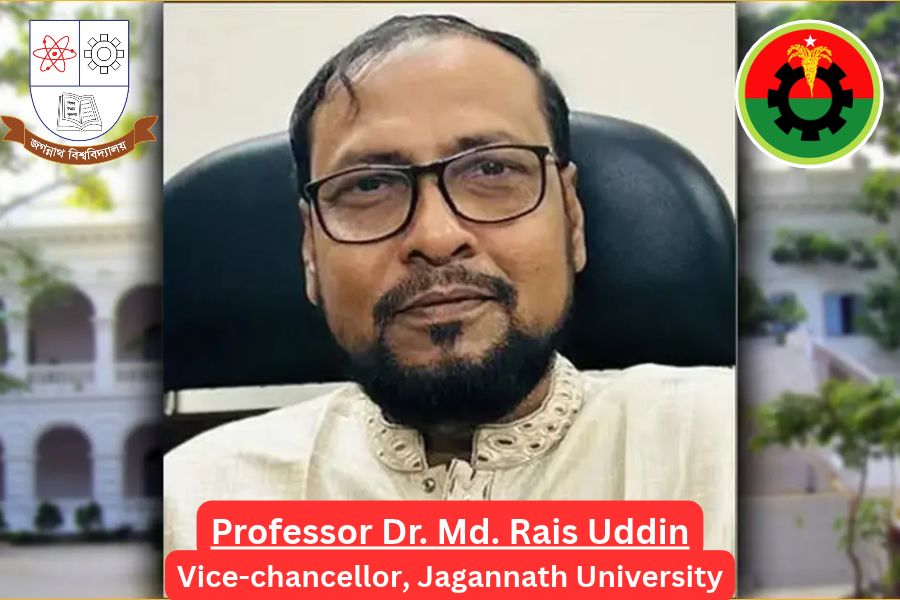
Jagannath University (JnU) Vice-Chancellor Professor Md. Rais Uddin has publicly stated that he holds the post because the Bangladesh Nationalist Party (BNP) is in power.BNP
Speaking on Friday (20 November) at a doa mahfil organised by the university unit of the University Teachers Association of Bangladesh (UTAB) at the campus central mosque after Jumma prayers, he declared: “I became Vice-Chancellor because the BNP is in power. What is there to hide? There is nothing to hide about one’s identity or self-identity.”
He addressed being tagged as a “BNP Vice-Chancellor,” saying there was no reason to conceal affiliations.
Prof. Rais Uddin, chairman of the Islamic Studies Department, president of the JnU Teachers’ Association and linked to the pro-BNP Sada Dal (White Panel), was appointed earlier this year by the BNP-led government after it assumed office.
He is one of multiple VCs across public universities with clear ties to BNP-aligned teachers’ organisations.
This pattern continues the politicisation and nepotistic leanings seen under the preceding Muhammad Yunus-led interim government. A December 2024 investigation found that at least 30 of 47 VCs (and many pro-VCs and treasurers) appointed during that period had links to pro-BNP or pro-Jamaat teachers’ organisations.
The interim authorities preferred such affiliations while sidelining others, and the BNP government has largely sustained and expanded this approach: reports indicate that of around 20 VCs appointed under BNP rule, the large majority (often cited as 19) are affiliated with BNP-backed groups such as UTAB, Sada Dal or related forums.
In several cases, appointments bypassed standard search committee processes. Education officials have denied pure partisanship, but the affiliations and the VC’s own admission make the continuity clear.
Rais Uddin defended his political identity by referencing the Awami League’s long rule, claimed the 2024 uprising restored freedoms, and urged prayers for Prime Minister Tarique Rahman’s long life and health as a civic duty for those who love the country.
He warned against repeating “fascist” practices and noted recent incidents of violence.
Under his administration, campus tensions have persisted amid allegations of inaction or selective response.
On 16 November 2026, activists of Jatiyatabadi Chhatra Dal (JCD, BNP’s student wing) and Chhatra Shakti (National Citizen Party’s student front) beat five university officials over alleged links to the banned Awami League and Chhatra League, then handed them to the proctor.
The officials included Himadri Shekhar Mondal (deputy director, Controller of Examinations), Sanjay Kumar Pal (deputy director, Finance and Accounts), Junaid Hossain (assistant registrar, Film and Television), Nurul Huda (section officer, Registrar’s Office) and Saidur Rahman Roni (deputy registrar).
A Bangla department teacher was also harassed over a portrait of Sheikh Mujibur Rahman. The university later suspended the five on the basis of “preliminary findings” of AL links, with Rais Uddin confirming the move and a probe.
Earlier, in October 2026 around Durga Puja, Islamist-linked student groups organised provocative “beef feasts.” Students from the Islamic History and Culture department cooked beef khichuri near the campus Muktamancha, close to the central Hindu temple; Hindu students objected, alleging bricks from the temple site were used.
After an initial administration notice restricting animal slaughter on hygiene grounds, groups including those tied to Islami Chhatra Shibir (Jamaat-e-Islami) and Khelafat Chhatra Majlis held cow-slaughter events and distributed beef, framed as protests. The administration clarified students could hold such events if they did not disrupt others, drawing criticism for failing to prevent communal tension near the temple.
Separately, reports and viral footage have documented Islamist student groups (linked to Jamaat and ) distributing copies of the Quran on campus, including to female students reported as Hindu. The university has hosted free Quran education initiatives by such groups.
Critics have pointed to the VC’s inaction in addressing these activities, which occurred amid broader campus Islamist mobilisation.
Rais Uddin’s open acknowledgment of political appointment, set against the continuity from the Yunus interim period and these campus incidents, highlights the entrenched politicisation of public university leadership in Bangladesh.