

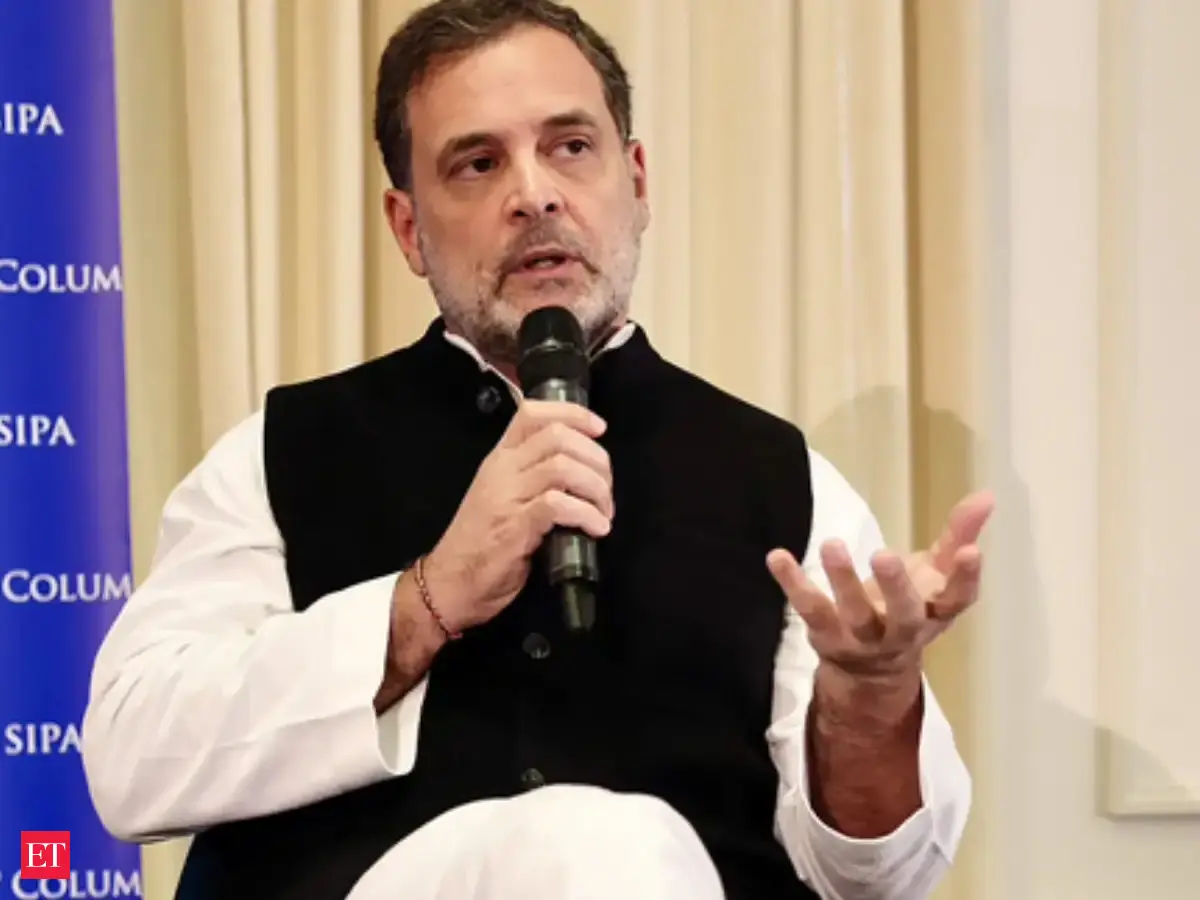
A fresh political confrontation erupted after Leader of the Opposition Rahul Gandhi’s comments on India’s economy at Columbia University in New York, with the Bharatiya Janata Party (BJP) labelling him the “Mir Jafar of India” and accusing him of deliberately defaming the country abroad.
Congress leaders defended the remarks as a reflection of ground realities and accused the government of focusing on “perception management.”
On November 17, during a fireside chat at Columbia University’s School of International and Public Affairs (SIPA), moderated by New York Times journalist Lydia Polgreen, Gandhi said India was “sitting on an economic disaster.”
He pointed to massive unemployment, deep problems in the education system, a struggling manufacturing sector, and what he described as a broken economic “spine” of small and medium enterprises and agriculture. Gandhi criticised initiatives such as Make in India and Start-up India, claimed growth was concentrated in a few large business groups (specifically naming Adani and Ambani), and said young Indians increasingly see no clear future for themselves.
He expressed optimism about India but warned that continuing on the current path could lead to serious trouble in the coming years.
BJP’s Response and the ‘Mir Jafar’ Label
The next day, BJP national spokesperson Gaurav Bhatia addressed a press conference in Delhi and sharply attacked Gandhi. He called him “immature, anti-India, and the ‘Mir Jafar’ of India,” accusing him of a pattern of making baseless, propagandist statements on foreign soil to damage India’s image.
Bhatia alleged that Gandhi travels abroad before every Parliament session with a “sinister design” and “evil conspiracy” against India’s democracy, and that he seeks guidance from “foreign masters” such as George Soros or takes “dictation” from US politician Ilhan Omar. He claimed Gandhi was trying to emulate models from Bangladesh, Nepal, and Sri Lanka to destabilise India. Bhatia highlighted India’s reported strong growth (citing figures around 7.8%) and progress under Prime Minister Narendra Modi over the past 12 years, contrasting it with Gandhi’s description of an “economic disaster.”
Other BJP voices reinforced the attack. National spokesperson Pradeep Bhandari called Gandhi the “leader of anti-India propaganda,” while CR Kesavan spoke of a “pernicious pattern” of tarnishing India’s image abroad. Union Minister Pralhad Joshi also commented on Gandhi’s frequent overseas travel.
Mir Jafar was the 18th-century Nawab of Bengal who betrayed Siraj-ud-Daulah at the Battle of Plassey in 1757, facilitating British control. In Indian political discourse, the name is used as a synonym for traitor or betrayer. This is not the first time BJP leaders have applied the label to Gandhi; in March 2023, spokesperson Sambit Patra called him a “present-day Mir Jafar” after remarks made in London.
Congress and Opposition Reactions
Congress leaders rejected the charge and defended Gandhi. Pawan Khera accused the government of prioritising “perception management” over addressing economic problems. He said: “The economy is in a bad state, but the government isn’t bothered by it. If Rahul Gandhi speaks about the economy being in a poor condition, it creates a problem. The administration has an even bigger issue with Rahul Gandhi speaking and others listening. Improving the economy is not a priority for them at all.” Khera further alleged the government focuses on suppressing facts and issuing “clean chits.”
Rajya Sabha MP Pramod Tiwari and Lok Sabha MP Amar Singh also backed Gandhi, arguing that his points on unemployment, inflation, job creation, and the education system match what he has said inside India and in Parliament, and that these reflect the lived experience of ordinary citizens.
The exchange underscores a recurring pattern in which BJP leaders frame Gandhi’s overseas critiques as anti-national, while Congress maintains that raising concerns about jobs, manufacturing, inequality, and governance is legitimate democratic opposition.
India’s official growth numbers remain strong by global standards, yet debates continue over job quality, manufacturing strength, youth unemployment, and the distribution of gains.
The controversy has been widely covered across Indian media and has drawn attention on social platforms, with both sides amplifying their positions. No immediate formal response from Rahul Gandhi himself to the “Mir Jafar” label was reported in the initial coverage.