


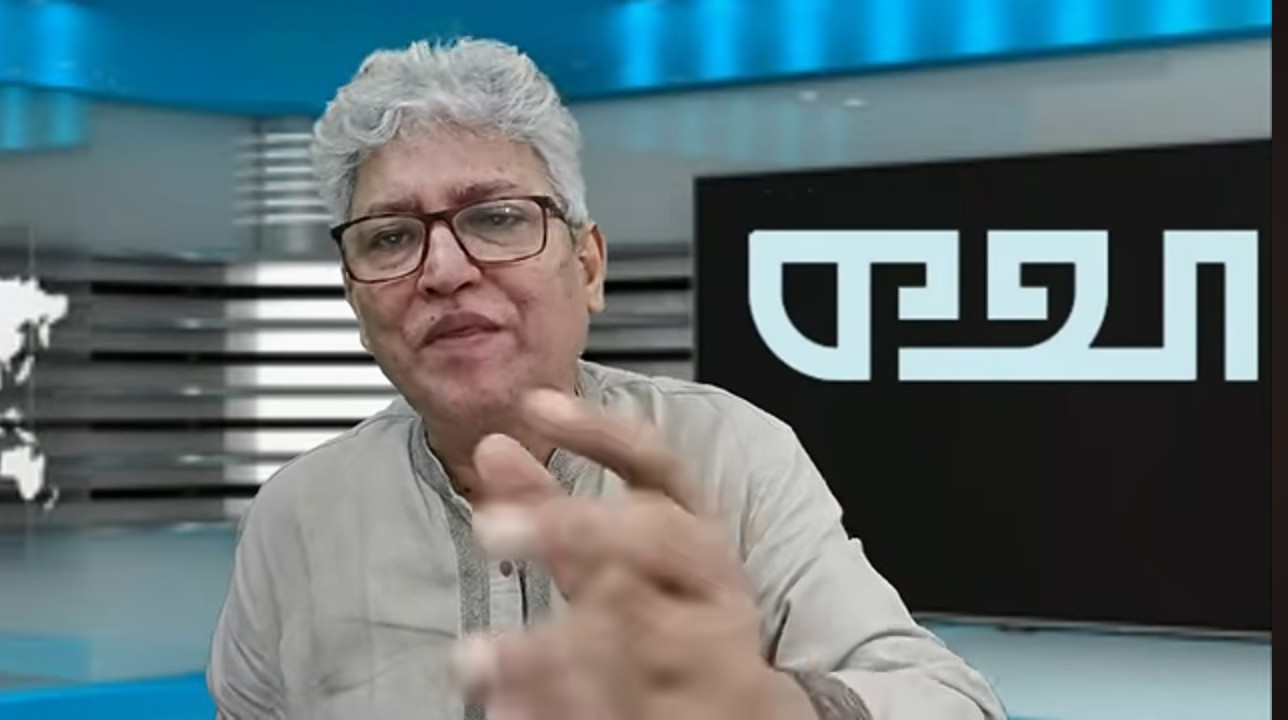
In a pointed commentary on his YouTube channel Kotha, senior journalist Masood Kamal urged Prime Minister Tarique Rahman and State Minister for Foreign Affairs Humayun Kabir to engage in self-reflection amid the ongoing unrest, particularly in Gopalganj.
He argued that the current political crisis requires consistent application of the rule of law rather than selective outrage or mockery of slogans.
Kamal began by acknowledging the recent violence that erupted in Gopalganj, the home district of ousted former Prime Minister Sheikh Hasina. Over the past few days, clashes involving supporters of the banned Awami League and its affiliates have included attacks on police stations, arson, and vandalism, with some incidents reportedly involving the chanting of “Joy Bangla.” He noted the Inspector General of Police’s visit and meetings in the area, praising language that emphasized working with the public to address the situation. “This is what I have been saying repeatedly,” he said. “Problems will arise, and some miscreants will be involved, but how you control them matters. If you respond with the same kind of aggression from a position of power, solutions will not come.”
He described the unrest as fundamentally a political problem and political crisis that must be handled politically. While praising the government’s overall approach so far—beyond isolated statements—he sharply criticized certain ministers, singling out Humayun Kabir. Kamal questioned the state minister’s grasp of sensitive issues, particularly after Kabir, responding to a petrol bomb attack near his residence in Sylhet, stated that banned Awami League activists were committing arson and violence while shouting “Joy Bangla” and fleeing, and sarcastically remarked that even a cat stands longer than they do when running. Kabir described “Joy Bangla” as having become a slogan for fleeing terrorists.
Kamal called this mockery counterproductive and historically tone-deaf. He pointed out that during the 1971 Liberation War, freedom fighters also used the “Joy Bangla” slogan while retreating from positions under fire. “Mocking the slogan by linking it to one incident is meaningless,” he said. “By doing so, are you applying a soothing balm to the hearts of those who love the slogan, or are you igniting a fire? If you ignite fire, will the outcome be better?” He stressed that “Joy Bangla” is tied to the birth of Bangladesh and that ridiculing it achieves nothing except spreading vengeance.
Turning to the broader pattern of violence, Kamal cited a Prothom Alo report on attacks, vandalism, and arson targeting homes and businesses of 15 Awami League leaders across five districts, including Patuakhali, Mymensingh, Chattogram, Feni, and Rajshahi. He listed specific cases such as the residences of Patuakhali district Awami League president Kazi Alamgir, central organising secretary Afzal Hossain, and others; the destruction of markets linked to Mymensingh leaders; attacks on properties of Chattogram and Feni leaders; and the home of former foreign state minister Shahriar Alam in Rajshahi. Additional incidents involved homes of Swechchhasebak League and Jubo League leaders in Dhaka, as well as properties in Barishal and Gazipur.
“Who carried out these attacks?” Kamal asked. “If the same people who shout ‘Joy Bangla’ and run away did them, why couldn’t they be caught? Or were they done openly by others?” He argued that arson, looting, and vandalism remain crimes regardless of the political identity of the perpetrators. Even assuming the targets had committed serious offenses, burning their homes, looting their properties, and terrorizing their families is not lawful. “Fire looks the same whether set at your house or mine. Setting fire is the crime. Who does it is secondary for the purpose of determining the offense.”
Kamal maintained that the state’s responsibility is to bring criminals from both sides under the law. Selective focus only on Awami League-linked violence, while attacks on its leaders’ properties go unaddressed, undermines public support. “If you cannot stop these, why only complain about the others and label those groups as terrorist organisations? If you pursue justice in all cases, the public will stand with you. When your people do more of the same, you lower yourself to the same level.”
He called for a clear statement from the government that criminals have no political identity, backed by action. Incidents of individuals taking the law into their own hands—such as humiliating or assaulting a Jubo Dal leader—must also be stopped, as they constitute crimes. Addressing Prime Minister Tarique Rahman, who has pledged to establish the rule of law, Kamal noted that nine months have passed since the government took office.
“Do it first in your own house. Once you do that, the public will help you with the rest. There is no gain in blaming others for what you have not done at home.”
Kamal concluded by reiterating that the unrest is a political crisis best handled through consistent, evidence-based law enforcement and political maturity rather than rhetoric that alienates segments of the population. The commentary comes as violence linked to the banned Awami League’s lockdown programmes continues in multiple districts, prompting heavy security deployments.