


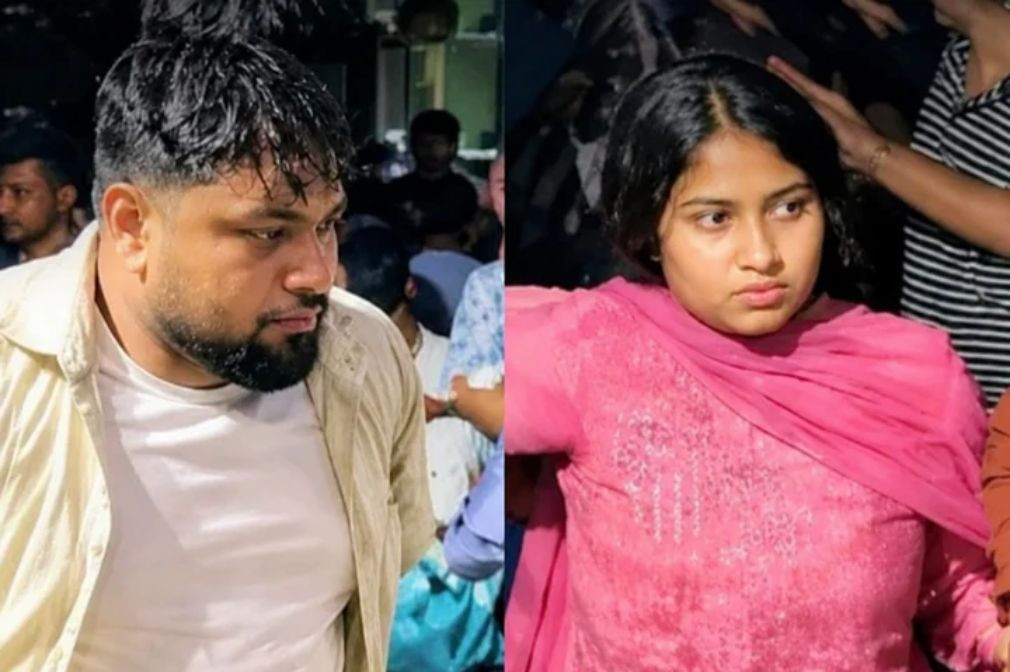
Police in Feni arrested atheist content creator and writer Anwar Hossain Parvez, known online as Lihon Prime (or Nihon Prime), and his wife Mahin Istiaz Jahan Tithi after a mob of local religious hardliners gathered outside their residence, assaulted him, and later attacked the police vehicle transporting the couple.
Two police officers were injured and the vehicle’s front section was damaged in the attack on the night of November 17.
The couple lived on the 16th floor of Garden City on College Road.
According to police and local sources, Parvez had posted on Facebook under the name Lihon Prime on topics including science, psychology, evolution, rationalism, and criticism of superstition.
One recent post cited scientific literature noting higher bacterial counts in human beards than in dog fur—material that locals and religious groups treated as an insult to Islam.
Around 9:30–10:00 p.m., 20–30 or more people surrounded the building. Police responded, detained the couple, and faced a crowd that assaulted Parvez with sticks as he was brought out, then hurled bricks, stones, and eggs at the police vehicle in an attempt to snatch him.
Female constable Bhanu Das (45) and constable Tarikul Islam (32) of Feni Model Police Station were injured and treated at Feni General Hospital. Officer-in-Charge Md Aminul Islam and other officers confirmed the sequence.
A case was filed under the Cyber Security Act and Penal Code sections for alleged religious defamation/derogatory remarks. The couple was produced in court on November 18 and sent to jail (Ranirhat) pending further investigation.
A separate general diary was opened for the attack on the police vehicle. Faces of some assailants were obscured in circulating video, while the victims’ images were not.
Writings and the Real Accusation
Parvez, who has used the alias for years (reportedly changing it under pressure), produces content on science, psychology, and the rejection of blind faith. He has been described by supporters as a science-minded rationalist who challenges superstition. Accusers framed the issue differently.
In on-the-ground interviews captured in commentary circulating after the attack, local voices stated the core complaint: he does not believe in Islam, does “Islam-hating work,” “manipulates Muslim families toward atheism,” and writes “disorderly” and anti-Islamic things on Facebook.
No evidence of pornography or other criminal production has been substantiated in available reports; the trigger remains his public non-belief and rationalist commentary.
This is classic apostasy (murtad) framing. Classical Islamic jurisprudence, drawing on certain hadith collections, prescribes death for an adult male Muslim who leaves the faith and does not recant—though the Quran itself does not explicitly mandate worldly execution for peaceful apostasy.
Mufti Imran bin Bashir, a former Hafiz, Maulana, Mufti, and imam from Chandpur who later left Islam after years of textual study and now lives in exile, has repeatedly described the mechanism: “Even expressing slight doubt about Islam meant you could be labeled a murtad—an apostate. And in Islamic law, the punishment for apostasy is death.”
He recounted family members being told it was their duty to kill him, fatwas circulating, and mobs mobilizing once screenshots labeled him an apostate.
“I didn’t leave Islam. Islam left me. I tried to understand and accept it rationally, but Islam does not tolerate reason,” he has said.
Friends and clerics told him the only punishment for “insulting the Prophet” or leaving was death, with no repentance accepted in this life.
Hypocrisy of the Touhidi Janata
Groups operating under the informal banner of Touhidi (monotheistic masses) have been the primary vehicle for such mobilizations since the August 5, 2024 fall of the Sheikh Hasina government. In this case, slogans reportedly included that there would be “no place for atheists in this Bengal.”
The same networks attack police vehicles when officers intervene, then later insist Islam is the “religion of peace” with no compulsion in religion—citing Meccan-period verses while ignoring Medinan ones and hadith on apostasy, conquest, and the treatment of non-believers.
They seek medical care, technology, education, and asylum in Europe and North America while demanding that freethinkers, former Muslims, Bauls, Sufis, and minorities have no right to exist in Bangladesh.
As the circulating commentary noted, Muslims who leave after studying the texts are counted demographically as Muslim until they publicly exit; once they do, they become targets. Mufti Imran has observed that the same texts that romanticize jihad and prescribe death for rejection are followed by those who then claim critics are merely “Islamophobic.”
Pattern Since August 2024 and Government Silence
Since August 2024, dozens of people have been lynched or burned over alleged blasphemy or religious insult. Documented cases include the December 2025 burning of Hindu garment worker Dipu Chandra Das in Mymensingh after he was beaten and hanged; the October 2026 killing of Wahiduzzaman Shamim in Satkhira; attacks on shrines (nearly 100 documented in some reports, with bodies exhumed and burned in places such as Rajbari); assaults on Baul gatherings; and repeated targeting of freethinkers and minorities.
Human rights monitors have recorded hundreds of mob-violence incidents, with limited arrests of perpetrators relative to the scale of attacks. Police often arrive after the fact or are themselves assaulted. Cases against the accused freethinkers or minorities proceed far more readily than cases against the mobs.
Successive administrations—the interim government and the subsequent elected one—have issued occasional condemnations but have not dismantled the impunity. Political actors across parties have at times coordinated with or deferred to Tawhidi Janata mobilizations against cultural events, Urs observances, and individuals. Constitutional Article 39 guarantees freedom of thought, conscience, and speech; belief and non-belief are personal. In practice, non-belief by those born into Muslim families is treated as a capital offense by the street, with the state frequently detaining the threatened party rather than the mob.
Mufti Imran bin Bashir has asked the obvious question in prior commentary on similar killings: if Islam does not support this extremism, why are the extremists not prosecuted, and why do large numbers of Muslims celebrate or defend the violence in comments and on the ground? If the texts do support it—as classical rulings on apostasy indicate—then the claim that “Islam is peace” and that only a fringe is responsible is false. Either the state implements the religion’s classical penalties or it protects citizens under the constitution. It has done neither consistently since August 2024.
Parvez and Tithi remain in custody. Supporters have called for their release and for accountability for the assault on police. The broader pattern suggests that rationalist and ex-Muslim voices in Bangladesh continue to face street enforcement of religious law with minimal effective state pushback.